


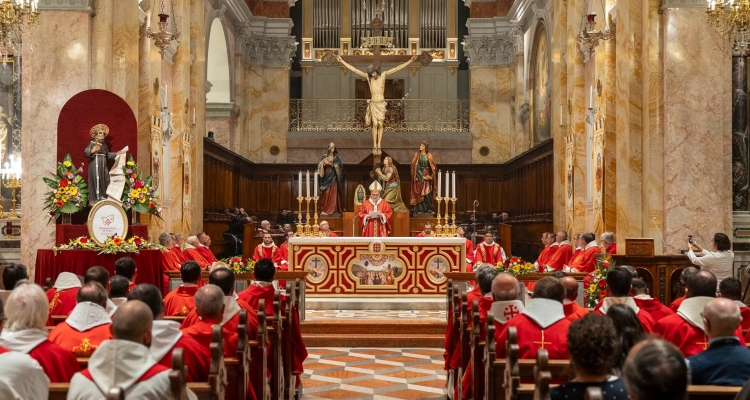
The cardinal Pierbattista Pizzaballa, Latin Patriarch of Jerusalem, has pointed out that the relations of Catholics in the Holy Land with Jews and Muslims must preserve encounter and openness toward others, but “without renouncing the clarity of the faith.”
The Patriarch made this reflection this Sunday, October 4, during the homily delivered in Jerusalem on the occasion of the feast of Saint Francis of Assisi, celebrated this year within the framework of the eighth centenary of the saint’s death.
Pizzaballa started from “Franciscan minority” to explain the way in which, in his view, Christians are called to make themselves present in a society marked by religious, cultural, and political differences.
“Franciscan minority indicates to us a way of being present: to stand beside people with the freedom of those who do not need to impose themselves,” he stated.
For the Patriarch, this attitude does not mean diluting Christian identity. On the contrary, he explained that the Church’s mission consists in “making Christ recognizable through a generous presence, open to all.”
It is precisely in this context that Pizzaballa placed relations with the other two great religious communities of the Holy Land: “Relations with our Jewish and Muslim neighbors also require this freedom, capable of preserving encounter without renouncing the clarity of the faith.”
Meekness without renouncing “speaking true words”
Immediately afterward, the cardinal turned to the words of Christ in the Gospel of Saint Matthew—“Learn from me, for I am meek and humble of heart”—to specify the manner in which this Christian presence must develop.
Pizzaballa implicitly rejected identifying meekness with passivity. “Evangelical meekness demands great inner strength,” he affirmed.
This attitude, he added, commits Christians to “seek justice and to speak true words,” while at the same time ensuring that “pain and indignation do not take hold of our hearts.”
The words take on particular meaning in a Church whose faithful live scattered across different countries and territories, subject to borders and movement restrictions. The Patriarch himself acknowledged that there are Catholic communities celebrating the Eucharist only a few kilometers apart that nevertheless find difficulties even in relating to one another.
“Borders, movement restrictions, and the weight of history hinder mutual knowledge,” he noted. For this reason, he warned that communion cannot be taken for granted, but “must be sought and preserved with patience.”
Not allowing divisions to determine whose suffering to listen to
Pizzaballa applied the same approach to the way the Church must confront the suffering caused by violence in the Holy Land.
The Patriarch remembered in his prayer “all the families” affected, those who mourn the death of a loved one, and those who face the future with fear.
“As a Church, we have the duty to stand close to those who suffer, to defend human dignity, and to give voice to those deprived of it,” he affirmed.
The cardinal added that this responsibility requires maintaining a “demanding freedom” with respect to belongings and confrontations “that would like to decide in advance which sufferings deserve to be heard.”
For Pizzaballa, the Church’s public word must arise from the Gospel and from concrete closeness to people. Its credibility will depend, he stated, on the capacity to support those in need, to educate young people for encounter, and “to continue building relationships even when everything pushes to interrupt them.”
“It is in this way that peace begins to have a face,” he maintained.
Making Christ recognizable in the Holy Land
The question of relations with Jews and Muslims was thus framed by Pizzaballa within a broader reflection on the mission of Catholics in the Holy Land.
The Patriarch recalled the episode narrated by Saint Francis in his Testament, when the Lord led him among the lepers. The saint experienced the transformation of his heart precisely by approaching with mercy those from whom he had previously kept his distance.
“Also for our Church, renewal passes through the neighbors we avoid, the poor and the sufferings we do not see, the questions that call our habits into question,” he affirmed.
Pizzaballa particularly mentioned families who find difficulties remaining in the Holy Land, the elderly who live alone, workers overburdened by daily hardships, and young people who look toward the future wondering “if there is still a place for them here.”
In this context, the Patriarch presented a Christian presence that combines encounter with those who profess other religions with an unequivocally Christian identity: to stand beside people without imposing oneself, to keep relationships open, and at the same time to make Christ recognizable and not renounce “the clarity of the faith”.