


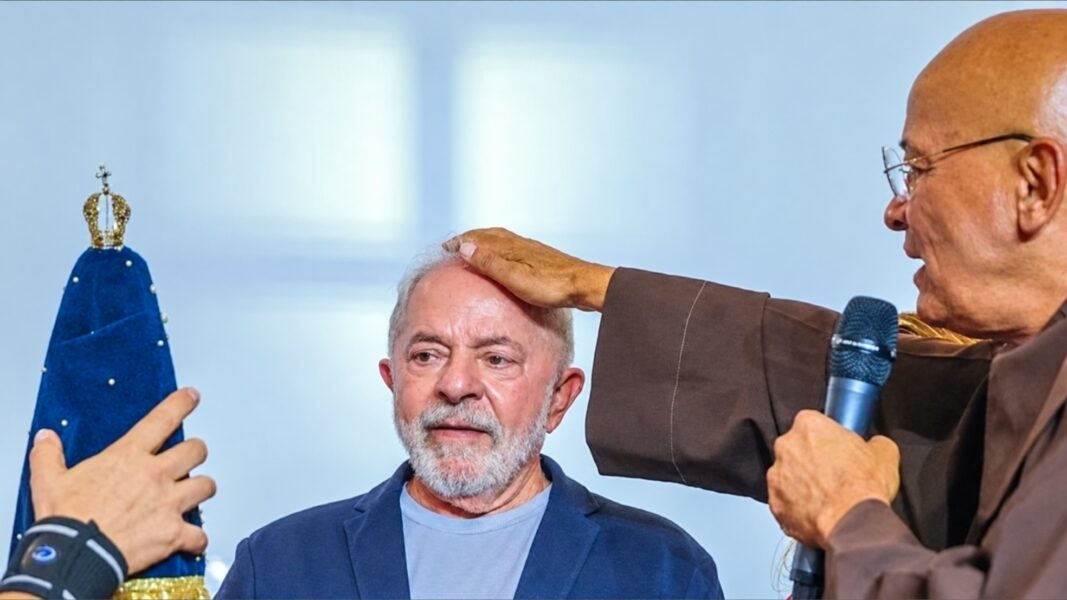
The first round on Sunday left Brazil split into two almost equal halves. Flávio Bolsonaro obtained 56.1 million votes, 47.03% of the valid ballots, and Lula da Silva 53.9 million, 45.16%. They will face each other again on October 25, and all polls agree that the runoff will be decided among the faithful. Lula dominated among Catholics with margins of sixteen to twenty-five points, according to the institutes; Flávio swept among evangelicals with advantages of twenty to thirty. The world’s most Catholic country votes today according to the pew in which it sits.
What Lula’s government has done
The president declares himself Catholic and has repeated for years a calculated formula: he is personally against abortion, but as head of state he must treat it as a public-health issue. His administration has gone considerably further than its rhetoric. In 2023 the ministries revoked the pro-life rules of the previous government, and Brazilian diplomacy adopted the language of “reproductive rights” at the UN. In 2024 the Ministry of Health issued guidance allowing abortion for rape up to nine months, withdrawn after the scandal, and Lula called the parliamentary bill equating late-term abortion with homicide an “insanity.” The official maternity booklet now includes a chapter on unwanted pregnancy and ways to terminate it. The Supreme Court still has pending the action that would decriminalize abortion up to the twelfth week without going through Congress, and most of its justices were appointed by the PT.
His dealings with the Church have been equally bold. He publicly called for an end to priestly celibacy, and in the final week of the campaign his party distributed among militants a conversation manual with the slogan of insisting that “Lula is Catholic and guided by Christian values.” The result was immediate: five points gained among Catholics in seven days, according to Quaest.
What Flávio Bolsonaro promises
The senator has been evangelical since entering politics, influenced by his mother, and attends the Comunidade das Nações with his wife. At the Copacabana rally that opened his campaign he promised to appoint four Supreme Court justices opposed to abortion and drug legalization, with the declared aim of curbing judicial activism in those areas. His party pushed a bill in the Chamber in 2024 to ban same-sex marriage. His first choice for vice president, Congresswoman Clarissa Tércio, is the author of a law that would require hospitals to post signs discouraging abortion; he ultimately chose Congressman Alfredo Gaspar.
The candidate’s weakness lies in the realm of devotion. His pastor, JB Carvalho, wrote that it would be advisable to strip Our Lady of Aparecida of the title of Patroness of Brazil, and one of his advisers labeled Marian devotion idolatry. Against that backdrop, the rumor spread that Flávio wanted to dethrone the Virgin. He denied it in a video, took the matter to the Superior Electoral Court, and compared it to the stabbing his father suffered in 2018; in a Catholic podcast he recounted that he still keeps with affection a crocheted image of Aparecida. The country’s leading pastors signed a manifesto in his support, but the damage was done: he lost nine points among evangelicals in a month, and the CNBB came out to rebut some of his statements against members of the Church.
Doctrine and episcopal silence
Catholic teaching offers a fairly precise compass here. Evangelium vitae places the right to life as the foundation of all others, and Ratzinger’s 2004 note to the U.S. bishops recalled that moral issues do not carry equal weight: one may disagree on war or the death penalty, but not on abortion and euthanasia. Benedict XVI later spoke of non-negotiable principles. By that measure, the Brazilian Catholic voter faces one candidate who attacks the foundation and another who defends it, and the fact that the latter prays in a different temple becomes secondary. Catholics in the United States traveled this path with Biden and Trump and in 2024 voted mostly for the Protestant who had appointed the Dobbs justices; Brazil now faces the same dilemma with a very similar casting of roles.
The episcopate has preferred not to get involved. Dom Jaime Spengler, president of the CNBB, stated on the eve of the vote that the Church does not express preference for any candidate. That same Conference found occasion to correct Flávio over the Marian controversy and none to comment on the ministerial guidance authorizing abortion up to nine months.
Aparecida in the middle of the campaign
Between the two rounds falls October 12, the feast of the Patroness. Both candidates will almost certainly go to the São Paulo basilica, each to demonstrate what he lacks: Flávio, that he respects the Virgin; Lula, that he is Catholic. The faithful who attend that day will have fifteen more days to decide whether the temple they share with one weighs more than the doctrine on life they share with the other.