


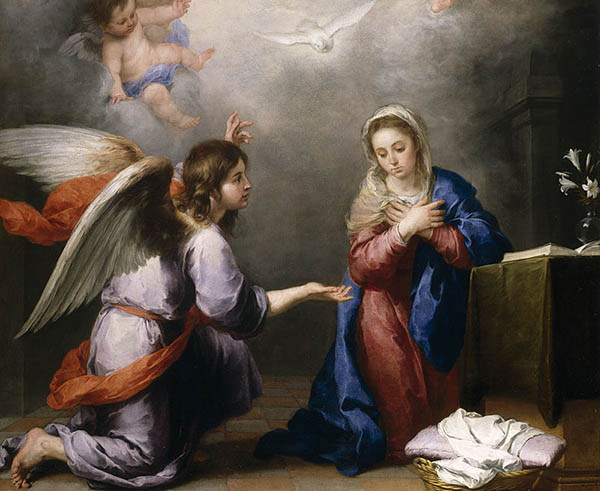
October is the month of the Rosary, and on Wednesday the 7th the Church celebrates the Virgin who gives it its name. Many Catholics will once again spend these weeks meditating on the joyful mysteries. The risk is reciting them as if reviewing the titles of paintings. Yet none of those five episodes was a scene from a picture book: joy came to a village girl and a poor craftsman amid alarms, journeys, stables, and nights of anguish.
Repetition is the great virtue of the Rosary and also its danger. The cadence of the Hail Marys soothes, orders the mind, and leaves space for contemplation, but habit tends to polish the mysteries until they become smooth. We say “the Annunciation,” “the Nativity,” or “the Finding of the Child Jesus in the Temple” as if reciting the title of a chapter we already know by heart. Yet tradition does not propose that we recite five headings, but that we peer into five scenes in which God entered the history of a concrete family, with names, trades, relatives, and neighbors.
The evangelists recount these events with a disarming sobriety. They devote only a few verses to each, without adjectives, without descriptions, without pausing to describe what the protagonists felt. This is not poverty of narrative, but respect: they leave space for the reader, or the one who prays, to inhabit it. That is why meditating on the mysteries has never been an exercise of memory, but of imagination. One must place oneself there, hear the sounds of the road, feel the cold of the night. Only then do the words we repeat cease to be formulas and become once again what they were: events that happened to people of flesh and blood.
The first takes place in Nazareth, on an ordinary day. A maiden betrothed to a carpenter of the house of David receives a greeting she did not expect: “Rejoice, full of grace, for the Lord is with you.” She is told she will be the mother of the Son of the Most High, and she asks for neither guarantees nor deadlines. She answers with a single phrase: “Here I am, the handmaid of the Lord.” It is likely that, for the rest of the village, that midday was no different from any other. No one saw anything. The event that split history in two happened in silence, without witnesses, in the house of a girl who had nothing to offer but her freedom.
The second mystery is a journey. Mary does not remain contemplating her secret: she sets out for the house of her cousin Elizabeth, an elderly woman whom, because of her age, no one believed capable of conceiving, and who had been pregnant for months. The encounter is an explosion of joy in which the child leaps in the old woman’s womb. But it is worth not forgetting what surrounds it. A pregnant young woman travels the roads of Palestine, and on her return she will have to give explanations in a small village where everything is known. The joy of the Visitation does not remove any of those difficulties; it coexists with them.
The third begins with an order from power: “All went to be registered, each to his own city.” A decree issued far away forces a humble couple to travel, with the birth imminent, to Bethlehem, where there is no room for them. The Messiah awaited by Israel is born in a cave, amid the smell of animals, and is laid in a manger. His first visitors are shepherds, people of dubious reputation in that rigidly ordered society, to whom an angel has announced: “Today a Savior has been born for you in the city of David, who is the Christ, the Lord.” No priests, no doctors of the Law, no authorities: shepherds. To contemplate this mystery with the imagination of a living-room nativity scene is understandable, but it misses the essential point: God chose the open air.
The fourth mystery is usually prayed quickly, and it is perhaps the most eloquent. Forty days after the birth, Mary and Joseph go up to the Temple to fulfill the Law: the purification of the mother and the redemption of the firstborn. Wealthy families offered lambs; they bring a pair of turtledoves, the offering of those who cannot afford more. For the child they pay the five prescribed shekels. In the Temple courtyard, among money changers, cages, and haggling, God made man is redeemed with a carpenter’s money, and no one around him notices that child. Few Gospel scenes show with such rawness how far the abasement reached.
The fifth is, without disguise, a mystery of anguish. Jesus is twelve years old and stays behind in Jerusalem without telling anyone. His parents search for him for three days. When they finally find him in the Temple, surrounded by doctors of the Law, Mary cannot contain herself: “Son, why have you done this to us? Your father and I have been anxiously searching for you.” The boy’s answer clarifies nothing: “Why were you looking for me? Did you not know that I must be about my Father’s affairs?” They do not understand her: not even Mary understands what “my Father’s affairs” the boy is referring to. And the Church calls this mystery joyful.
Therein lies the key. The joyful mysteries are not called so because they were comfortable, but because in each of them God was present, even though the scene seemed to say the opposite. There is joy in the surprise of Nazareth, in Elizabeth’s house, in the cave of Bethlehem, in the Temple of the turtledoves, and in the reunion after three days. But it is a joy that does not eliminate bewilderment, poverty, incomprehension, or fear. It is exactly the kind of joy the Christian of today needs to learn, because it is the only one that endures when life does not turn out as one had planned.
In these five scenes there is a character who almost always remains in the background. Joseph does not utter a single word in the Gospels. He obeys in dreams, seeks shelter, pays the ransom, and searches Jerusalem for three days with his heart in his throat. When Herod’s threat looms over the child, he receives another equally terse order: “Rise, take the child and his mother, and flee.” And he flees, by night, without arguing, toward a foreign land with a family in his care. The Gospel summarizes his attitude with admirable sobriety: “When he awoke, Joseph did what the angel of the Lord had commanded him.” Praying the joyful mysteries while also looking at them through Joseph’s eyes changes the prayer. It forces us to ask what a simple man felt when God entrusted him with His Son and gave him no explanation.
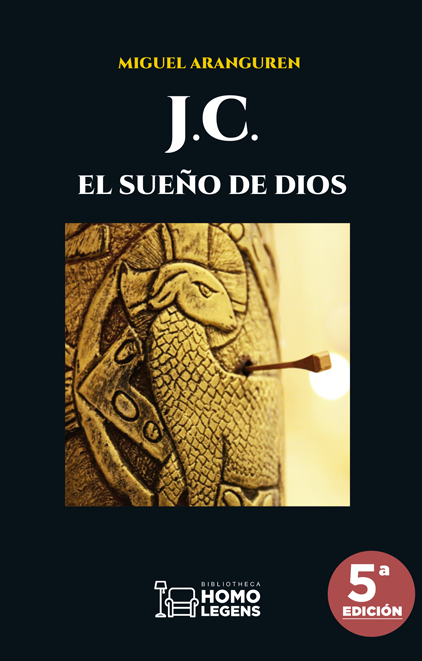
That is the question asked, across nearly six hundred pages, in J.C. El sueño de Dios, the novel by Miguel Aranguren. Its Joseph doubts whether he is equal to what God expects of him. In Bethlehem he has nothing with which to pay for shelter, and obtains the cave in exchange for some booties that Mary will knit. Years later he will recall it laughing: “That was the price of our son’s birth: a pair of woolen booties.” Perhaps praying the Rosary consists in that: in remembering that salvation entered the world at so small a price.