


By: Pilar Abellán OV
In 1514, the Portuguese king Manuel sent an impressive entourage to the Pope, composed of men, exotic animals (panthers, leopards, parrots, elephants, and even rhinoceroses) and gifts from the Indian expeditions.
In 1515, Afonso de Albuquerque died and was succeeded by Lopo Soares de Albergaria, a Portuguese nobleman. In 1521, King Manuel died and was succeeded by John III, the last heir of the Portuguese Empire.
Portugal’s successful imperial experience along the coasts of the Indian Ocean took a radical turn from 1517, when the Protestant heresy erupted in the heart of Europe, which in a few decades broke the greater Christendom, in the words of Francisco Elías de Tejada, the Christian continent. The low population of the Portuguese metropolis made the maintenance of the Empire ruinous. Curiously, in parallel to the Portuguese imperial decline, an intense evangelization effort developed in Goa.
Furthermore, in 1517, the Ottoman Empire, under Sultan Selim I, had conquered Mamluk Egypt and secured the coast of the Red Sea. This marked a considerable change in the situation. The Ottomans, at the zenith of their military and administrative power after their victory over the Persians, presented a stark contrast to the politically fragmented and economically weakened Mamluks. Their entry into the Indian Ocean theater altered all strategic calculations: the Portuguese were no longer facing a declining power, but a vast, centralized empire capable of responding to their naval dominance, protecting Muslim merchant convoys and challenging the monopoly on which their economy depended.
Regarding the Portuguese’s initial actions in Goa, P. Shirodkar (1997), who studied the cultural ties between Portugal and Goa in the sixteenth century, stated that when Afonso de Albuquerque conquered Goa on November 25, 1510, freeing it from the Muslim siege, he did not alter the existing basic administrative organization. Gradually, the Portuguese introduced their own administrative system and established the Senate of Goa, the Fazenda, the Casa da Moeda, etc.; but at the same time, they were extremely cautious not to disturb the ancient traditional indigenous institutions, as the local population was deeply attached to them in the performance of their socio-religious activities.
Much reliable information about life in Goa during the early period of the conquest is available in A Suma Oriental, written by the apothecary of Prince D. Afonso who arrived in Goa in 1511. Tomé Pires vividly describes the life and people of Goa at that time. He reveals that caravans of ox carts, loaded to the brim and coming from distant lands outside Goa, brought goods, and merchants enjoyed far greater prosperity compared to the situation they had faced under Muslim rule before the Portuguese arrived. Goa, according to him, was a refuge for merchants of all nations, and men with substantial capital owned several ships in the good harbor to prosper. Those who sailed their vessels were local residents, who were skilled seamen. Since their businesses were large-scale, the revenues obtained by Goa at the anchorage, as well as duties on goods, in addition to tolls collected through Tanadarias—offices of the local police chief with military authority to collect imports and customs duties—were enormous. He revealed that these wealthy people of Goa had numerous temples with Brahmin priests. It was customary for a woman to immolate herself on her husband’s pyre. If she refused to sacrifice her life in the flames, her relatives were dishonored, and the people would admonish other women who were not in favor of the sacrifice and force them to immolate themselves. Albuquerque has the merit of having ended this pernicious practice for humanitarian reasons. More importantly, Hindu society in Goa at the time was no different from its counterparts in the rest of the country: it was a caste-dominated society, socially cohesive, highly conscious of customs, rituals, and deities.
As in mainland India, in Goa rulers usually collected all the taxes they wanted, thus subjecting the population to great hardships. Such was the situation when Adilshah had to cede Goa to the Portuguese. But in the meantime, another scenario was gradually emerging that was changing Goa’s demographic profile. Within a decade and a half, in 1524, the Portuguese who had married and settled in Goa numbered 450, in addition to many others, including fidalgos, knights, shield-bearers, and other individuals of merit who had dispersed outside the city with sons and daughters of marriageable age and who, by their nature, were populating the land, thus creating ethnic changes.
Dom João, King of Portugal, approved in 1526 the Foral dos uzos e costumbres os gancares e lavradores desta illa, a charter that was one of the most significant events after the occupation; it not only imprinted the mark of Portuguese domination and the assertion of control, but also brought an abrupt change to the socio-religious life of the Goans, in addition to introducing revolutionary changes in village administration. It granted such power to the viceroys, tanadar chiefs, revenue supervisors, and magistrates of justice that their orders, decisions, and sentences gave rise to a plethora of social laws in the years to come, thereby increasing the influence of jurisprudence in the daily life of Goa’s inhabitants. The Charter addressed civil law, criminal and fiscal legislation, and even the rural economy of the communities and civic matters.
Each ganvkar was asked to cede, free of charge, unoccupied lands from his village for use by village officials, namely the temple priest, the secretary, the doorkeeper, the tenant, the washerman, the shoemaker, the carpenter, the blacksmith, the temple maid, and a jester. No ganvkar was allowed to cede lands or orchards free of charge merely by paying a fixed rent, except with authorization from the ordinance to that effect. If the ganvkar or a villager wished to sell any inheritance in any of these villages, he was prevented from doing so without the permission of all the ganvkars of the village. Likewise, no one could buy without such permission. During sowing and harvest times, the principal ganvkar would have preference in plowing and harvesting. Likewise, the principal ganvkar would first cover his house with palm leaves and pots.
It is worth taking a look at the religious life of the Goans of the time, which was completely disrupted: Portugal attacked Hinduism and Hindus. Most of the temples in Goa in Ilhas, Bardez, and Salcete belonged to the major Saiva sect and the Nath cult, with the rest belonging to the Vaishnavite sect. While Hindus lived their lives according to ancestral practices, the Franciscans, who had settled on the island of Anjediv, off Goa, in 1505, carried out constant evangelization work from 1518. Friar Antonio had begged the King of Portugal not to allow yogis to enter Goa from the mainland because they carried flowers offered to their deities in the temples and other tokens with which they attempted to renew the pagan traditions of the natives. An ecclesiastical structure was established in Goa from the beginning of the Portuguese settlement, and the Bishop of Dumenas, mentioning the existence of “images of the enemies of the Cross” on the island, recommended to the King that it would be a great service to God if the temples on the island of Goa were demolished and churches built in their place. He also suggested that the King order that anyone who wished to live on the island and have a residence and lands convert to Christianity, and if not, leave the island. He was firmly convinced that no one on the island could remain without converting, since if they were expelled from the island they would not be able to support themselves.
Historian Rowena Robinson states that “the conversion of Goa to Catholicism was largely the work of several religious orders that arrived in Goa in the sixteenth century. The Franciscans arrived in 1517 and their work was mainly limited to Bardez, while the Jesuits were the most influential order to arrive in Goa, being the architects of the conversion of Tiswadi and Salcette. With their arrival in 1542, missionary activity in Goa received a great boost. The other two important orders were the Dominicans, who arrived in 1548, and the Augustinians, who arrived a few years later”.
In 1532, a new vicar general, Miguel Vaz, arrived in Goa, and in 1534 Goa was elevated to the rank of bishopric (diocese), although the small Christian population did not justify it. In 1541, the Church introduced the Rigor de Misericordia in Goa, destroying all Hindu temples on the island. In addition, important Hindu ganvkars were forced to voluntarily agree to divert the revenues from the lands of the destroyed temples for the maintenance of churches and chapels, thus depriving guravs, dancers, Brahmins, blacksmiths, and other servants of their livelihood. Not only that, but native priests were ordered to be appointed as chaplains because the local population could accept them with satisfaction, as they would prefer to learn easily from them since there was no language barrier. In April 1541, Father Miguel Vaz and Diogo de Borba established the Confraternity of the Holy Faith to provide assistance to poor Christians and for the maintenance of churches. It also contributed to the establishment of the Seminary of the Holy Faith and the College of St. Paul to provide priestly education to young people from the East. The Confraternity also sought preference for Christians in government positions. The following year, the landing of the Jesuit missionary Francis Xavier on May 6, 1542, boosted the evangelization process in Goa and other parts of the South, as well as in the Far East.
Meanwhile, the Council of Trent, which was to last from 1545 to 1563, was beginning.
Shirodkar recounts how Miguel Vaz sent a note to the King, which was received by him in November 1545, requesting a special order that there be no public or secret Hindu temple on the island of Goa and that violators be severely punished. He recommended that the manufacture of idols of wood, stone, copper, or any other metal not be allowed. He further suggested that no public Gentile festivals be allowed and that Brahmins from the mainland be prevented from taking refuge in their homes. He wanted the Crown to allow the authorities of St. Paul to raid the homes of Brahmins and Gentiles if they suspected the existence of idols. He also wanted no native (Hindu) unbeliever to be allowed to earn a living by painting sacred Christian images. All of this generated resentment among a sector of the natives of Goa, as can be seen from Master Diego de Borba’s letter to Jesuit priest Simão Rodrigues, in which he states that the Indian Gentiles did not wish to know or hold in high esteem the Holy Name. Faced with this attitude, the Crown appears to have acted vehemently following Miguel Vaz’s recommendations: it ordered Governor Martim Afonso de Sousa to severely punish those who continued to perpetuate idolatry of any kind and to allow converts to enjoy exemptions and freedoms in the payment of duties that would allow them. The Governor was also instructed to exempt Christians from India from being forcibly recruited into the Portuguese armed forces, thus avoiding violence.
Following the trend, the Crown ordered the new viceroy, Dom João de Castro, to treat well and favor the new converts among the natives, allowing them to occupy all positions in the city of Goa and in the villages of the island. In the instructions given to Father Miguel Vaz, the King asked him to make every effort on the mainland with care and without scandals, removing all idols and planting crosses in their places, where new Christians could be taught as much of the religion as possible to help with greater conversion.
A rule had also been imposed that when the slaves of Muslims and Hindus converted to Christianity, their owners had to sell them immediately only to Christians. No Brahmin or Gentile was to hold any administrative position. In a maneuver aimed at giving greater impetus to evangelization, the Crown ordered that residents and natives, if they converted to Christianity, enjoy the same status in the city and on the island of Goa as the Portuguese. Sadly, the general trend in historiography considers these to have been maneuvers of tactical cunning to “win over” the natives, and not that they were truly considered Portuguese, as was the case in the Americas. From the secularist mentality of contemporary academia, it is difficult to understand that there were no political or economic interests behind these ordinances, but rather a genuine understanding of human dignity and a true interest in the salvation of souls.
King D. Sebastião promulgated another law, ordering that there be no temples or idols in anyone’s houses or outside them on the island of Goa and other adjacent areas. He also imposed restrictions on all kinds of festivities by Gentiles, both in their residences and outside them, in addition to prohibiting all kinds of image-making. Anyone who contravened this law would lose their property, half of which would go to the accuser and the rest would be used for the works of the church under whose jurisdiction the offender resided, who would be sent to the galleys without any pardon.
In academic historiography, the fact that the Crown and the Church acted in unison and intended to eliminate Hinduism is perceived negatively, destructively, disruptively. This is due to its inability, blinded by secularism, to understand the logic by which the Church acted, obliged by Jesus Christ to make disciples of all nations, baptizing them and teaching them, for their good and for the salvation of their souls, with the conviction of being the only true religion. Joseph Pearce sums up the issue well when he states that “if we try to study History through the prejudices and preconceptions of our own time, we will only succeed in misinterpreting the motives and intentions of historical actions. If we do not know what those people believed, we will not understand why they acted and behaved as they did. We will not truly understand what happened. Our prejudice or our ignorance will have blinded us. To understand History, we must understand its protagonists well enough to empathize with them, even if we do not sympathize with them”.
The Crown allowed children, grandchildren, and relatives to inherit the property of their converted parents, whether Gentiles or Muslims or other unbelievers according to Portuguese law. If they converted, each of them would inherit one-third of the property. The introduction of these laws created dissensions in Hindu families and dealt a severe blow to the joint family system, which had been crumbling for a long time but survived and grew again under two different beliefs: Hinduism and Christianity. Hindus had only two options: to emigrate or to remain in an extremely servile condition, accepting the new faith, even against their wishes.
On September 5, 1551, the expedition arrived in Goa carrying the Jesuit provincial father of India, Melchor Núñez Barreto. He was accompanied by ten orphans trained doctrinally and musically at the Colégio dos Meninos Órfãos in Lisbon. One of the main activities of these children was to preach and teach doctrine in the streets. With this mission, many of the children educated at that college were embarked for different enclaves in America, Africa, and Asia. The children must have stayed at the College of São Paulo, established in 1548, which became the main Jesuit institution in India. It had its precedent in the Seminário de Santa Fé, established a year before the Jesuits arrived in Goa. Shortly after Francis Xavier’s arrival in 1542, they first took charge of its spiritual administration and, a few years later, in 1549, also of its financial administration, under its new name. It is very likely that during their stay in Goa, which lasted more than two years, the children who arrived on the expedition carried out their doctrinal activity in the streets, singing their prayers and sacred songs, since this was one of their main tasks in India, as Pedro Domènech, first rector of the Colégio dos Meninos Órfãos in Lisbon, indicated to Ignatius of Loyola in a letter dated April 1, 1551, a few days after the expedition departed: “I wrote to Your Paternity how the King ordered me to choose nine of these children to send them to India to teach the Indian children and particularly in three colleges that are being built there for them, because he wants them to be raised with this spirit, I mean in the spirit and customs of these… Every day they sang Veni Creator Spiritus and O Gloriosa Domina so that the Lord might enlighten me in choosing those whom His Majesty would be most pleased to serve…”
During this time, they would also participate in all the celebrations organized by the Society of Jesus, singing at masses and vespers on Sundays and the most important feast days, as they did in their Lisbon residence, together with other children trained at the college in Goa. Núñez Barreto, in a letter dated December 9, 1551, a few months after arriving, gives an account of one of the devotional activities that the Jesuit community organized on Fridays, in which these orphan children participated by singing the psalm Miserere, in the style they were supposed to do at the college where they had been educated in Lisbon: “On Fridays we have a procession, which Father Master Gaspar [Barzeo] ordered, and then a sermon that ends at nightfall. And when it ends, the discipline begins, with the children singing a Miserere mei Deus in the Lisbon manner.” This Lenten practice, celebrated on Fridays, with procession, prayer, and public “discipline,” accompanied by the singing of the psalm Miserere, is found in different missionary establishments in Asia.
During the time the expedition was in Goa, an event of special significance for the Jesuit community occurred: the arrival from Malacca of the body of Francis Xavier to be buried at the College of São Paulo. The children participated in the various ceremonies that took place during those days, as we will see in another event dedicated exclusively to this occasion. Francisco de Sousa, in the Oriente conquistado a Jesu Cristo pelos Padres da Companhia de Jesus da Provincia de Goa (Lisbon 1710), explains: “In the East these children were very advanced in virtue and first letters: skilled in solfège and a variety of musical instruments; they were raised with the doctrine of the Company to become suitable ministers of the Gospel and even, we say, great disseminators of the Portuguese language… These were the first chapel masters of the seminary of Goa and the first in India, imitating the nine choirs of Angels, to serve divine worship by officiating at masses with organ singing.”
After the death of St. Francis Xavier on December 3, 1552 on the island of Shangchuan, off the coast of China, his body was initially buried there in a simple tomb. Recognizing the saint’s importance, the body was exhumed in February 1553 and transported to Malacca, where it remained in the Church of St. Paul for several months. In December 1553, the decision was made to transfer it to Goa, as it was an important center of Jesuit missions. Upon its arrival in Goa in early 1554, the body was preserved in the Basilica of Bom Jesus and, surprisingly, remained incorrupt, showing no signs of decomposition even after years. It was then first exposed for public veneration in Goa, from March 16 to 18, 1554.
The Holy Inquisition was introduced in Goa in 1560. The Jesuit Francis Xavier, later canonized as patron of the East, had been the first to request the establishment of the Inquisition in Goa in 1546, although it took 14 years to materialize. During its 248 years of existence, the Inquisition caused mass migrations to the south of the country. Many families were permanently separated. Some left behind relatives to convert or had already converted before fleeing. Many villages left with their deities and reestablished them in the neighboring regions of Antruz and Sattari. Let us remember, to correct misinterpretations, that the Inquisition tribunal did not deal with non-Christians, but investigated the heterodoxy of Christians, especially converts, in order to determine whether they were secretly continuing to practice their old beliefs.
A large number of baptisms took place in Tiswadi: according to Father Lucena, in one year there were as many as 20,000, and in 1560, according to Father F. de Sousa, the number was 3,092. Miguel Vaz destroyed numerous Hindu temples from 1546 onwards, and in 1567 the Franciscans demolished nearly 300 temples in Bardez alone. The Inquisition in Goa was abolished in 1812. The Portuguese Crown emphasized from the beginning to its authorities in Goa that the Crown’s main responsibility in the conquests was the conversion of unbelievers. And it exhorted vigorous efforts with zeal to ensure that no unbeliever remained there without converting. In this way, just as many conversions took place, many families who wished to preserve the Hindu religion also abandoned the place and moved to reside outside Portuguese dominion. Despite the population decline this implied, the growth of Christianity was such that in 1567 the first Provincial Council (provincial ecclesiastical assembly) was held in Goa. The Council determined that, along with Hindu temples, mosques should also be destroyed. It deliberated against all kinds of ceremonies, festivities, and modes of worship, the worship of demons as deities, the cremation of the dead, and various other rites, invocations, fasts, processions, the thread ceremony, the application of sandalwood paste—on the forehead, animal sacrifice, tree worship, etc. (decree no. 9-10). Gentiles who left Portuguese territories to participate in temple festivities or religious processions were also severely punished. The Council also desired that, in the villages, when flat lands were leased, they be leased, according to the Charter, only to Christians and not to Gentiles, and that tax collection be entrusted only to Christians (decree no. 15). It prohibited Hindu painters from painting images of divine worship, goldsmiths from making chalices and crosses, and tinsmiths from making metal objects or tin articles (decree no. 28).
More personal aspects were also addressed (decree no. 42): the neophyte was prohibited from attaching his child’s caste. Nor could he allow his child to marry a Hindu girl. He was prevented from mourning his dead as he used to do before converting. He could not go to any temple or offer money. If he fell ill, no Hindu, not even his own father, could pay him a courtesy visit. Nor could he attend any Hindu festival or go to the adjacent territories of the mainland to celebrate festivals with Gentiles (decree no. 42). He advised the parish priest and the chaplain to help neophytes bury their dead (decree no. 45). Most of these decrees were legalized by Viceroy D. Antão de Noronha. The measures had no immediate effect, and Hindus continued their old traditions of worshiping idols as before; which forced the Crown to issue a new order in 1580 to put an end to the “abominable errors” that harmed conversions.
The 4th ecclesiastical assembly held in Goa in 1592 took serious note of the entry of Hindu priests, astrologers, yogis, preachers, and kurumbins into the city of Goa through the island’s passes, taking refuge in the homes of Hindu and native Christian residents, reminding old and new Christians of their ancient rites and customs, festivities, thus acting against the Christian faith. Hence, it recommended that such individuals not be allowed entry into the city and that, if found, they be imprisoned and punished, and that anyone who gave them shelter be fined 50 cruzados, in addition to punishment for the offense.
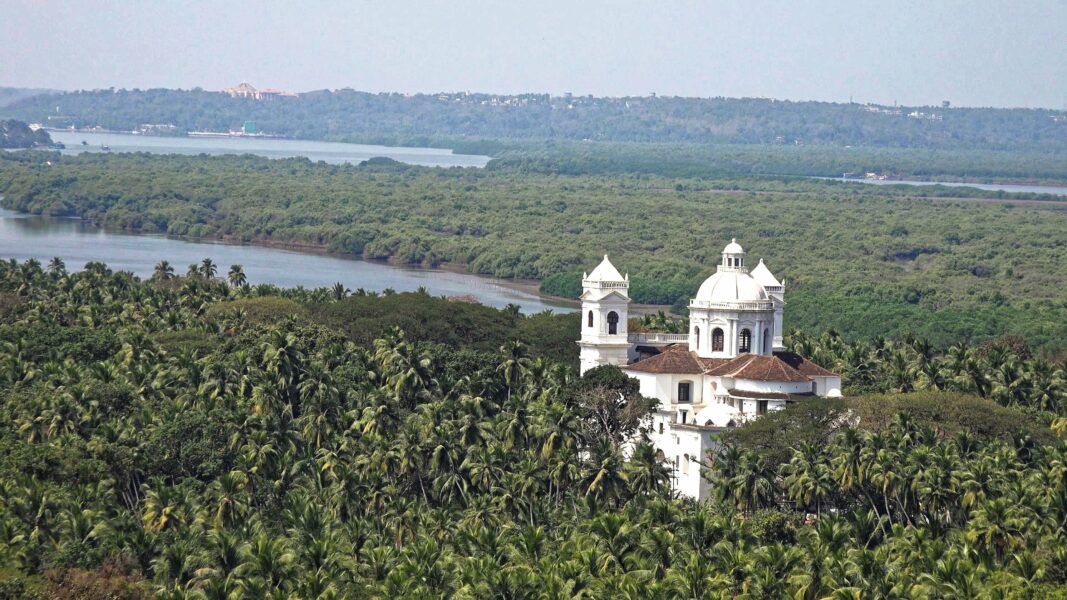
It is necessary to read between the lines of P. Shirodkar’s statements, which we have been following mainly so far, in order to separate the wheat (historical data and facts) from the chaff (the author’s ideology). By carrying out this operation, the data he provides is useful for reconstructing the history of the evangelization of Goa in the sixteenth century, a history that we can expand upon by following historian Rowena Robinson in her already cited book “Conversion, continuity and change: lived Christianity in Southern Goa,” which details the history of the conversion to Catholicism in the sixteenth century of a large part of the local population of Goa’s coastal district from a historical perspective. Robinson collects the documentary testimony of a 1596 survey of Goa showing, among the houses and viceregal buildings, a series of religious places: the cathedral, parish churches, religious houses, and chapels. It was an urban landscape enormously transformed by the Portuguese. As early as 1542, the Jesuit Francis Xavier had reported upon his arrival at the newly established Society of Jesus in Rome that “Goa is a pleasant city to behold, entirely inhabited by Christians. It has a monastery with many friars of St. Francis, a very beautiful cathedral with many canons, and many other churches. There is reason to give many thanks to God our Lord seeing how well the name of Christ flourishes in such distant lands and among so many unbelievers.”
By the end of the seventeenth century, a large part of Goa’s population had converted to Christianity. Again, we can read in the vast majority of scholarly works on this period that many of the conversions were against people’s will. This is part of the narrative we can call the Portuguese Black Legend, which we will analyze later. Rowena Robinson—as practically all historians who have worked on this issue—must also be read between the lines, since she does not hesitate to consider that “what is most regrettable is that what is written has an apologetic stance (sic) and a critical approach to the subject has not yet been firmly established.” Writing in 1998, I cannot agree with that statement, as it is a time of effervescence of purportedly scientific studies in Goa about its past, with figures such as Jesuit Teotónio R. de Souza (1947–2019) and the Xavier’s Center of Historical Research, founded in 1977. The leading role of the Jesuits in constructing the narrative of the Portuguese Black Legend in Goa, with their accusations of religious and cultural imperialism, has yet to be studied. This contribution continues to the present, as we can read in the articles of Gaspar Rullán, presented as “theologian, specialist in Hinduism, contributor to Fronteras CTR,” on this blog of the Jesuit Pontifical University of Comillas (https://blogs.comillas.edu/FronterasCTR/?p=3839). We leave the reflection on the role of the Jesuits in constructing the Black Legend of the Church in Goa for a future chapter.
In the Indian Ocean, the Portuguese strategy of armed monopoly did not go unanswered. Its disruptive effects provoked direct reactions from the main regional powers, whose motivations highlight what was at stake. The conquest of Gujarat by Mughal Emperor Akbar in 1572 was a crucial event, driven by two imperatives. First, it was an economic calculation to gain control of the region’s numerous ports and appropriate the profits of the lucrative Indo-Persian maritime trade. Second, it entailed a profound religious-political duty: to secure the maritime routes from Surat to Jeddah, thus safeguarding the Hajj pilgrimage for his subjects—an essential obligation of a Muslim sovereign. Akbar’s action therefore posed a direct challenge to Portuguese absolute control over the very arteries of trade and faith.
Meanwhile, in the distant metropolis, the city of Lisbon, in the last third of the sixteenth century, Portuguese and Spanish elites began to think about a union of the two Iberian crowns. In 1578, King Sebastian I of Portugal died young and without heirs. The throne passed to his great-uncle, Cardinal Henry, the closest in the dynastic line. Upon his death, without an heir, a provisional governing junta was formed. King Manuel’s grandchildren rose as claimants. Philip II of Spain himself was a strong contender: he sent his armies to Portugal to seize the throne by force, leading to the Battle of Alcântara in 1580. In 1581, Philip II officially assumed the Portuguese crown, which initially meant relief for the Portuguese economy. Spain also sent military forces to overseas possessions. Philip II placed his nephew, Albert of Austria, as viceroy in Lisbon, and he began dealing with Elizabeth I of England, Spain’s enemy, regarding the independence of the Netherlands, which had fallen to Protestantism and which Philip II hoped to reconquer for Catholic Spain. The Dutch sided with Great Britain. Protestant England and Catholic Spain came to arms in 1588. Philip II attempted to invade England but failed. The English landed in Portugal in 1589 to restore local Portuguese power. They failed, but they did succeed in keeping the Netherlands free from Spain. And, ironically, it would be the Dutch who would come to torment both the Spanish and Portuguese Empires.
The union of the Iberian monarchies weakened both. The increasingly aggressive Dutch attacked the Portuguese, thinking they were the weak link in the Iberian union and that they could gain overseas territory at their expense. The Portuguese were very dispersed and maintained their territories with a small number of troops. Furthermore, the struggle between Dutch and Portuguese was both material and religious: Portugal found itself in the Indian Ocean with this Protestant threat; as one historian says, “the fact that the Dutch were as Protestant as the Portuguese were Catholic contributed to fueling the aggressiveness and animosity between them.” These were times of Christianitas minor or lesser Christendom, following Elías de Tejada’s concepts: the Catholic tradition had been reduced mainly to the Iberian Peninsula (Italians and French were not embarked on crusade projects in this century).
In 1598/99, the first Dutch aggressions against the Portuguese occurred in São Tomé & Príncipe, islands located off the western coast of Africa. The Dutch thus began attacking the Portuguese islands and enclaves that were isolated, as they were an easy target, both in the Atlantic and in the Indian Ocean.
In the first third of the seventeenth century, the English entered the scene in the Indian Ocean, beginning a game of changing alliances and strategies among them, the Portuguese, the French, and the Dutch. And in 1663 the Iberian union was dissolved, the Empire on which the sun never set. After Portugal’s new independence, its empire—especially in Asia—was considerably reduced. Portuguese India was reduced by the end of the century to its minimum expression. The chronicles of the Portuguese Jesuit Manuel Godinho in that same year of 1663 state that “the Lusitanian Indian Empire or State, which formerly dominated the entire East (…), is now reduced to so few lands and cities.”
__
Bibliographic References
Crowley, R., 2005. “El mar sin fin”, ed. Ático Libros.
Elías de Tejada, F., 2021. “Le radici della modernità”, Collana di Studi Carlisti, Solfanelli.
Olivera Ravasi, J.,2018. “Que no te la cuenten. La falsificación de la Historia”. Vol III. Ed. Katejon
Pearce, J., 2013. Por los ojos de Shakespeare. Madrid: Rialp.
Robinson, R., 1998, Conversion, continuity and change: lived Christianity in Southern Goa. New Delhi: Sage Publications.
Shirodkar, P. P., 1997. “Socio-cultural Life in Goa during 16th Century”. En: Borges, Charles J. (ed.), Goa and Portugal. Their cultural Links. Pp. 23-40. Concept Publishing House. A/115-116, Commercial Block, Mohan Garden, New Delhi 110059.