


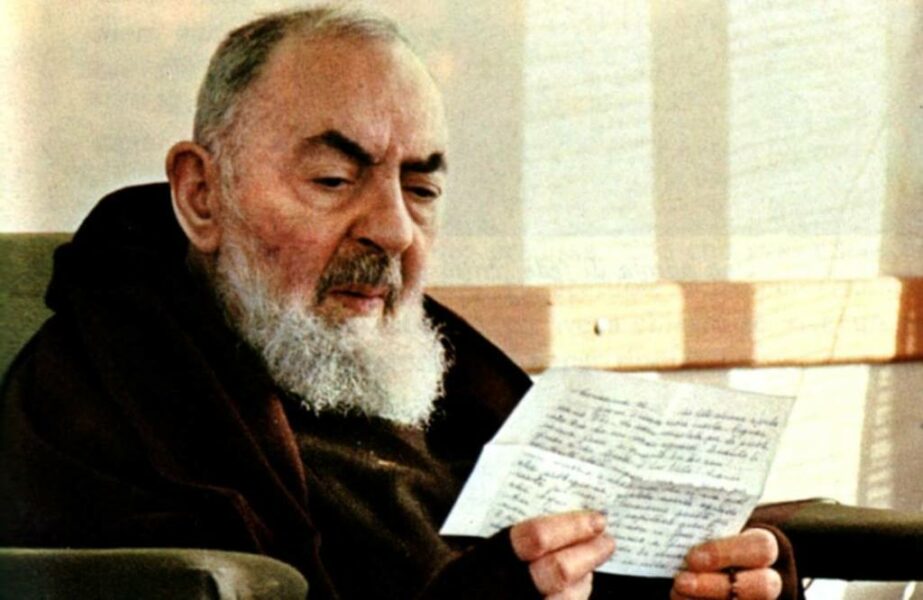
The name of Padre Pio is one more among the varied and wandering arguments used to support the supposed apparitions of San Sebastián de Garabandal. Few contemporary saints inspire such deep veneration or possess such a singular charismatic reputation. That is why claiming that the Capuchin of Pietrelcina recognized those “apparitions” produces an immediate persuasive effect, especially when the claim is accompanied by letters, photographs, and testimonies from religious who knew him. But it produces that persuasive effect only in those incapable of noticing the most elementary logical trap—those whom a commentator on these articles—not I—calls, in their defense, “functional idiots.” Because a careful investigation reveals that beneath the expression “Padre Pio endorsed Garabandal” lie materials of very different natures, whose probative force cannot be treated as equivalent.
There is an anonymous letter dated 1962; a spiritual reply placed in 1964; a letter addressed to Mother Nieves in January 1968; a note for Conchita, attributed to Father Pellegrino and dated August of that same year; the memory of a visit by Conchita to San Giovanni Rotondo; the testimonies of Joey Lomangino and Joachim Bouflet; and, finally, an explanation given after the saint’s death concerning the announced “Miracle.” We are not, therefore, dealing with a single letter or a single account. Precisely for that reason it is necessary to separate the pieces: the apparent abundance of documentation does not exempt us from examining what each document actually proves.
An existing letter, an authorship to be demonstrated
The first piece is dated 3 March 1962. According to the account collected by Father Eusebio García de Pesquera, a letter written in Italian reached the girls and was translated by Félix López, a former seminarian and teacher in Garabandal. The document bore no signature. Its attribution to Padre Pio rested, on the one hand, on the translator’s impression of its style and, on the other, on the identification that Conchita claimed to have received from the apparition itself, which explained so many things to her.
In November 2018, a publication favorable to Garabandal released photographs of what it presented as the original: a typewritten text in Italian, an envelope addressed to Conchita, and a Spanish sheet containing a particular “Rosary of the Virgin of Fatima.” The publication also noted that some previously circulated handwritten reproductions were copies or translations, not the original. The distinction matters greatly: a handwritten copy cannot be used to authenticate Padre Pio’s handwriting, but neither can it be used to refute the authorship of a text whose supposed original is typewritten.
Prudence must be applied in both directions. It would not be correct to claim that the letter was written in the saint’s own hand, because the published photographs show a typewritten text; nor would it be correct to declare its falsity proven through a handwriting comparison performed on a copy. The researcher’s first obligation is to identify what object lies before them: an original, a transcription, a translation, or a later reproduction. Without that distinction, the discussion can reach considerable intensity while the parties are literally speaking of different papers.
The 1962 document contains an extraordinary claim: the sender asserts having received that morning a communication from the Virgin concerning the girls. It does not limit itself to offering them prayers or a blessing; it reports a supernatural intervention. That is why its authorship demands especially careful verification: the greater the claim attributed to a person, the less reasonable it is to settle for general indications about its origin.
A seal does not sign for anyone
The photographs of the envelope show a conventual seal. The 2018 publication compares it with another used in correspondence from San Giovanni Rotondo and considers that this coincidence proves the origin of the mailing. It is an indication that deserves examination, not systematic dismissal. But establishing institutional provenance and certifying personal authorship are distinct operations.
A conventual seal, if its authenticity and connection to the mailing are verified, can support that a letter passed through the convent or was sent from it; it does not by itself identify who composed, dictated, or authorized it. Likewise, the typewritten date inside a letter does not automatically equal a verified postal date. To establish with certainty the material history of the whole, one would need to examine the original, the legible postal marks, the relationship between envelope and contents, and its chain of custody.
The favorable publication, however, takes an additional step: it maintains that, since the sender speaks of an apparition of the Virgin and Padre Pio was known for his mystical experiences, the author could only have been him! But that deduction presupposes precisely what it should demonstrate: that the supernatural communication recounted in the letter actually occurred and that the writer was authorized to speak in the Capuchin’s name. If the text expresses the claim of a mystical experience, it does not, by that fact alone, contain proof of that experience or the identification of the person claiming it.
The problem is not in recognizing an indication of provenance, but in converting it into an exclusive identification. A seal proves what it proves; asking it additionally to act as signature, witness, and certificate of authenticity may be loading too much work onto a small rectangle of ink.
Garabandal as proof of Garabandal
In the interview published by the magazine Needles in 1975, Conchita explained that, having asked the “apparition” who had sent the letter, she received as answer the name of Padre Pio. In the same interview she recalled another small reply attributed to the apparition, related to her childhood desire to see him in Spain. These memories form part of the testimonial tradition, but they must not be confused with the exhibition and authentication of the corresponding writings.
Identification through the apparition poses an insurmountable logical difficulty if it is to be used as external proof. One wishes to authenticate Garabandal by Padre Pio’s authority, yet one authenticates Padre Pio’s intervention through a statement originating from Garabandal. For those who already believe in those peculiar “apparitions,” the explanation may be satisfactory; for those examining whether they were authentic, it does not constitute independent corroboration.
Nor does Félix López’s stylistic impression resolve the question. Recognizing in a letter a tone reminiscent of a writer is a legitimate conjecture; attributing the letter to him documentarily requires more. Linguistic affinity can guide an investigation, but it cannot replace it.
Pellegrino: a signature and a different letter
Father Pellegrino Funicelli was a Capuchin who assisted Padre Pio and left an account of the saint’s final hours, preserved and disseminated by the authorities of San Giovanni Rotondo. His closeness to the Capuchin is therefore documented by sources independent of Garabandalist propaganda and must be acknowledged without reservation.
But the note attributed to Father Pellegrino is dated 22 August 1968, not 3 March 1962. This is the piece to which José María Zavala refers in his article “Garabandal: the letter from Padre Pio to Conchita,” published on 22 August 2013. The text, also reproduced in other publications, conveys a prayer of Padre Pio that the Virgin console Conchita and lead her to holiness, followed by a blessing. Zavala expressly identifies the signer as Father Pellegrino. Here the documentary question changes. It is no longer an anonymous writing whose authorship is deduced from the account of an apparition, but a note presented as signed by a known religious close to the saint, communicating his words. If the original and the signature are authenticated, it may constitute a written testimony of genuine interest concerning Padre Pio’s benevolence toward Conchita. Yet precisely because the piece is more concrete, it is also easier to specify what it does not say. It does not declare the apparitions supernatural; it does not mention a revelation confirming them; it does not authenticate the messages; it does not pronounce on the prophecies. It asks for consolation and holiness for a person and transmits a blessing. A priest may bless someone without ratifying all their claims. He may even pray for their sanctification precisely because they are going through a confusing or painful situation. The blessing does not constitute a historical certification of their experiences. The main difficulty with this note need not be its material falsity: it suffices to notice the distance between its content and the conclusion some draw from it. An authentic letter can be interpreted abusively. And no authentication of the August 1968 note would transfer, by contagion, to the anonymous March 1962 letter: they are different documents, with different dates, contents, and attribution problems.
More letters do not mean more approvals
Favorable compilations include a reply dated 28 October 1964, in which Conchita is assured of Padre Pio’s remembrance in his prayers, advised to trust in divine mercy, and given a paternal blessing. Here too, the published content is one of spiritual direction and consolation, not an explicit declaration of supernaturality. Its eventual authenticity would prove a correspondence relationship; it would not by itself demonstrate the divine origin of the visions.
There is, moreover, a piece that prevents framing the question as if only anonymous writings existed. The January–March 2023 issue of Garabandal Journal reproduces a letter dated 22 January 1968, addressed to Mother Nieves. The photograph shows a text of spiritual response and a signature attributed to Padre Pio; the magazine also provides a translation. The published image deserves consideration, although a photographic reproduction is not equivalent to an expert examination of the original. What is decisive for this examination is that its text contains exhortations and prayers, not an explicit recognition of Garabandal.
It would not, therefore, be accurate to claim indiscriminately that no correspondence attributed to the saint in relation to persons connected with Garabandal has been preserved or published. It is published, but that does not allow the same meaning to be attributed to all such correspondence. A letter to a religious who knew Conchita does not automatically prove Conchita’s visions; a prayer for her does not authenticate her prophecies; and a signature on one document does not resolve the authorship of another.
The pertinent question is not simply how many letters exist, but which ones contain the claim that is meant to be demonstrated.
Where the document ends and interpretation begins
Zavala’s article presents Father Pellegrino’s note and adds that Padre Pio had already recognized the apparitions during a conversation with Joey Lomangino in 1963. But these two claims rest on different foundations: the first refers to a written document; the second, to the testimony of a conversation. The note does not incorporate that conversation nor declare that the apparitions were true. This distinction allows the argument to be examined respectfully without attributing bad faith to its author. Zavala may find the convergence of the accounts convincing, but his conviction does not alter the nature of the sources. A document that transmits a blessing does not become a document of authentication because it is published alongside a favorable conversation. The passage from “a letter exists” to “the apparitions were authenticated” requires intermediate steps that must be demonstrated separately. The material existence of a writing, its attribution, its interpretation, and its ecclesial scope are related questions, but they are not interchangeable.
Direct witnesses, non-definitive proofs
Joey Lomangino reported that, during his 1963 visit, he asked Padre Pio whether it was true that the Virgin was appearing in Garabandal and received an affirmative reply. It would not be correct to treat that account as if its narrator had merely heard a rumor: it is presented as direct testimony. If it occurred exactly as he recounted, it would prove a favorable opinion on the part of the Capuchin. But we are still dealing with testimony about a conversation, not with a written declaration by Padre Pio whose tenor and context can be independently verified.
More developed is Joachim Bouflet’s account, which places his meeting on 23 August 1968. According to his narration, Padre Pio exhorted him to consecrate himself to the Virgin of Mount Carmel who had appeared in Garabandal and verbally confirmed the truth of the apparitions. Bouflet also states that he wrote down that same night the words he remembered. This last detail must be mentioned, because it prevents describing his testimony simply as a reconstruction without any alleged contemporary support. However, claiming that notes were taken in 1968 is not equivalent to offering the researcher that original manuscript, with its verifiable date, provenance, and preservation. The later publication of the recollection and the possible contemporary note are two different objects. Nor does the presence of other religious near a conversation constitute corroboration unless it is identified what they heard and where they left testimony of it.
These accounts possess testimonial value that should not be arbitrarily annulled. But neither can they be granted a category higher than they have. It is reasonable to say that there are people who directly attributed favorable words to Padre Pio; it is not reasonable to claim that therefore we possess a definitive documentary authentication of Garabandal.
A prophecy and its later explanation
The Lourdes episode belongs to October 1968, after Padre Pio’s death.
The episode took place in Lourdes, in October 1968, a few weeks after Padre Pio’s death. The account holds that there Father Bernardino Cennamo delivered to Conchita González the veil that had covered the Capuchin saint’s face and transmitted to her the “August note”: certain words attributed to him. When she asked how the one who, according to the prediction, was to see the Miracle could have died, the religious supposedly explained that Padre Pio had seen it before dying. Father García de Pesquera records this episode in Se fue con prisas a la montaña. In the English translation of the work, the corresponding note initially identifies the intermediary by an abbreviation and proposes his identification with Cennamo; it also refers to a pamphlet by Father Alfred Combe entitled Conchita parle du Padre Pio. That reference allows recognition of part of the literary transmission of the account, but it does not turn the oral explanation into content of Pellegrino’s letter.
This is the decisive point: the note dated 22 August does not say that Padre Pio had seen the Miracle. The claim comes from the words attributed to Cennamo. The document and the explanation are delivered together within the account, but they must not be merged as if the former certified the latter. It is admissible that Cennamo may have been faithfully transmitting a confidence. What is not admissible is to consider the supernatural content of that confidence proven by the existence of a writing that does not mention it. To establish the episode more firmly it would be necessary to locate and contrast Cennamo’s own statements, their date and circumstances, as well as any independent written testimony from Pellegrino concerning that supposed vision. Moreover, the explanation appears when the saint’s death had created a difficulty for the expected interpretation of the prophecy. That does not prove it was invented, but it does require examining it with special care: an explanation that preserves a prediction needs its own corroboration; it is not demonstrated by the prediction it comes to preserve.
Repetition does not multiply witnesses
The fact that this story is reproduced in numerous publications does not mean that there are equally numerous independent testimonies. The same pieces frequently reappear: García de Pesquera’s narration, Conchita’s interview, Lomangino’s recollection, Bouflet’s account, and Pellegrino’s note. Their reproduction in different languages or publications increases their diffusion, not necessarily their corroboration.
Historical methodology requires returning to the witness or document closest to the event. Ten articles that copy an interview continue to depend on that interview. Five authors who cite a note do not contribute five notes. And a conclusion repeated with growing certainty does not thereby acquire a new source.
Nor would it be fair to demand that every authentic document necessarily bear a solemn seal or a modern certification: many private letters are authentic without such formalities. What is necessary is a sufficient set of converging indications and an interpretation proportionate to their content. In the documentation examined there are indications of dealings and benevolence, documents of prayer and blessing, and testimonies of verbal approval; there is no unequivocal personal writing by Padre Pio that explicitly recognizes the supernatural character of Garabandal.
Holiness does not dispense with proof
The conclusion should not be that everything is necessarily false, nor that Padre Pio could never have held a favorable opinion. Both claims would exceed what has been verified. There is a relevant testimonial tradition and several pieces of correspondence that must be studied individually.
The rigorous conclusion is that no conclusive authentication of Garabandal by Padre Pio has been demonstrated through the documents examined. The most explicitly approving letter remains unsigned and of debatable attribution; the better-identified letters and notes do not contain that recognition; and the most categorical claims depend on testimonies of conversations whose independent documentary corroboration has not been established.
Even if it were fully proven that the saint expressed a favorable private opinion, that opinion would remain fallible. Canonization recognizes the holiness of a person; it does not guarantee the accuracy of all their historical judgments nor turn every conversation of theirs into an ecclesial sentence. Padre Pio could listen to an incomplete account, trust a person, or form a benevolent impression without thereby possessing infallible knowledge of the phenomenon. To venerate him also requires not placing his name at the service of conclusions greater than his verifiable words. His spiritual authority deserves something better than being used to fill the empty spaces of a demonstration. Blessings may retain all their beauty; testimonies, the value legitimately due to them. What they must not receive is the capacity to close an investigation that still leaves questions open. Saint Pio does not need Garabandal to be true in order to keep his holiness intact. Those who wish to rely on him should, for the same reason, ensure that his prestige does not make the documents say what they, examined patiently, do not say.