


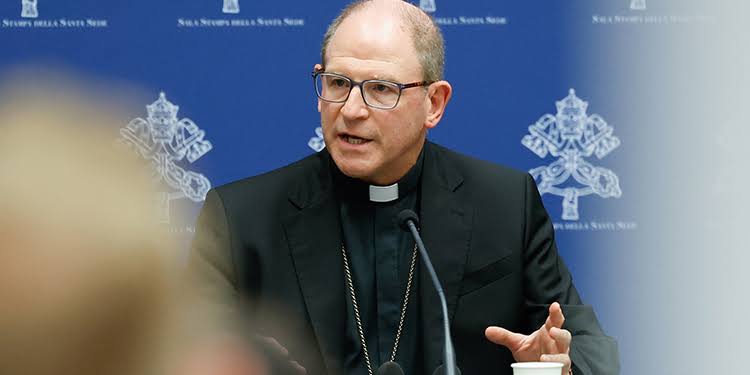
The new prefect of the Dicasterio for Legislative Texts, Mons. Anthony Randazzo, has warned against interpretations of synodality that view the current ecclesial moment as an opportunity to discard elements of the Church’s life and tradition considered outdated. Renewal, he maintains, does not consist in abandoning the roots, but in allowing them to produce new fruits.
Randazzo made the warning in his first in-depth interview since Leo XIV appointed him head of the Curia body responsible for canonical legislation. The conversation was published this month by the specialized journal Vox Canonica, where the Australian archbishop addressed the relationship between Canon Law, synodality, reform, and the evangelizing mission.
The danger of cutting the “dead wood”
To explain his conception of ecclesial renewal, Randazzo used the image of an ancient tree. The Church, he stated, can experience the present period as “a new spring,” in which the old wood produces new green shoots without the tree ceasing to be what it is.
The prefect then introduced his warning: “Some overly enthusiastic interpretations of synodality may see this moment simply as an opportunity to cut what is perceived as dead wood.”
The danger arises when such pruning is carried out without the necessary discernment. What is presented as renewal may end up causing “unnecessary harm” and weakening the tree instead of allowing it to flourish.
“The Church is not renewed by abandoning its roots, but by allowing those roots to nourish new growth,” he explained.
Randazzo does not reject synodality. On the contrary, he considers that the synodal life has long belonged to the reality of the Church. His objection is directed at presenting the current process as a rupture that would allow elements received from ecclesial tradition to be dispensed with.
“Synodality and accompaniment are not new realities”
The Vatican official maintains that terms such as “synodality” and “accompaniment,” although they have acquired a particular presence in contemporary ecclesial language, express realities already incorporated into canonical tradition.
“Synodality and accompaniment are not new realities,” he stated. They are contemporary expressions intended to help the Church “scrutinize the signs of the times and interpret them in the light of the Gospel.”
Randazzo finds this continuity both in the Code of Canon Law of the Latin Church and in the Code of Canons of the Eastern Churches. In both he identifies three elements he considers fundamental for a synodal Church: communion, participation, and mission through accompaniment.
For communion he cites canon 208 of the Latin Code, which establishes the true equality existing among all the faithful in their dignity and action for the building up of the Body of Christ. For participation he refers to canon 212 §3, on the right and, in certain circumstances, the duty of the faithful to express to their pastors their opinion on matters concerning the good of the Church.
Regarding accompaniment, he mentions, among others, canon 1063, concerning the pastoral assistance that must be provided to the faithful so that the married state may be maintained in a Christian spirit and progress toward perfection.
“These canons demonstrate that accompaniment is not simply a pastoral method, but a juridical expression of the communion, participation, and mission of the Church,” he noted.
Randazzo prefers to speak of “regeneration”
In contrast to a concept of reform understood primarily as the modification of structures or the abandonment of inherited elements, the prefect expressed his preference for speaking of “regeneration.”
To regenerate means, he explained, “to return to the genesis of our identity and mandate as disciples of Jesus Christ.”
From this perspective he also situates Canon Law within the continuity between Sacred Scripture and Sacred Tradition. Citing Dei Verbum, he recalled that both proceed “from the same divine source” and tend toward the same end.
“The law, therefore, is not separated from Revelation, but serves it. Its purpose is to safeguard and foster the communion of the faith received from the Apostles,” he stated.
This approach leads Randazzo to reject also an understanding of Canon Law as a mere administrative instrument or mechanism for imposing particular conceptions of the Church.
He warned, in fact, of the temptation existing among some canonists, both lay and clerical, to approach the Code as an instrument intended to demonstrate how the Church should be sanctified, taught, and governed according to “their own particular vision.” In his judgment, this attitude risks transforming Canon Law into “a means of control” instead of recognizing it as a service to communion.
Christ as the permanent reference
Randazzo likewise questioned the tendency to consider the present age as exceptionally complex for the Church. Every generation, he explained, has had to face its own difficulties.
The fundamental response also does not change with each new historical stage. “Jesus Christ is ‘the way, the truth, and the life,’” he recalled. “He must be our beginning and our end; only He is our permanent point of reference.”
The archbishop directly links this affirmation with the way of interpreting and applying ecclesiastical norms. “I do not believe I can deal with Canon Law if I have not first been nourished by the Gospel, because the law is always at the service of the Gospel,” he explained.
The task of canonists, therefore, consists in ensuring that the juridical life of the Church remains at the service of its evangelizing mission: “The Gospel must continue to be the lens through which we understand, interpret, and apply the law entrusted to us.”
The new head of the Church’s canonical legislation
Leo XIV appointed Anthony Randazzo prefect of the Dicasterio for Legislative Texts on March 25 and simultaneously granted him the personal title of archbishop. Until then he was bishop of Broken Bay, in Australia, where he had exercised the episcopal ministry for six and a half years.
The Dicasterio has among its principal responsibilities assisting the Roman Pontiff in legislative matters and promoting the knowledge, correct interpretation, and application of Canon Law in the Latin Church and in the Eastern Catholic Churches.
Randazzo has indicated that his intention at the head of the body is to listen to the needs of the Church and to encourage Catholics to remain “firm in Christ, faithful to the profession of our faith, and united in the one, holy, catholic, and apostolic Church.”
As the ultimate criterion for his work he cites the canon with which the Latin Code concludes, canon 1752: “The salvation of souls, which must always be the supreme law of the Church, must always be kept in view.”
“That is our modus operandi. That is our mission,” he stated.
Randazzo’s reflection also comes on the eve of an international meeting on Canon Law and synodality to be held at the Angelicum between September 30 and October 3. The prefect himself will participate together with Cardinal Mario Grech and Cardinal Kurt Koch in sessions dedicated precisely to the canonical implications of synodality.