


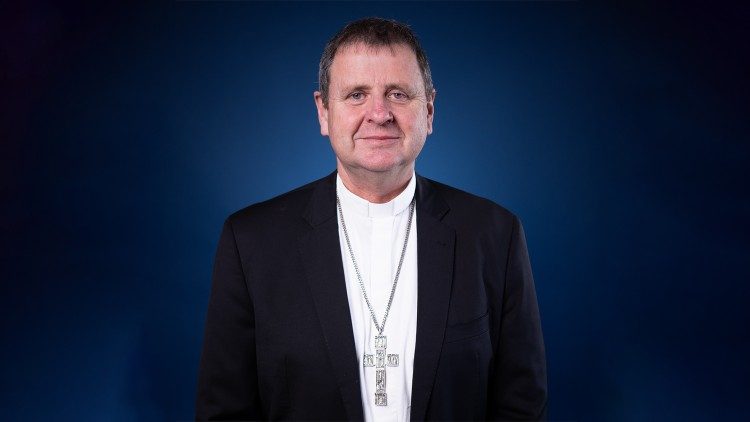
The Bishop of Auckland and President of the New Zealand Episcopal Conference, Bishop Stephen Lowe, has asked the priests and liturgical committees of his diocese to review how they celebrate Mass and compare their usual practices with the General Instruction of the Roman Missal. The goal, according to the prelate, is to celebrate the Eucharist in accordance with what the Church asks and not according to each celebrant’s “personal devotional or spiritual style.”
According to CathNews New Zealand, Lowe made the request in a letter sent this month to the clergy and those responsible for liturgy in the Diocese of Auckland. The bishop wants parishes and communities to study the General Instruction of the Roman Missal and examine how far local customs actually align with its provisions.
“Servants of the liturgy”
Lowe recalls that the rubrics of the Mass are not purely external indications, but “reflect and guide us toward” the theological and spiritual foundations of the celebration.
For this reason, he maintains that attention to the rubrics must determine the way priests celebrate, as they are “servants of the liturgy” entrusted by the Lord to the Church and not owners of a celebration that can be adapted to their personal preferences.
The approach is explicitly supported by Desiderio desideravi, the apostolic letter on liturgical formation published by Francis in 2022.
Lowe acknowledges that the review has also led him to correct his own way of celebrating. After the conferences given this year in New Zealand by American liturgist Fr. Paul Turner, he says he has introduced “a series of changes” in his own celebration of the liturgy in order to enter more fully, together with the faithful, into the sacred mysteries.
Turner’s visit had been organized by the New Zealand bishops precisely in response to Desiderio desideravi. The American priest gave workshops for the clergy of the country’s six dioceses and meetings for the laity in several cities. Lowe, who serves on the International Commission on English in the Liturgy (ICEL), presented the initiative at the time as an opportunity to deepen understanding of the Mass.
Reviewing parish by parish how Mass is celebrated
The request does not remain a generic exhortation to celebrate better. Lowe wants priests and liturgical committees to carry out concrete review work.
The study of the General Instruction of the Roman Missal should serve, he explains, as formation for the committees themselves and as a tool to ensure that the celebration of the Eucharist in Auckland is “better, more fully in line with what the Church asks of us, and more beautiful.”
The starting point involves recognizing that practices established in a parish do not acquire legitimacy simply because they have been carried out for years. They must be compared with the liturgical books and the norms of the Church.
Lowe’s concern coincides with an issue on which Leo XIV has insisted in recent months. In a catechesis on the liturgy, the Pope asked that the beauty of celebrations be cared for “without arbitrariness.” In another intervention directed especially at priests, he called for respect for liturgical texts and norms as an expression of humility before God and fidelity to the communion of the Church.
Focus also placed on music
The Bishop of Auckland specifically points to a problem still found in parishes and schools: musical settings of the parts of the Mass that do not literally respect the text established in the Missal.
Lowe asks that all versions of the Gloria, the Sanctus, the acclamation after the consecration, the Great Amen, and the Agnus Dei be “faithful” to the official text, that is, that they use the same words as the Missal.
The indication, he recalls, was already given when the new English Missal came into force in 2010. However, some parishes and educational centers continue to use other versions.
According to Lowe, after the introduction of the Missal, authorization had to be requested for new musical settings of its texts. The system ultimately failed, and currently numerous musical groups use their own compositions.
The bishop also identifies a pastoral consequence: the proliferation of different versions can end up causing the faithful themselves not to sing. For this reason, he recommends using common and sufficiently well-known musical settings.
Music must serve the participation of the faithful
Lowe also grounds this indication in the Constitution Sacrosanctum Concilium of the Second Vatican Council. Music, he affirms, must help all the faithful to participate in the liturgical celebration in a “full, conscious, and active” way, as the very nature of the liturgy demands.
The intervention is significant because it shifts the concept of participation from the multiplication of particular initiatives toward the common celebration of the rites that the Church has established.
The bishop does not propose a reform of the Missal or suggest introducing new options. His request consists precisely in returning to the norms already in force, examining the customs that have developed locally, and correcting them when they do not coincide with what the Church has laid down.
Lowe, Bishop of Auckland since 2021 and current President of the New Zealand Episcopal Conference, is also involved in international work related to English-language liturgical texts. He currently participates, together with episcopal representatives from Australia and Ireland, in the joint project for a new edition of the Lectionary of the Mass based on the Revised New Jerusalem Bible.
His request to the parishes of Auckland can thus be summarized in a simple idea: the beauty of the Mass does not depend on imprinting it with the personal stamp of the one who celebrates it, but on learning to receive and celebrate with fidelity the liturgy that the Church has entrusted to priests and faithful.