


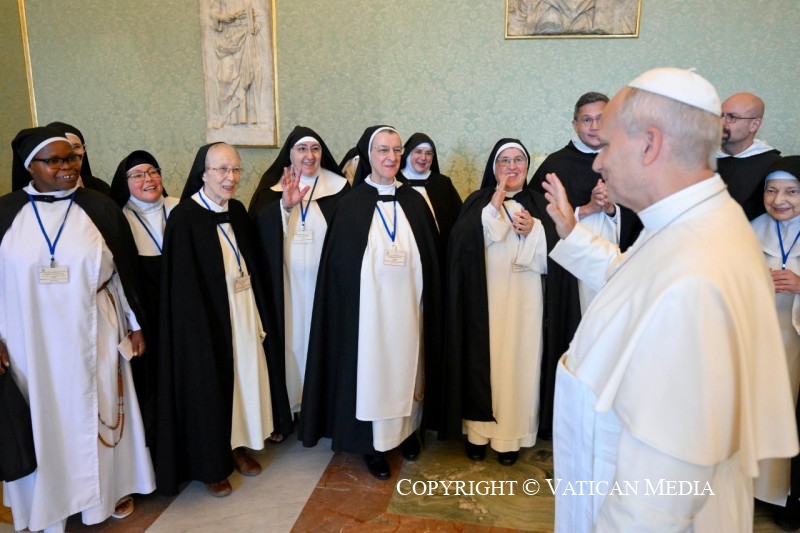
Pope Leo XIV received on Wednesday, September 30, in audience, at the Vatican Apostolic Palace, the International Commission of the Dominican Contemplative Nuns. During the meeting, the Pontiff affirmed the place of contemplative life in the Church’s mission and assured that it is not “on the margins of the mission,” but rather constitutes “its beating heart.”
The Pope dwelt especially on the value of silence and also addressed the difficulties that numerous contemplative communities face due to aging, the scarcity of new vocations, economic problems, and the maintenance of large properties. In the face of the temptation to limit oneself to preserving structures, Leo XIV asked them to listen to “what the Spirit asks today of Dominican contemplative life” and recalled that, before the works to be administered, there exists “a call to which to respond, a fire that burns and that cannot be allowed to die.”
ADDRESS OF THE HOLY FATHER LEO XIV TO THE INTERNATIONAL COMMISSION OF THE DOMINICAN CONTEMPLATIVE NUNS
In the name of the Father, and of the Son, and of the Holy Spirit.
Peace be with you.
Sisters and brothers, good morning!
I am very happy to meet with you, shortly after the recognition of the heroic virtues of the Servant of God Sister María Petra Giordano, a professed nun of the Order of Preachers, who made faith and vocation the fixed points of her consecrated life.
Faith and vocation can also guide this meeting of ours, to reaffirm that the contemplative vocation, in the Dominican spirit and in the entire Church, is not located on the margins of the mission, but is its latent heart (cf. Ecum. Conc. Vat. II, Decr. Ad gentes, n. 40; Constitutionum Fratrum Ordinis Prædicatorum, 2025, nn. 142.144).
Moreover, in the writings of Jordan of Saxony, the immediate successor of Saint Dominic, it appears how immediately, from the very beginning, the nuns of the first women’s communities, dedicating themselves principally to contemplative prayer and study, accompanied the preaching of the brothers with penance, sharing the same charism.
The principle of Saint Thomas Aquinas, according to which the fruit of one’s own contemplation is transmitted to others (cf. Summa Theologiæ, II-II, q. 188, a. 6), takes up the intuition of Saint Dominic, according to which every word of proclamation, in order to be true, must have its origin in silence, listening, prayer, and a deep relationship with God. Contemplation is the “breath” of our relationship with God (Francis, General Audience, 5 May 2021), a silent pause in which to welcome the Word and allow oneself to be transformed by it, which enables us to know ever more, in Him, things and persons, so that we may afterwards give to others what we have seen and understood.
Here, in particular, there is a reminder for you, Federal Presidents. Your presence in the visits to the monasteries and in the animation of the Federation, beyond the necessary administrative procedures, makes you above all guardians of these values (cf. C.I.V.C.S.V.A., Instr. Cor orans, n. 117).
Saint Dominic, of whom it is said that he preferred to speak with God or to speak of God, has taught you to grow in this style. It is right, therefore, that the visits also be always, first of all, moments of common encounter with the Lord: in prayer, in mutual listening, in fraternal correction, and in reconciliation.
Accordingly, your Constitutions (cf. n. 46) require the diligent respect of a fundamental value in cloistered life: silence. This, cultivated faithfully, will be valuable to you, not only to safeguard the observance completely and to foster quiet in the monastery, but also to look within yourselves, to be attentive to the sisters of the community and to those outside.
To make silence is an act of the will, which involves the whole person and which helps to live solid relationships, because they are animated by the Word of God. It is to create spaces of freedom and of truth, in which to guard attention, becoming sensitive to the voice of those who “do not count,” and maturing in wisdom and generosity.
This is particularly important in a world marked by speed, in which everything must be immediately visible and every void is quickly filled. In silence, in fact, the questions that each person asks are heard, but to which it is not always easy to respond alone. For this reason it is necessary that your communities offer oases of true and deep peace, where the chaotic anxiety linked to external things is silenced and one can listen to the voice of God.
Your experience as Federal Presidents, moreover, leads you to encounter also situations of difficulty: communities that languish; deaths that exceed new vocations; decrease in work capacity, with consequent economic problems; management of large and costly properties; challenges such as shared formation, interculturality, and the organization of structures of communion.
The temptation of the “spirit of survival” insinuates itself, which leads to isolation and to reducing commitments, with the illusion that one’s remaining strengths suffice, so as not to depend on others or not have to suppress monasteries.
In the face of all this, I invite you not to ask yourselves how to maintain structures that are emptying. Listen, rather, to what the Spirit asks today of Dominican contemplative life, being aware that, before managements to be carried out, there is a call to which to respond, a fire that burns and that cannot be allowed to die, as Saint Catherine of Siena said (cf. Dialogue of Divine Providence, cc. XCI-XCII).
Dear Sisters, even amid the problems of the moment, never lose heart. Your service to the Church is precious: continue it with confidence, in communion and with discernment, united but without uniformity, faithful to tradition and open to novelty, contemplative because you are capable of bringing the world before God.
May the Virgin Mary, invoked with the Holy Rosary, teach you to see each day the invisible work of the Lord and, with the help of her grace, to pour also upon the wounds of humanity of our time, the oil of consolation and the wine of hope (cf. Roman Missal, Common Preface VIII).
I thank you for the gift that you yourselves are and, from my heart, I impart to you the Apostolic Blessing.