


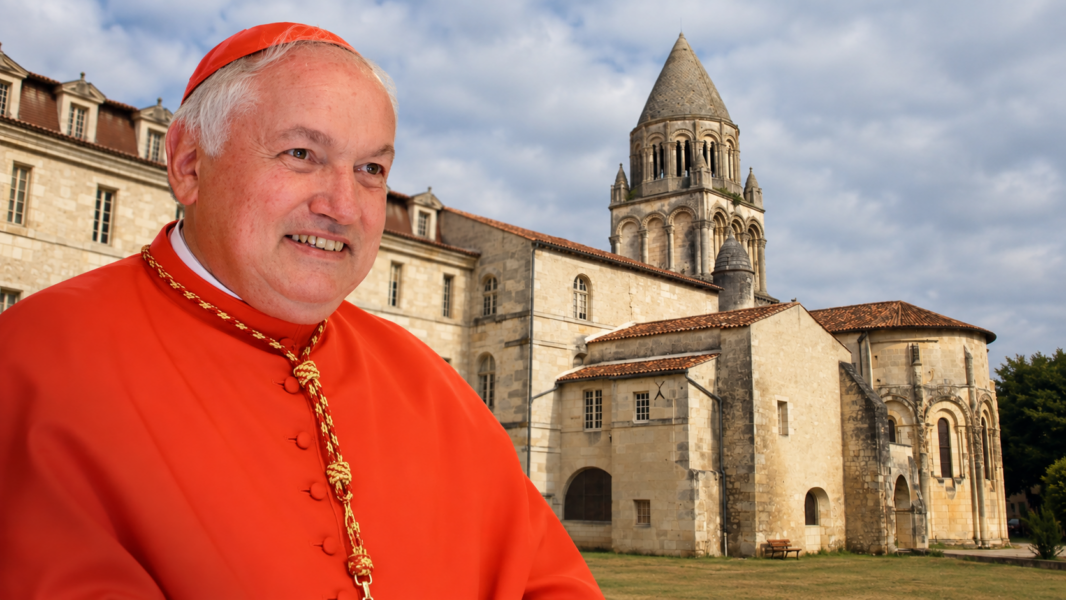
Europe did not begin with the community institutions or the treaties of the twentieth century. Centuries before the current European Union, monasteries had woven an extensive spiritual, cultural, and intellectual network that crossed borders and connected peoples from the Atlantic to the eastern reaches of the continent. Cardinal Jean-Marc Aveline claimed this Monday in Metz that this monastic heritage was one of the historical realities that made Europe possible.
The president of the French Episcopal Conference addressed the issue during his speech before Leo XIV at the Robert Schuman Congress Center, on the final day of the Pope’s apostolic journey to France. Aveline maintained that “Europe, whose roots are strongly imbued with Christianity, predates the political constructions that currently attempt to give it a face.”
Cîteaux and a kind of “first European Parliament”
To explain this claim, Aveline drew on a recent experience at the abbey of Cîteaux, cradle of the Cistercian Order.
The cardinal recalled having visited the building of the Definitorium there, where the leaders of the monastic communities periodically gathered.
Aveline described it as “a kind of first European Parliament,” an image he used to illustrate the breadth of the relations that religious orders had established across the continent long before the current supranational institutions existed.
The leaders of the communities met every year, he explained, “patiently weaving the fabric of Europe, from the shores of the Atlantic to the far reaches of the great plains of the East.”
The comparison was not intended to equate those monastic structures with a parliament in the modern political sense, but to highlight that for centuries there existed stable networks capable of transcending the territorial, linguistic, and political divisions of Europe.
A Europe prior to its political institutions
Aveline’s argument placed the formation of the continent in a much longer history than the European integration that began after the Second World War.
“For centuries, in fact, Europe has been taking shape, thanks to the genius of the peoples that compose it, in the diversity of their languages and cultures, and through a constant debate between faith and reason,” he stated.
The monasteries played a decisive role in that history. Religious communities shared rules, spirituality, knowledge, and forms of organization while maintaining relations between territories separated by great distances.
Monastic life thus helped create bonds that did not depend on the existence of a common political authority. Monks, manuscripts, knowledge, and traditions circulated among communities belonging to different kingdoms and peoples, while the great orders extended their houses across much of the continent.
Aveline also incorporated into his reflection the contribution of the Jewish people. “And who could ignore, in the diversity of Europe’s spiritual components, the immense part played by the Jewish people, whose intellectual contribution was so great and whose martyrdom was so appalling?” he asked.
Leo XIV: “Without this monastic heritage, European civilization would not exist”
Leo XIV’s subsequent intervention reinforced the historical reading presented by the cardinal.
The Pope recalled the figure of Saint Benedict of Nursia, proclaimed patron of Europe by Paul VI, and emphasized that the monasteries were not merely centers dedicated to prayer, but places from which a decisive work for the cultural and social configuration of the continent was carried out.
Leo XIV pointed to the monastic contribution to education, universities, hospitals, medicine, the sciences, law, and the organization of cities.
“Without this monastic heritage, European civilization as we know it would not exist,” he stated.
The Pontiff’s conclusion was even more explicit: “One cannot speak of Europe without mentioning Christianity.”
The words spoken in Metz thus positioned Christianity not as an element added later to an already formed European identity, but as one of the historical factors that participated in its configuration.
From the monasteries to Schuman
Aveline linked that Christian Europe predating the modern states with the project of reconciliation that emerged after the two world wars.
The choice of Metz to close Leo XIV’s journey responded precisely to that purpose. The cardinal revealed that, when he proposed to the Pope a visit to Lorraine to speak “of war and peace, of Europe and reconciliation,” Leo XIV replied: “Metz, for Europe.”
In a region marked for generations by conflicts between France and Germany, Aveline recalled Robert Schuman, Alcide De Gasperi, and Konrad Adenauer, three Christian leaders who played a fundamental role in the process of European integration after the Second World War.
For the cardinal, the institutions created in the twentieth century did not arise on empty ground. They were built upon a much older European reality, formed over centuries through diverse languages and cultures, the dialogue between faith and reason, and Christian networks capable of crossing borders.
The image chosen in Metz summarized that historical continuity: long before Brussels, Strasbourg, or Luxembourg, the leaders of monasteries scattered across Europe were already meeting and, in Aveline’s words, “patiently weaving the fabric of Europe.”