


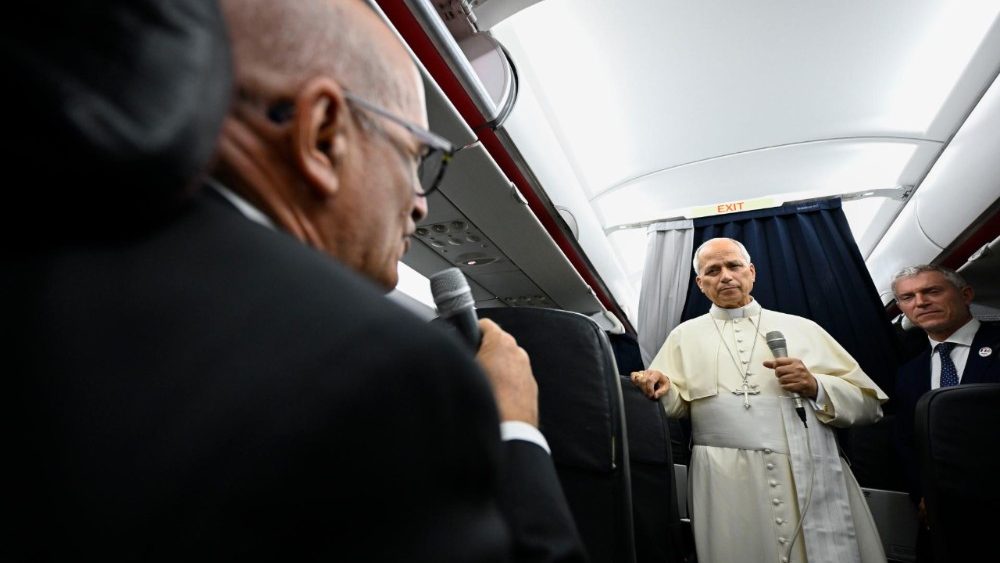
Pope Leo XIV addressed sexual abuse in the Church, the war between Russia and Ukraine, the arms industry business, and the risks of artificial intelligence during the extensive press conference he held this Monday aboard the plane that took him from Metz to Rome, at the end of his apostolic journey to France.
According to the transcript published by Vatican News, the Pontiff answered questions from the journalists accompanying him after four intense days in France. He also spoke about the recent legalization of euthanasia in the country, the housing crisis in Spain, the situation of the Church in Germany, and the growth of extremist political movements.
«Four days full of blessings»
Before the questions, Leo XIV gave a brief summary of the trip and especially highlighted his stay in Lourdes and the meeting with the sick and suffering people.
«These four days have been, literally, full of blessings. Almost miracles, I would say», the Pope stated, recalling having seen how «the grace of God’s presence» touches people’s hearts, transforms their lives, and «restores dignity to the sick, the elderly, and those who, in some sectors of society, are marginalized».
Leo XIV also highlighted the meeting with 80,000 young people from all over France, in whom he said he had found «enthusiasm», «joy», and a «sense of hope» that they can now pass on to others.
Abuse: Leo XIV qualifies the term «systemic»
The first question was related to the meeting Leo XIV held on Sunday in Lourdes with seven abuse victims, four men and three women. After the meeting, some of the participants stated that the Pontiff had recognized the «systemic» nature of sexual abuse in the Church.
The Pope wanted to clarify his words.
«Many of them have spoken of systemic abuse. Personally, I prefer to express it differently», he noted. Leo XIV acknowledged that «some organizations within the Church» have at times been able to act «abusively as a system», but insisted on the importance of making a distinction.
«Sexual abuse is, above all, a human problem. When it occurs within the Church, it actually takes on another dimension, because people’s life of faith is deeply wounded and, at times, even destroyed», he explained.
Leo XIV stated that the Church has a «special responsibility» to accompany those who have suffered abuse and help them on their path to healing.
«Wars no longer make sense»
His most extensive response was dedicated to the war between Russia and Ukraine. Asked about the real possibilities of negotiation and his denunciation of the «illusion of rearmament», Leo XIV started from the principles of the Church’s social doctrine and rejected «violence, hatred, weapons», and the reappearance of nuclear weapons discourse.
The Pope criticized the continuous increase in military spending and pointed to the economic interests behind the arms industry.
«A few are getting enormously rich from an industry that promotes war», he stated.
Leo XIV contrasted the billions allocated to armaments with basic needs that remain unresolved: «With these billions of euros or dollars, problems like world hunger, housing, and unemployment situations could be solved».
Against the logic of rearmament, he called for a voice that proposes «another path» and warned that continuously increasing weapons spending fuels tensions that can lead «to the outbreak of another war, another conflict».
Russia and Ukraine must «sit down» and dialogue
The Pontiff expressly defended negotiations between Moscow and Kiev and maintained that the Church must continue to offer an alternative to imposition by force.
Leo XIV stated that powers seeking to «impose through power instead of dialoguing and promoting negotiations» bring the world ever closer to new wars.
The Church, he explained, has the responsibility to defend human dignity, life, and the possibility of «spending more on health and education and less on weapons».
In that context, he called for continuing to invite «leaders like those of Russia and Ukraine» and from other countries «to come, to sit down, to dialogue, to seek how to solve problems without continuing those wars that no longer make sense».
The Pope admitted the limits of ecclesial mediation: «We cannot force anyone; sometimes it seems it may be useless, but we will continue speaking, we will continue inviting, we will continue proclaiming the Gospel».
Read also: Zuppi arrives in Moscow: children, prisoners, and civilians, at the center of the Vatican mission
Artificial intelligence: «I am not in panic»
Artificial intelligence was another of the major topics of the press conference. Journalist Justin McLellan, from the National Catholic Reporter, asked the Pope about warnings from specialists who even raise catastrophic scenarios for humanity.
Although he assured that the topic lets him «sleep well», the Pope nevertheless refused to downplay those warnings. «I believe that the concerns raised by many experts and specialists in AI should be taken seriously», he stated.
The issue occupied a significant part of his speech before UNESCO in Paris, where he warned of the risks of artificial intelligence separated from ethics and recalled that machines cannot answer the fundamental questions about the meaning of human life.
During the press conference, Leo XIV considered it irresponsible to merely affirm that the risks will not materialize and to «turn a blind eye» to the possible consequences of technological development.
The Pope also revealed that the Vatican has created an Artificial Intelligence Commission to coordinate the use of these technologies in the Holy See and to study both their possibilities and their risks.
The objective, he explained, is to help ensure that artificial intelligence does not reach a point where it can «destroy humanity or exclude it from the debate».
«I am relatively optimistic that we can achieve this», he stated, although he insisted on the need to continue working and promote dialogue among political leaders, technology companies, social organizations, and specialists.
Euthanasia, housing, and Germany
The press conference also addressed three other topics of special relevance. Leo XIV defended the Church’s legitimacy to intervene publicly in defense of life after being asked about his criticisms of euthanasia during the trip. The Pontiff maintained that «when the Church speaks about the defense of life or issues of social doctrine, it is not doing politics, but applying the Gospel to people’s lives». During his time in France, he had already claimed before the bishops the public voice of the Church against a conception of secularism that seeks to relegate faith to the private sphere.
Asked about the case of Maricarmen, an 87-year-old woman with a disability affected by an eviction in Madrid, the Pope called for solutions to the housing crisis and asked what «the problem in the system» is that allows similar situations. He also pointed to the responsibility of political authorities in seeking responses.
Leo XIV finally referred to Germany. He confirmed that he has received an invitation to visit the country, although there is not yet a date, and assured that World Youth Day in Korea is, for the moment, the only confirmed trip for next year. In the face of the decline in religious practice in Germany, he defended the recovery of the «true missionary spirit» and also referred to the relationship between certain religious expressions and political movements classified as far-right.
Before concluding, the Pope thanked those who worked on organizing his trip, from Holy See staff and French authorities to the bishops and numerous laypeople who participated in the various activities.
«There are so many people who work behind the scenes and who do not receive the applause that the Pope receives when he passes by», Leo XIV concluded.