


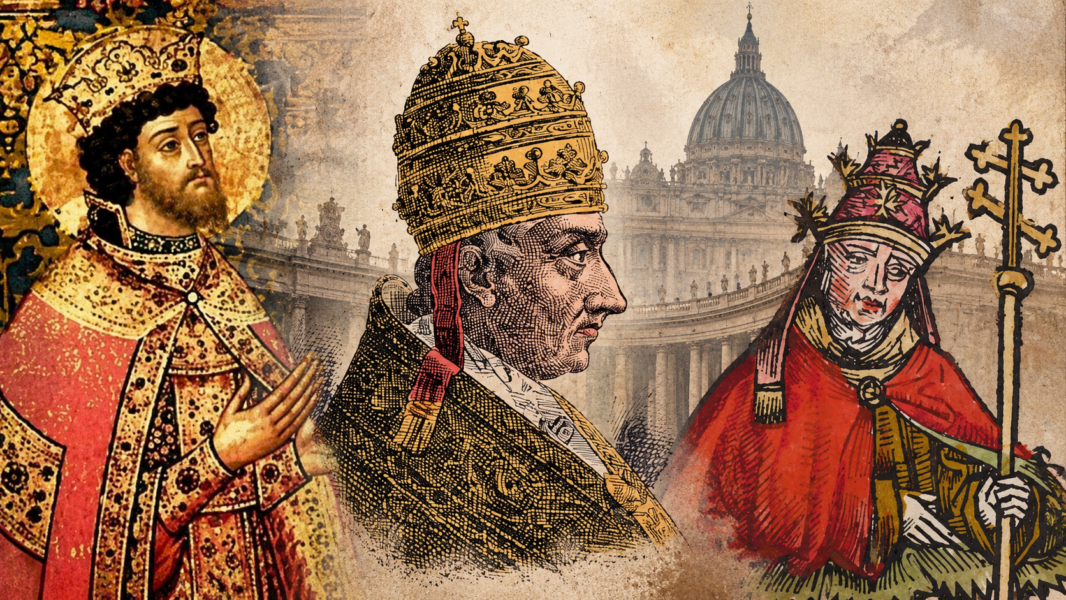
Between the years 928 and 965 the Church had three Popes named Leo, and none of the three reached the chair of Peter by the will of those who were supposed to elect him. The sixth was placed there by a woman, Marozia, who ruled Rome with the title of senator. The seventh was placed there by that woman’s son, Alberic, who ruled with the title of prince. The eighth was placed there by a German emperor, Otto I, who did not even bother to look for a cleric. Thirty-seven years, three masters and three ways of wearing the chain: the first wore it in silence, the second found a way to loosen it, and the third became a chain for someone else. This series, which runs through the thirteen predecessors of Leo XIV, had stopped at Leo V, deposed and imprisoned in 903, at the beginning of what Cardinal Baronio called the dark century. The three following Leos lived within that darkness and it is fitting to read them together, because together they say something that none of them says separately.
Leo VI was Roman, the son of a Christopher who had been primicerius, one of the high offices of the pontifical administration, in the time of John VIII. He was cardinal priest of Santa Susanna when he was elected in mid-928, and the word “elected” is generous. His predecessor, John X, had tried to govern on his own; Marozia and her husband, Guy of Tuscany, had him seized in the Lateran and locked up in Sant’Angelo, where he died. Liutprand of Cremona, who wished none of the parties well, recounts that he was suffocated with a pillow. The sources do not agree on whether the prisoner was still alive when Leo was enthroned, and the doubt portrays the age better than any certainty: Rome had a new Pope and no one knew for sure what had become of the previous one. Leo reigned seven months and five days. From his government there remains a bull granting the pallium to Archbishop John of Spalato, ordering the bishops of Dalmatia to obey him without exceeding the limits of their dioceses, and settling the dispute of Bishop Gregory of Nona by assigning him another see. It was a matter John X had left unfinished. That is all. He was buried in St. Peter’s and Marozia installed another. Two years later she would install her own son.
Between Leo VI and Leo VII seven years passed and the jailer changed. In 932 Alberic, son of Marozia’s first marriage, rose against his mother on the day she celebrated her third wedding, to Hugh of Provence, king of Italy. He imprisoned her, expelled his stepfather and governed Rome for twenty-two years as prince and senator of all the Romans. The Pope at the time, John XI, was his half-brother and ended his days confined to the Lateran, reduced to sacred functions. When he died, Alberic looked for a man without ambitions and found him in the priest of San Sisto, probably a Benedictine monk, who was elected on 3 January 936. Leo VII had no army, no territory, no foreign policy, and no power to appoint anyone Alberic did not want. He had only one thing left: the possibility of calling someone, and he called Odo, abbot of Cluny.
Odo arrived in a besieged city. Hugh of Provence wanted to recover Rome, and the abbot, who had credit with both sides, negotiated a truce sealed by the marriage of Alberic and Alda, daughter of Hugh. The real task was different. Cluny had been founded in 910 with an unusual clause that removed it from every lay lord and every bishop and placed it under the direct protection of the Roman see, and it was already the workshop where the monastic life of the West was being rebuilt. Leo VII set Odo to reforming the monasteries of Rome and its surroundings, beginning with San Paolo fuori le Mura, and almost all the surviving bulls issued by him are privileges granted to abbeys, Cluny first among them. The least free Pope of his century protected the freedom of the monks with his signature. Alberic allowed it and even favored it: observant monks did not dispute Rome with him.
Leo also appointed Archbishop Frederick of Mainz as his vicar in Germany, with authority to proceed against unworthy clerics. Consulted by him about the Jews, he forbade their forced baptism and authorized the expulsion from cities of those who refused to convert. He died on 13 July 939. From that world of reformed abbeys, in Burgundy and Lorraine, would come, a century later, the men who freed the papacy from its cage.
Alberic died in 954 after making the Roman nobles swear, before the altar of St. Peter’s, that the next Pope would be his son Octavian. He became Pope the following year, at about eighteen years of age, and took the name John XII. He called Otto I against King Berengar, crowned him emperor in February 962, and conspired against him as soon as he left Rome. Otto returned in November 963 and convened a synod in St. Peter’s. There a catalogue of accusations was read against the absent Pope, known to us only through Liutprand, a party to the matter. It ranged from ordaining a deacon in a stable to drinking to the health of the devil. The synod deposed him on 4 December. To replace him the emperor did not propose a bishop or a cardinal. He proposed Leo, protoscriniarius, head of the notaries of the curia, a Roman from the Clivus Argentarius and a layman. That same day he was elected. Bishop Sico of Ostia conferred the orders on him at once, skipping the intervals required by the canons, and on the 6th he was bishop of Rome.
What followed was a year of crossed Popes. The Romans rose in January and were crushed; Leo interceded so that Otto would return the hundred hostages. As soon as the emperor moved away, the city expelled its Pope and John XII returned. He held his own synod on 26 February 964, declared everything that had been done null and void, and degraded those ordained by Leo. He took revenge on the bodies of his adversaries: a cardinal deacon had his right hand cut off. He died on 14 May. The Romans asked Otto’s permission to elect the deacon Benedict, whom they called the Grammarian for his learning and of whom no one spoke ill. Otto refused, and they elected him anyway. The emperor besieged Rome until it surrendered from hunger, and on 23 June they handed Benedict V over to him. In the Lateran synod presided over jointly by Leo VIII and Otto, the defeated man was stripped of his pontifical vestments. According to Liutprand, writing for the emperor, it was Leo himself who broke his crozier. Benedict died in exile in Hamburg, with a reputation for sanctity. Leo VIII died in Rome in the spring of 965.
The Church has never resolved which of the two was Pope and when. The old Catholic Encyclopedia calls both the deposition of John XII and the election of Leo illegal, and admits Leo as true Pope only from July 964, on condition that Benedict accepted his deposition. The Annuario Pontificio, in the note accompanying its list of Popes, acknowledges that on this point historical and theological-canonical criteria cannot be harmonized, as will happen again in the mid-eleventh century. It admits that it is impossible to decide clearly on which side legitimacy lay, and because of that uncertainty, it explains, the official list renounced numbering the pontiffs. Leo VIII still rendered a posthumous service to his patrons. During the Investiture Controversy, the imperial party circulated under his name bulls granting Otto and his successors the right to designate the Pope and to invest bishops. Criticism regards them as forgeries or, at the very least, manipulated beyond recognition.
Three pontificates without freedom oblige us to begin with what prevents scandal. In thirty-seven years the Roman see had a mistress, a master and an imperial patron. One Pope died in a dungeon with the see already occupied or about to be, and another was degraded to deacon by his rival with the emperor present. The apostolic succession was not broken and the faith did not waver: none of these three Leos, who taught almost nothing, taught an error. Christ promised that the gates of hell would not prevail. He never promised free Popes, or worthy ones, or even indisputable ones. On the legitimacy of Leo VIII the Holy See itself admits that it does not know how to pronounce, and the Church has lived with that doubt for a thousand years without losing a single article of the Creed.
No one can reproach Leo VII for not overthrowing Alberic. He is measured by the only thing he had in his hand: the choice of whom he called, and he called the best man of his time. It is a useful standard because it serves for any Pope: appointments portray a pontificate more accurately than speeches. It serves all the more when there is no Alberic at the door. Leo XIV governs without a senator, without a prince and without an emperor, with a freedom his tenth-century namesakes could not have imagined.
There remains the posthumous lesson of Leo VIII. To maintain that a Pope had ceded to civil power the investiture of bishops, the imperialists of the eleventh century had to fabricate the bulls. Even the crudest caesaropapism assumed that this right could come only from Rome and that Rome had not granted it. In 2026 the State that intervenes in the appointment of the bishops of China does not need to forge any parchment. It possesses an authentic agreement, signed in 2018, extended until 2028 and of secret text, under which consecrations continue to take place.
The next Leo in this series, Bruno of Toul, came from that world of reformed abbeys that Leo VII protected with his signature. He found the papacy still in the hands of Roman families and emperors. He had five years. We shall see what he did with them.
Read also