


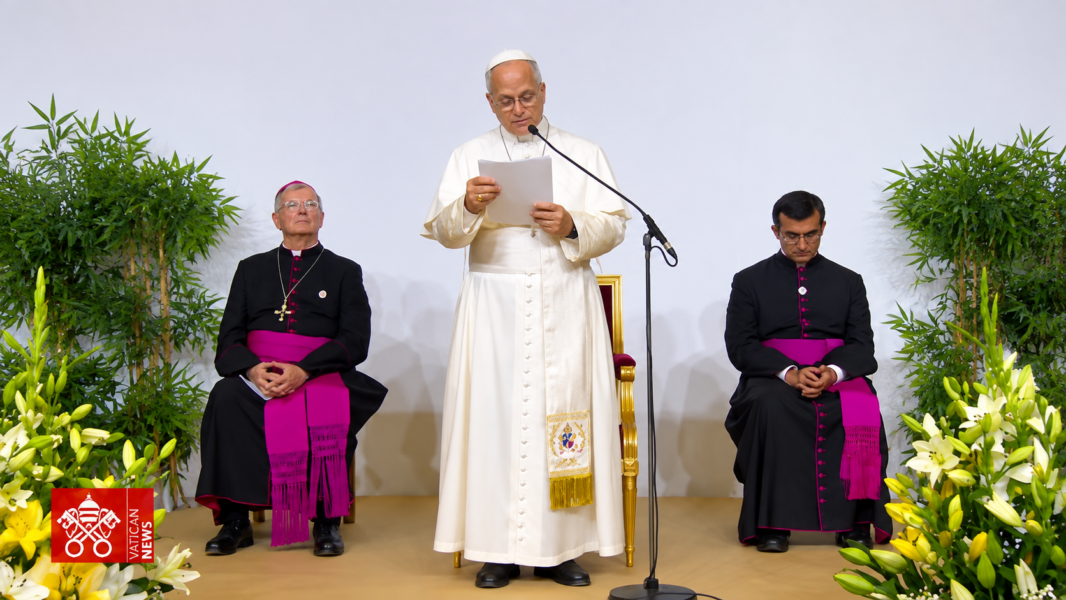
Pope Leo XIV has asked this Saturday in Paris that the strong growth of catechumens and new baptized persons in France be accompanied by solid formation covering Sacred Scripture, theology, doctrine, Christian morality and liturgical life. During his meeting at the Institut Catholique de Paris with members of the provincial synodal Assembly, catechumens and neophytes, the Pope warned of the need to avoid the “post-baptismal void” and to fully integrate those who receive the sacraments of Christian initiation into the life of the Church.
The meeting, the second public event of the day after the visit to Maison Bakhita, began at 10:10. Pope Leo XIV was received by Cardinal Jean-Marc Aveline, Archbishop of Marseille and President of the French Episcopal Conference; the Archbishop of Paris, Msgr. Laurent Ulrich; the Rector of the Institut Catholique, Emmanuel Petit; the President of its Board of Directors and the parish priest of Saint-Joseph-des-Carmes.
The rise of conversions in a secularized France
The Pontiff focused much of his address on the phenomenon currently affecting the French Church: a growing number of adults, many of them young, are approaching Catholicism and requesting the sacraments of Christian initiation.
After hearing the testimonies of Josué, Marielle and Sophie, Pope Leo XIV said he was surprised by the number of people who are once again presenting themselves “on the threshold of faith” and by the number of adults requesting the sacraments. In his view, it is particularly significant that this awakening is taking place within a society characterized by a strongly secularized culture.
The phenomenon is supported by figures from the French episcopate: at Easter 2026, 13,234 adults were baptized in France, 28% more than the previous year and more than triple the 4,124 recorded in 2016. The growth has led Cardinal Aveline himself to acknowledge that many of the new converts are coming to the Church through paths that pastoral structures had not foreseen. Official data from the French Episcopal Conference also confirm that young people between 18 and 25 years of age currently constitute the largest group among baptized adults.
Pope Leo XIV noted that these conversions contradict defeatist attitudes and “sterile pessimism,” but at the same time warned against a naively triumphalist reading. Growth, he said, requires responsibility, serious questions and concrete pastoral decisions.
Avoiding the “post-baptismal void”
One of the central points of the address was precisely what happens after Baptism. Pope Leo XIV took up the question raised during one of the testimonies about how to avoid the “post-baptismal void” and maintained that it is not enough to prepare a person to receive the sacraments.
The newly baptized must subsequently be accompanied and fully integrated into communities and prayer assemblies, with a truly family-like space and integral formation that allows the faith received to be united with one’s own life.
The Pope detailed the contents he considers necessary. Neophytes must deepen the foundations of the Christian faith, receive adequate biblical and theological formation, progressively discover the richness of Catholic doctrine and know the different dimensions of Christian morality that derive from the profession of faith. To all this he expressly added initiation into the liturgical life of the Church.
The liturgy is part of the path of conversion
Pope Leo XIV devoted particular attention to the liturgy and rejected understanding it as a reality that comes only after catechesis, as a practical application of previously acquired knowledge.
On the contrary, he explained that the liturgy manifests and actualizes the paschal mystery of Christ and, through its rhythms, languages and rites, forms part of the very journey of conversion and preparation for the sacraments. Some of the testimonies heard during the meeting had precisely pointed to liturgical celebration as the gateway to the mystery of faith.
The issue is of special interest in the French context, where various testimonies of young converts have highlighted the importance that the liturgy has had in their approach to the Church. In Paris, the parish of Saint-Roch welcomed 55 adults who received Baptism during the past Easter Vigil, the largest number recorded at that time in a parish in the French capital.
Formators capable of teaching and accompanying
The Pope also insisted on the responsibility of those who accompany catechumens and neophytes. He recommended adequately preparing godfathers and godmothers and called for a deep knowledge of the Rite of Christian Initiation of Adults.
The preparation of pastoral agents, he added, must not be limited to biblical, theological, liturgical and spiritual aspects. They must also possess the human qualities necessary to discern and accompany people whose life trajectories may be especially complex.
Pope Leo XIV recalled that some come to the Church moved by a spiritual thirst, a search for meaning or an initial attraction to the Gospel, while others do so after painful experiences, situations of loneliness or deep wounds. Welcome and listening, he said, must be accompanied by the capacity to encourage them to face the demands proper to the Christian faith.
“A promise of fruitfulness for the Church in France”
The Pontiff finally rejected considering the newly baptized as mere recipients of pastoral action. Their faith, he affirmed, also constitutes a gift offered to the Church.
To explain this he gave the example of Saint Augustine, introduced to the faith by Saint Ambrose and baptized when that faith was still like a small seed that would later grow to become one of the great references of the Christian tradition.
Addressing catechumens and neophytes directly, Pope Leo XIV assured them that he sees in them not only the fruit of the action of the Holy Spirit, but also a “promise of fruitfulness for the Church in France,” and exhorted them to become themselves missionaries of the Gospel within French society.
The Pope proposed as references Saint Thérèse of the Child Jesus, for her “little way” of trust, and Saint Martin of Tours, an example of charity and fraternal self-giving. He concluded by invoking the Virgin Mary, principal patroness of France, as well as Saint Genevieve and Saint Denis, patrons of Paris.
From the path of the martyrs to the provincial Assembly
Before the meeting, Pope Leo XIV entered the church of the Institut Catholique, where students, professors and seminarians were gathered, and remained briefly in prayer. He then proceeded to the Georges Bernanos Auditorium following the route of the martyrs of September 2, 1792.
Msgr. Laurent Ulrich delivered words of welcome and presented the Pontiff with the Instrumentum Laboris of the provincial ecclesial Assembly. Pope Leo XIV also recalled the figure of Brother Lawrence of the Resurrection, whose spirituality of the presence of God in daily life, he said, has profoundly marked his own journey of faith.
After his address, the Pope returned by car to the Apostolic Nunciature to have a private lunch. The agenda for this Saturday will continue in the afternoon with the Mass in the Place de la Concorde and, subsequently, with the transfer to Lourdes, the second stage of the apostolic journey.
ADDRESS OF THE HOLY FATHER POPE LEO XIV
Your Excellency,
dear priests and consecrated persons,
dear members of the synodal Assembly,
dear catechumens and neophytes, brothers and sisters:
I am pleased to meet with you and to pause, in the context of this Apostolic Journey, on the path you are traveling as a Provincial Ecclesial Assembly.
I thank His Excellency Msgr. Laurent Ulrich, Archbishop of Paris, who has recalled the historical and spiritual importance of the place where we find ourselves, also evoking Brother Lawrence of the Resurrection, who profoundly marked my journey of faith with his mysticism of daily life. But above all, I express my gratitude for the Instrumentum Laboris that you have presented to me, an expression of an ecclesial journey in which the People of God have participated, with a spirit of mutual listening and synodality.
The Catholic Institute of Paris welcomes us today, an institution situated at the crossroads between science and faith which, for centuries, has contributed to forming minds and hearts in the service of the Gospel. I greet the professors, students and staff of this university, as well as all the members of the synodal Assembly of the ecclesiastical Province of Paris, committed to reflecting on pastoral perspectives for welcoming neophytes and catechumens, as well as for the life of the Church.
Observing closely the work you are doing, but above all listening to the moving testimonies of Josué, Marielle and Sophie, I feel above all a great gratitude for the unpredictable work of God. Like you and with you, I am amazed by the number of people who today present themselves on the threshold of faith and the number of adults who request the sacraments of Christian initiation.
It may seem paradoxical that this phenomenon of so many people rediscovering the Gospel and embracing the faith is taking place in the context of a society like the French one, marked by a strongly secularized culture. Your experience and your testimony, dear catechumens and neophytes, are the tangible sign of the work of God’s grace, which surpasses numerical and sociological analyses. This phenomenon, which contradicts every defeatist attitude—what Pope Francis called “sterile pessimism” (cf. Ap. Exhort. Evangelii gaudium, nn. 84-86)—must be welcomed with a spirit of responsibility.
Indeed, we are called to turn toward our brothers and sisters, rediscovering God’s own style, made of closeness, compassion and tenderness. With pastoral tenderness and fraternal charity, we must recognize, welcome and preserve the small flame that the Holy Spirit has kindled in the darkness of the night, the small seed that aspires to grow even amid thorns and brambles.
Wonder at what is happening to so many of our brothers and sisters must not enclose us in naive complacency. On the contrary, we must commit ourselves to seeking, to asking ourselves questions and to undertaking concrete pastoral actions. This is the spirit that animates your synodal Assembly and, more generally, the path of the Church in France: amazed by the unpredictable work of God, what must we do and where does the Holy Spirit impel us to accompany the catechumens, the neophytes and those who “begin again”?
First of all, I would like to recall an expression used by the French episcopate many years ago, which exhorted us to imagine and embody a Church “in a state of initiation,” which cares for catechumens, neophytes and those who begin their journey again, offering them over time solid support. Christian initiation—as a whole—has been at the center of the solicitude of pastors since the years following the Second World War. Requests were already numerous, and the theological and liturgical ferment of those years contributed widely to the renewal of catechumenal itineraries that occurred later during the Second Vatican Council. Although the current context is different, you can refer to this well-rooted pastoral tradition regarding the initiation of catechumens. Nor let us forget that this already existing practice received a new impulse from 1996 onward, the year in which the Letter to the Catholics of France saw the light and, in parallel, the last French edition of the Rite of Christian Initiation of Adults.
Dear brothers and sisters, being “in a state of initiation” means welcoming the new seekers of God, discovering in this an opportunity and a mission. The opportunity consists in the fact that, thanks to them, the community of believers also renews its own journey of faith and discovers in a new way the joy of the Gospel. The mission, for its part, consists in caring for them and serving as their guide, even after they have received the sacraments. It is fitting to welcome with joy those who present themselves, to start from their spiritual experience, to respect their history and to favor an essential proclamation of the kerygma, especially through the formulas known in the personal or communal itinerary. However, let us not forget that in many of these persons there later arises the question we heard in Marielle’s testimony: how to avoid the post-baptismal “void”?
Therefore, it is essential to accompany and fully integrate these persons into our communities and our prayer assemblies after their baptism, offering them a family-like space and as integral a formation as possible, capable of encompassing the different aspects of Christian life and of favoring the unification of their faith with their life. Indeed, neophytes often have a thirst and need to deepen the foundations of the faith and of Christian prayer, to receive adequate formation from the biblical and theological point of view, to discover more and more the richness of doctrine, as well as the different dimensions of Christian moral action linked to the profession of faith.
Finally, they also need to be initiated and introduced into the liturgical life of the Church. In the testimonies we have also heard how the celebration of liturgical rites has been for some a gateway to the mystery of faith. After passing through this door, it is necessary to go further and discover the richness of the liturgy that sustains the whole life of faith. This is a fundamental area of the Church’s life that requires pastoral attention rooted in the teachings of the Second Vatican Council. Indeed, the liturgy cannot be considered a reality “subsequent” to catechesis, in which what has been learned throughout the itinerary would be put into practice. On the contrary, it manifests and actualizes the mystery of Christ’s Passover and is therefore the event capable of revealing the meaning of the Good News and of communicating the very life of God. With its rhythms, its languages and its rites, the liturgy forms an integral part of the path of conversion and of preparation for the sacraments.
To carry out this mission, the role of formators is essential. As the ancient tradition of the Church teaches us, it is a matter of preparing godfathers and godmothers of the community, especially formed to initiate neophytes. In the context of this formation, I recommend a deep knowledge of the Rite of Christian Initiation of Adults. At the same time, it is necessary that pastoral agents be formed—not only in the biblical, theological, liturgical and spiritual life areas, but also in the area of human qualities—so that they know how to discern and guide those who have more complex and less linear life trajectories.
We heard it a moment ago: some come with a simple spiritual thirst, a search for meaning and an attraction to the Gospel; while others are marked by painful experiences, situations of loneliness and deep wounds. It is here that the style of closeness, compassion and tenderness acquires all its meaning: it is fitting to find a wise balance to welcome them, to listen to them and, at the same time, to encourage them to face the demanding challenges of the faith. On this path, the rhythm of the other must be respected, advancing progressively, with attention and in fraternal accompaniment. It is a matter of adopting the style of “walking together.” On the paths of the Christian faith we enrich one another and grow together: priests and laity, godparents and catechumens, pastoral agents and neophytes.
And yet, this is still not enough. The newly baptized are not called only to receive: their faith is a treasure offered to the Church of France and to the universal Church. I think of what happened with one of the most famous catechumens in history, Saint Augustine. He was initiated into the faith by Saint Ambrose, and his faith was barely a small seed when he was baptized. But that seed grew and multiplied, becoming a tree so large that, under its foliage, we can still find consolation today.
Looking at you, dear catechumens and neophytes, I see not only the fruit of the Spirit who has set you on the way, but also a promise of fruitfulness for the Church in France. Be, in your turn, missionaries of the Gospel in this society!
May the great witnesses of this beloved land sustain you on your path. I think of Saint Thérèse of the Child Jesus, who teaches us, through her “little way,” how trust opens the doors of grace; I think of Saint Martin of Tours, an emblematic figure of sharing and fraternal charity. Together with so many other saints and holy women who have arisen from this land of France, they remind us that the mission is built today by preserving, above all, the presence of the Lord in daily life.
By welcoming one another, may you all together form the living people of the Church in France, capable of transmitting the faith. Invoking the maternal protection of the Virgin Mary, Principal Patroness of France, and the intercession of Saint Genevieve and Saint Denis, protectors of this city, I cordially impart to you my blessing.
Thank you and Godspeed!