


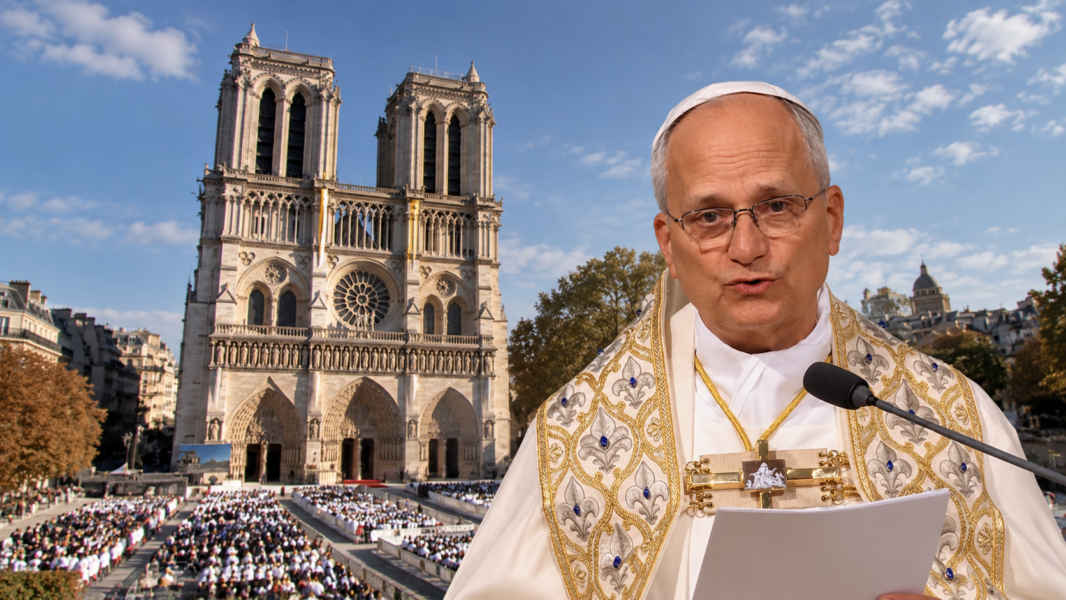
Pope Leo XIV presided over Vespers this Friday at Notre-Dame Cathedral in Paris, where he reaffirmed the centrality of liturgy and the Eucharist in the life of the Church and urged bishops, priests, deacons, and consecrated persons to celebrate always “with dignity and decorum.” “The cathedral is not a stone shell meant to be admired: it lives from the sacred mystery celebrated within it. Deprived of liturgical action, it would lose its soul,” he stated.
The meeting with French bishops, priests, deacons, consecrated persons, and seminarians was the main ecclesial event of the first day of Pope Leo XIV’s apostolic journey to France. The Pope arrived at Notre-Dame after visiting the Élysée Palace in the morning and, in the afternoon, the UNESCO headquarters.
The celebration also carried strong symbolic weight. Seven years have passed since the fire that devastated part of the Parisian cathedral on April 15, 2019; it was reopened for worship in December 2024 after extensive restoration.
Notre-Dame “lives from the sacred mystery celebrated within it”
Pope Leo XIV began by recalling the fire that held the world in suspense and affirmed that the global reaction proved the cathedral represents far more than a historic monument. “In this place beats the heart of a people,” he said.
The Pope thanked those who worked on the reconstruction and highlighted the pastoral project developed after the reopening. Yet he wished to recall the ultimate reason why Notre-Dame—and every other Catholic church—exists.
“We must not forget that the purpose for which this temple, like all others, was built is prayer and the praise of God,” he noted.
The center of that life is the Eucharist, in which the Christian community renews “the redemptive sacrifice of Christ.” Hence, according to Pope Leo XIV, a cathedral deprived of liturgical action would lose “its soul.”
Celebrations “with dignity and decorum”
The Pontiff devoted one of the central passages of the homily directly to French priests and bishops. In an age he described as “lacking fullness, depth, and promises,” he maintained that liturgy can become “a glimmer of hope” and “an oasis of peace” within a “hyper-connected and noisy” society.
“To those of you who celebrate the Eucharist daily, I ask that you ensure liturgical celebrations are always marked by dignity and decorum, even in smaller communities,” he exhorted.
Pope Leo XIV urged them to be “conscious heirs of the Fathers and Saints of the Church” who, over the centuries, handed on “the profound meaning and beauty of the liturgy,” always showing humility before the Mystery celebrated.
The Pope linked this heritage to the Second Vatican Council and, specifically, to the constitution Sacrosanctum Concilium, before calling on bishops, priests, deacons, and consecrated persons to “cultivate an authentic love for the liturgy.”
“The Christian community is not a refuge”
Another key theme of the homily was the Church’s mission in a secularized society. Drawing on St. Paul’s words—“God sent his Son”—Pope Leo XIV argued that the Incarnation prevents us from viewing Christian faith as an escape from the challenges of our time.
“The Christian community is not a refuge in which to withdraw and protect itself from its age,” he stated. Rather, it must offer itself as “a space of welcome, respect, revelation, and meaning for all.”
The Pontiff asked the French clergy and consecrated persons to let themselves be inspired by the reconstruction of Notre-Dame and to give priority to the “missionary conversion” proposed by Pope Francis in Evangelii gaudium.
This mission, he added, must not be limited to Paris or major urban centers. Pope Leo XIV explicitly mentioned peripheral and rural areas and called for a Church that is “living, multiform, and close,” from the north of the country to the Mediterranean and France’s overseas territories.
He also highlighted the role of the laity, whom he described as “the living vanguard of the Church at the crossroads of daily life.”
Communion with the Successor of Peter above “personal sensibilities”
Pope Leo XIV also connected liturgical celebration with ecclesial unity and made a specific request of those present: “Place communion with the Successor of Peter and with the Church above personal sensibilities, in order to foster the unity of the people of God.”
For the Pope, liturgy must reflect a reality in which “authority becomes service” and eucharistic communion generates fraternity and solidarity.
“Together we will be the prophecy that a reconciled world is possible,” he affirmed.
The Pope asks the French clergy to recover silent prayer
In the final part of the homily, Pope Leo XIV addressed especially those called to priestly or religious life and urged them not to neglect their personal relationship with Christ.
Citing a reflection by the French mystic Madeleine Delbrêl, he recalled that personal prayer is “the essential foundation of every vocation” and called on priests, seminarians, and consecrated persons to nurture their interior life “by always drinking from the source of God’s infinite love in silent prayer.”
Mission, he insisted, does not arise primarily from structures or programs, but from “that intimate relationship with the Lord.”
Pope Leo XIV concluded by turning his gaze toward the medieval image of the Virgin and Child that survived the fire at Notre-Dame and entrusted the future of the French Church to Mary: “Holy Mary, Notre-Dame of Paris and Mother of the Church, pray for the French people, sustain their shepherds, and walk always at our side.”
Full Homily of Pope Leo XIV at Notre-Dame de Paris
Dear brothers and sisters:
Evening prayer gathers us in this place which, for centuries more than any other, invites Paris to lift its gaze to heaven. Seven years have passed since the whole world, holding its breath, watched the cathedral consumed by a terrible fire. Even then we raised our eyes, bewildered, aware of human powerlessness before the unforeseen. That pain was not only that of Catholics, nor even of believers. In that dramatic hour we understood that Notre-Dame is much more than a monument. Everyone’s participation in its reconstruction and, today, the splendor of the result, show that in this place beats the heart of a people; that we stand at the vital center of a civilization; that here past and future embrace and heaven and earth meet.
I wished to meet you in this emblematic place of the Church in France. It is a joy for me to have crossed its threshold only moments ago, as thousands of brothers and sisters do each day, arriving here from every corner of the world. Simply entering places us before a beauty that speaks to our restless heart and calls it to peace. By returning this space to all humanity, we have understood how deeply each visitor can be renewed by what is seen, heard, and experienced. The public, ecclesial, and private institutions involved in the restoration of Notre-Dame have thus contributed, each with its specific gift, to reactivating the cultural, existential, and spiritual paths the cathedral offers. In this context, the Church has understood its mission not only in terms of preservation but also of creativity, living tradition with the boldness of those who have faith and look toward Hope. I therefore thank Archbishop Laurent Ulrich, his collaborators, and the diocesan community of Paris, who have likewise conceived a pastoral itinerary of first proclamation and Christian initiation accessible to all. The baptistery, placed at the entrance as a blessing and an invitation, is a sign of this.
The reconstruction of the cathedral has been an occasion for an encounter that has widened spaces of welcome and participation beyond the borders of ecclesial belonging. Dear bishops, priests, deacons, consecrated persons, and seminarians of France: let yourselves be inspired by what has happened here! Give priority to Evangelii gaudium, that is, to the missionary conversion of which Pope Francis gave witness from his very first Apostolic Exhortation.
In the Letter to the Galatians we heard the reason why we must not be afraid: “God sent his Son” (Gal 4:4). He sent him among us, into our world! In the Pauline text the verb describes a real, historical event, not ideal circumstances. Christians do not flee from complexity, because God himself has called them to follow his Son in a world already inhabited, already in motion, already marked by the miseries and goodness of human beings. The way of the cross certainly reveals the darkness that runs through the world, but even more radically the love of God that triumphs over death.
The cruciform plan of the cathedral, where stone and light merge, evokes the meeting of earth and heaven. It gathers and orders the events of history, woven of human joys and sufferings. It holds them together in a symbolic dynamic that builds a living language from diverse expressions, integrating them into a unity.
Dear friends, from the Incarnation—“God sent his Son”—flows the identity of the Church, called always to be “on the way out.” As disciples of Christ, you know well that the Christian community is not a refuge in which to withdraw and protect itself from its age. On the contrary, like the ancient cathedrals, it offers itself as a space of welcome, respect, revelation, and meaning for all. Herein lies the strength of a living Church: to welcome the periphery already present in its heart, to welcome those who are far yet in reality already near, to welcome the stranger in whom Christ already knocks at the door.
If Notre-Dame is a sign of this encounter at the heart of Paris, all the more so may the other cities and regions of France, even the most peripheral and rural, be transfigured by a missionary presence that is simple and benevolent, helping also to harmonize cultural differences and heal the wounds present in our societies. From the coasts of the North to the Mediterranean, from the inland regions to the Overseas Departments, be a living, multiform, and close Church. Poverty of means does not prevent mission, because it is the grace of God that makes possible interior freedom and simplicity of life, so that an evangelical style may shine forth. In all this, confidently value the missionary presence of the lay faithful, who are the living vanguard of the Church at the crossroads of daily life.
Brothers and sisters: we must not forget that the purpose for which this temple, like all others, was built is prayer and the praise of God. It is the place where the Christian community celebrates the highest form of prayer and praise, renewing in the Eucharist the redemptive sacrifice of Christ. The cathedral is not a stone shell meant to be admired: it lives from the sacred mystery celebrated within it. Deprived of liturgical action, it would lose its soul. Here at Notre-Dame this truth is evident in the placement of the altar at the center of the space. Thus the community that praises the Lord stands at the heart of the building, and visitors, even during celebrations, walk around it and contemplate it. The Church thus appears as it is: a living organism, a believing community that gathers in praise all that culture and Tradition hand on to it. It is a body that, in celebrating, manifests to all the reason for its existence.
Today more than ever we live in an age that seems to lack fullness, depth, and promises. The noble simplicity of chant, word, and liturgical gesture can represent for many a glimmer of hope, an oasis of peace in a hyper-connected and noisy society, where it is possible to experience the presence of the Author of the greatest love: “When the fullness of time had come, God sent his Son” (Gal 4:4). The celebration of the liturgical year, of Sunday and the feasts, also makes us contemporaries of Christ, attentive to the different moments of his life, entirely given to the Father for the world. In this way we become more sensitive and open to the signs of the times. Indeed, the communal listening to the Scriptures and prayer allow us to contemplate historical events in the light of God, becoming more aware of our responsibilities, capable of unmasking unjust power relations and preserving the seeds of justice and peace. It is hope, then, that animates us, not resignation. From this are born bonds of greater fraternity and networks of solidarity, the fruit of communion in the one Sacrifice of Christ.
To those of you who celebrate the Eucharist daily, I ask that you ensure liturgical celebrations are always marked by dignity and decorum, even where smaller communities gather. Be conscious heirs of the Fathers and Saints of the Church who, over the centuries, have handed on to us the profound meaning and beauty of the liturgy, always bearing witness to great humility before the Mystery celebrated. The Second Vatican Council, whose richness owes much to France, eminently received and deepened this heritage, recognizing its central place in ecclesial life (cf. Sacrosanctum Concilium, 10). I therefore exhort all of you—bishops, priests, deacons, and consecrated persons—to cultivate an authentic love for the liturgy and to be witnesses and servants of the prophetic, priestly, and royal vocation of the entire people of God.
In this, liturgy remains a reflection of life. Eucharistic joy is affirmed and spreads wherever harmony is recovered, wherever dignity is reborn, wherever authority becomes service, wherever freedom opens a path anew. This is the greatest gift we can share. Therefore, place communion with the Successor of Peter and with the Church above personal sensibilities, in order to foster the unity of the people of God. Together we will be the prophecy that a reconciled world is possible.
Dear bishops, priests, seminarians, and consecrated persons: to you who have been called to follow Christ, I thank you for your response and your fidelity to the Lord. Never neglect that friendship, desired by the Lord, which must be cultivated in personal prayer, the essential foundation of every vocation. As Madeleine Delbrêl said: “Without prayer, we will not love God with love. Perhaps we may be his servants or his fighters, or even his disciples; but we will not be loving children of our Father nor friends […] of Jesus Christ” (The Joy of Believing, Santander 1997, p. 213). Therefore, care for your interior life with the Lord in the light of the school of the many saints who have preceded you, always drinking from the source of God’s infinite love in silent prayer. Your mission springs above all from that intimate relationship with the Lord, who awaits you there.
In the heart of the city, the open cathedral is a sign of a community that praises the Lord and lives hospitality as the very form of its existence, so that all may feel at home, without being dominated or marginalized in a changing world. “God sent his Son, born of a woman, […] so that we might receive adoption as children” (Gal 4:4-5). And “if a child, then also an heir” (Gal 4:7). Heirs by grace, brothers and sisters gathered here, it now belongs to each of you, to this praying and living assembly, to become flesh and voice of this promise. Shepherds and consecrated persons of France, you are called to be the first guardians of this open house, living stones of a Church that hopes and does not fear the future. This cathedral has been reborn so that you may be reborn with it in a new impulse of holiness and daily mission. In the midst of your people, be a transparent expression of the divine motherhood of the Church which, bearing witness to God’s love, rebuilds and heals the human family.
Let us lift our gaze toward the fourteenth-century image of the Virgin and Child, which the fire did not reach and which shines anew before us. May Mary, who bore the Word in her womb, keep her fidelity and be the star that guides the mission of the Church in France. Holy Mary, Notre-Dame of Paris and Mother of the Church, pray for the French people, sustain their shepherds, and walk always at our side.