


The beatification of Fulton Sheen brought together this Thursday, September 24, in St. Louis some 50,000 faithful, 89 bishops, nearly a thousand priests, hundreds of seminarians, religious, and deacons. Cardinal Luis Antonio Tagle, pro-prefect of the Dicastery for Evangelization, presided over the celebration as the Pope’s representative.
It was the end of a particularly long road for the cause of the celebrated American archbishop and, at the same time, the beginning of a new stage: from this Thursday, the Church can publicly venerate him as Blessed Fulton J. Sheen.
The moment of the beatification
The long procession of bishops and priests preceded one of the central moments of the celebration. At the beginning of the Mass, the petition for beatification was formally presented, and Tagle read in Latin the apostolic letter of Leo XIV. Afterward, the bishop of Peoria, Msgr. Louis Tylka, proclaimed the text in English.
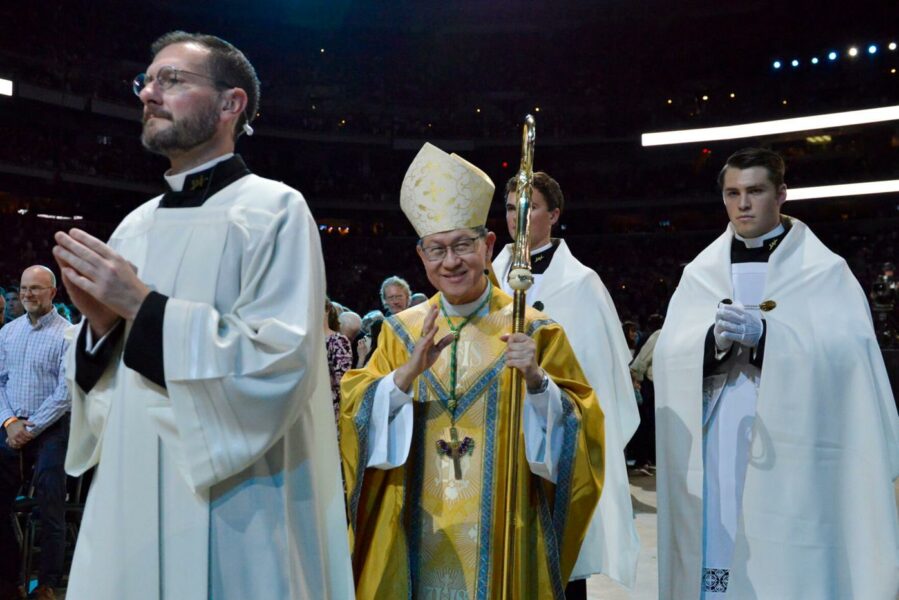
In it, the Pope describes Sheen as an “untiring preacher of the Gospel through modern means of communication” and a “diligent shepherd animated by missionary zeal.”
After the proclamation, the official image of the new blessed was unveiled. Almost simultaneously, another copy of the same portrait was presented to the faithful in the Cathedral of St. Mary of the Immaculate Conception in Peoria, Illinois, where Sheen’s remains rest.
The choice of Peoria as the second venue of the day was no accident. Sheen was born in Illinois in 1895, grew up in that diocese, was ordained a priest there in 1919, and maintained a strong bond with his native land throughout his life. The diocese itself celebrated the beatification as the elevation to the altars of “a great son of Peoria.”
A “doorkeeper” of the house of God
Tagle did not focus his homily on Sheen’s television celebrity, but on the root that sustained his apostolate.
He recalled a conversation between the archbishop and Pius XII. The Pope asked him how many conversions he could attribute to himself. Sheen replied that he had never counted them so as not to fall into the temptation of considering them his own work.
He preferred to define himself another way: he was simply a “doorkeeper” who, on some occasions, had managed to lead someone to the open door of the house of God.
For Tagle, that image summed up an essential characteristic of the missionary: the evangelizer is not the owner of the people to whom he proclaims the Gospel, nor can he appropriate what God accomplishes in them.
“Blessed are you, doorkeeper of the door of the house of God!” the cardinal exclaimed.
The mission, he insisted, was not for Sheen an activity chosen according to his personal preferences. The missionary is first someone called and sent by Christ.
The boy who survived after 61 minutes without a heartbeat
Among the tens of thousands of attendees was a presence especially linked to the ceremony.
James Fulton Engstrom, now 16 years old, carried Sheen’s relics during the Mass. His story made it possible for the cause to reach beatification.
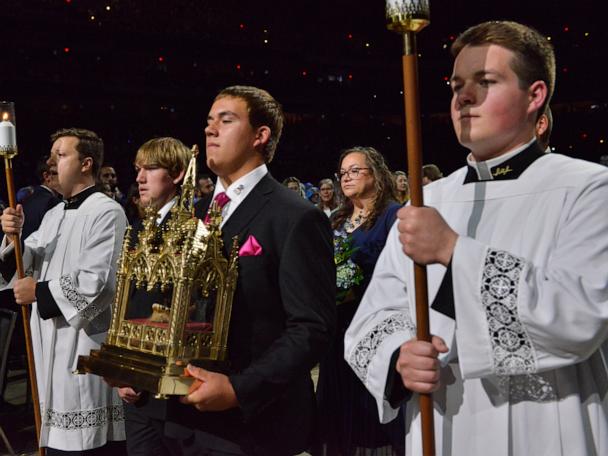
James was born in 2010 without vital signs. For 61 minutes he had no heartbeat, while his family repeatedly invoked the intercession of Fulton Sheen. Finally, he regained his pulse and survived without the serious aftereffects that might have been expected.
The case was submitted to the procedure of the Congregation for the Causes of Saints and received the unanimous approval of doctors, theologians, and cardinals. On July 6, 2019, Francis authorized the decree officially recognizing the miracle attributed to Sheen.
Sixteen years later, the same child whose healing opened the doors to beatification stood before the crowd carrying the relics of the new blessed.
From the Holy Hour to millions of homes
Thursday’s scene had a particular correspondence with Sheen’s life. A man who very early understood the reach of the new means of communication ended up being raised to the altars before a multitude, with the ceremony broadcast beyond the stadium.
Sheen began in 1930 to appear on The Catholic Hour, a radio program that reached about four million listeners. In the 1950s he made the leap to television with Life Is Worth Living, which reached audiences of around 30 million viewers. In 1953 he even received an Emmy Award as a television personality.
But behind the cameras was a spiritual discipline he maintained throughout his priestly life: the daily Holy Hour before the Blessed Sacrament.
His influence on this point was also evident among those who traveled to St. Louis. Father Solomon Patrick Zaku, national director of the Pontifical Mission Societies in Nigeria, explained that he had come to know Sheen’s writings as a seminarian and that his example led him to incorporate the Holy Hour into his own priestly routine.
The Nigerian priest also recalled another legacy of Sheen that remains alive in the missions: the Missionary Rosary, which the new blessed promoted during his years as national director of the Pontifical Mission Societies in the United States.
Leo XIV himself had highlighted this dimension a few months before the beatification. In June he described Sheen as “a light of faith, hope, and love” that shone for decades through radio and television.
And on the eve of the ceremony he referred to him again during the general audience, expressing the hope that the example of this bishop known for his evangelization through the media would inspire others to find new ways of proclaiming the Gospel “with joyful enthusiasm.”
Six possible miracles on the path to canonization
While St. Louis prepared for the Mass, Sheen’s cause was already looking toward the next step.
Msgr. Jason Gray, executive director of the Archbishop Fulton J. Sheen Foundation, reported on Thursday that data are being gathered on six possible miracles attributed to his intercession. Among them is the alleged instantaneous healing of a cancer. The cases will have to be investigated, and if any meet the necessary conditions, they may be formally presented to Rome.
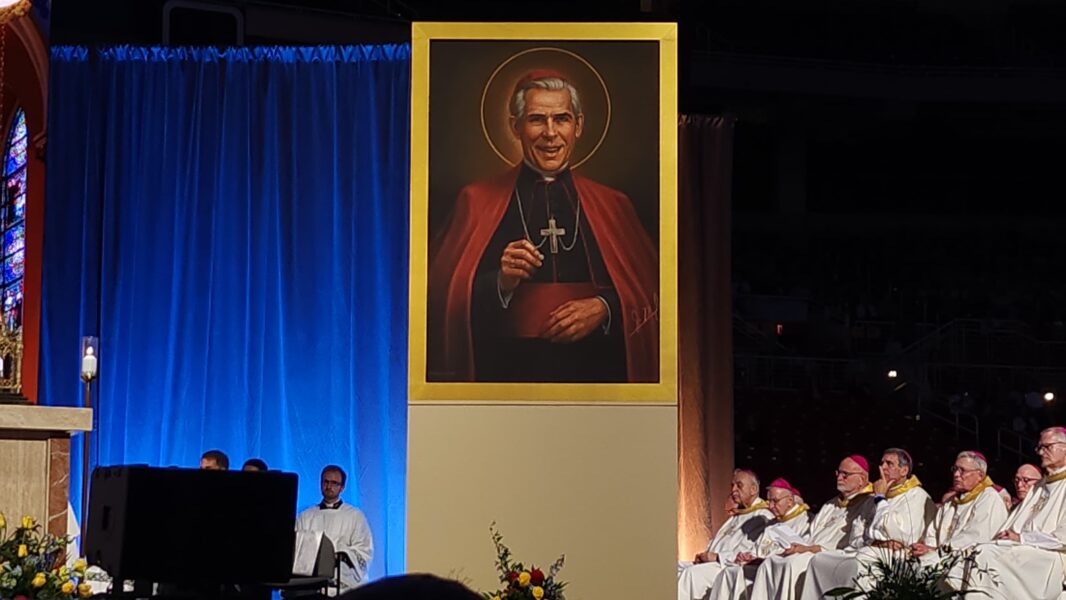
The recognition of a new miracle occurring after the moment established by the cause could open the way to canonization.
Msgr. Tylka, at the end of years of waiting, preferred to look already toward that possibility. “Today we rejoice at the recognition of this great son of Peoria,” he stated in the official communiqué issued after the ceremony, “and we hope with confidence for the day when, God willing, Blessed Fulton Sheen will be declared a saint of the universal Church.”
His memorial will be celebrated on December 9
The liturgical memorial of the new blessed has been set for December 9, the date of his death in New York in 1979.
The celebration has been approved as a optional memorial in the diocese of Peoria. According to the Sheen Foundation, it may be extended to other dioceses with the corresponding authorization of the competent Dicastery.
The date turns the gaze back to the end of his life. Fulton Sheen died on December 9, 1979, at the age of 84. He had spent decades teaching, preaching, and using the mass media to proclaim the Gospel.
This Thursday, almost 47 years after his death, thousands of Catholics gathered once again to listen to him. This time not from a television screen or a radio receiver, but through the liturgical formula with which the Church officially presented him as Blessed Fulton J. Sheen.