


The PSOE and Sumar, the two parties that make up the Spanish Government, top the list of political formations to which the Observatory for Religious and Conscience Freedom (OLRC) attributes attacks on religious freedom during 2025. Of the 306 cases documented during the year —the highest figure since the series began in 2012—, 105 originated, according to the Observatory, from political representatives or parliamentary groups.
The Report on Attacks on Religious Freedom in Spain 2025, presented on September 15, attributes 31 cases to the PSOE, 26 to Sumar, and 18 to Podemos. For the OLRC, the fact that the two parties of the Executive occupy the top positions represents a “grave institutional responsibility.”
The Government, “at the forefront of political responsibility”
The Observatory itself opens this section of its conclusions with an unequivocal statement: “The Spanish Government, at the forefront of political responsibility”.
The 105 cases linked by the report to political representatives or parliamentary groups represent approximately one in three attacks recorded during 2025. PSOE, Sumar, and Podemos account for 75 of them.
“It is equally unacceptable that the parties of the Government head the list of political actors responsible. This is not secularism: it is belligerent laicism and hostility toward religion,” says María García, president of the OLRC.
The organization includes within its category of “belligerent laicism” actions it considers aimed at actively excluding religion from public life. In 2025, it recorded 105 cases of this type, 12% more than in 2024, making it for the second consecutive year the most numerous category.
The Observatory’s pointing comes, moreover, at a time when PSOE and Sumar have agreed to promote a reform of the Penal Code that contemplates the elimination of the offense of offending religious feelings. Both groups present the modification as an expansion of the protection of freedom of expression.
Record of attacks and Catholics as the main target
The political component is framed within a generalized increase in documented attacks. The OLRC recorded 306 cases in 2025, compared to 243 in 2024 and 195 in 2023. This represents an increase of 26% in one year and 57% in two years, and constitutes the highest figure in the historical series that began in 2012.
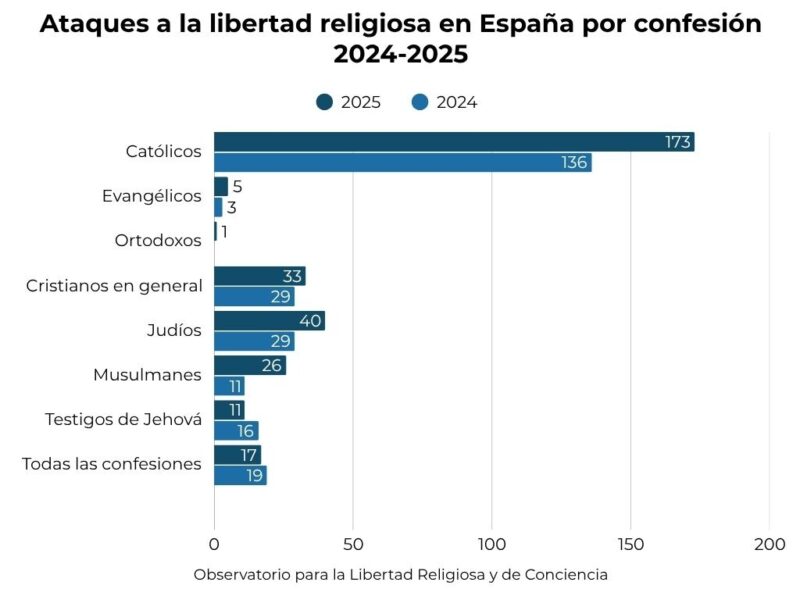
Catholics were the main target, with 173 of the 306 cases, 56.5% of the total. If the 33 directed against Christians in general, five against Evangelicals, and one against Orthodox are added, the number rises to 212 cases against Christians: approximately two out of three.
Among Christians, the two categories with the highest incidence were precisely “belligerent laicism,” with 60 cases, and religious mockery, with 40.
The Jewish community appears in second place, with 40 cases, 13% of the total. The Observatory highlights that attacks against Jews have multiplied thirteenfold since 2022. Muslims suffered 26 cases, Jehovah’s Witnesses 11, and another 17 were classified as directed against all confessions.
Nearly 60% more attacks against temples and symbols
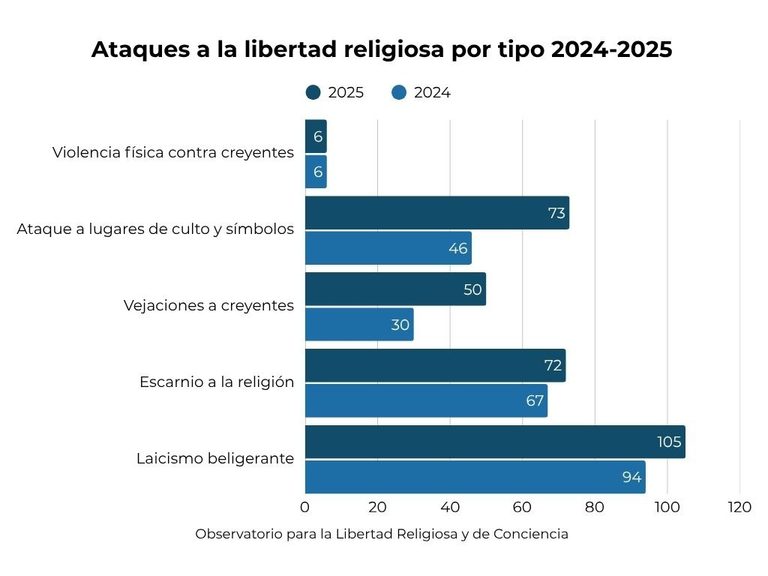
The deterioration recorded by the OLRC is also observed in material attacks. During 2025, it counted 73 attacks against places of worship and religious symbols, compared to 46 the previous year, representing a 59% increase.
Outrages against believers increased by 67%, reaching 50, while cases of religious mockery grew by 7%, reaching 72. The report also documents six episodes of physical violence against believers, the same figure as in 2024.
“That attacks on places of worship have grown almost 60% in a single year is data that should alarm any government that takes coexistence seriously,” warns García. The Observatory notes that in many of these attacks the perpetrators are unknown, a circumstance that makes their judicial prosecution difficult.
RTVE also appears in the report
The report does not limit its analysis to the strictly partisan sphere. In the media section, the OLRC attributes five cases to RTVE and recalls what happened during the New Year’s Eve chimes on January 1, 2025, when public television showed an image parodying the Sacred Heart of Jesus.
The Observatory maintains that during 2025, artistic and expressive freedom was repeatedly invoked to justify the mockery and ridicule of believers, especially Catholics, and mentions cases registered on television, radio, political posters, and carnival performances.
“It is unacceptable that public television, financed with the taxes of all Spaniards, including believers, is one of the actors that most attacks on religious freedom protagonizes,” says García.
The OLRC calls for protecting religious feelings
In light of the data collected, the Observatory demands that the Government and legislators protect symbols and places of worship, maintain in the Penal Code the offense of offending religious feelings, respect the right to pray in public spaces, and eradicate what it calls “belligerent laicism” from institutions and public media.
The OLRC defines itself as an independent civil association founded in 2006. Its annual report compiles aggressions suffered by people due to their religious confession and attacks against symbols and places of worship. The organization also participates as an advisor to the Monitoring Commission of the Action Plan against hate crimes, under the Ministry of the Interior.
“Spain has the obligation, before its citizens and international law, to ensure that religious freedom is not a second-class right,” concludes the president of the Observatory.