


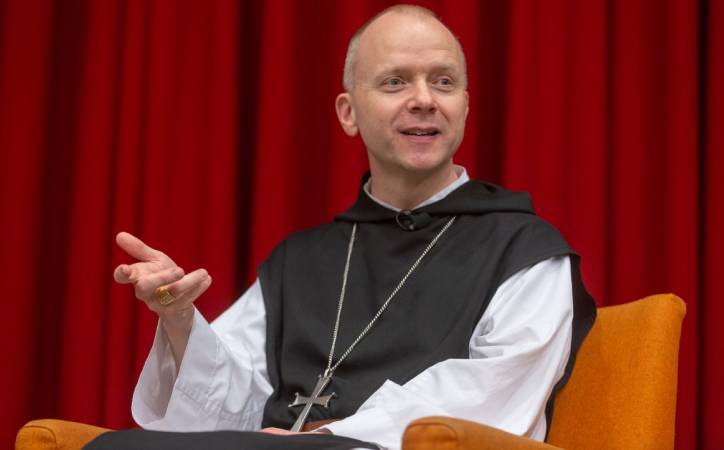
Mons. Erik Varden, Bishop of Trondheim and President of the Nordic Bishops’ Conference, opened the organization’s autumn plenary assembly, held in Paderborn from 21 to 25 September, with a reflection on immigration, national identity and Christian hospitality. The prelate upheld the duty to assist the stranger, yet also recalled that hospitality does not require renouncing one’s own culture and traditions, and that those who settle in another country have obligations towards the society that receives them.
Drawing on the account of the Tower of Babel, Varden also addressed the rise of populism in the West, which he refused to dismiss simply as a harmful phenomenon: behind it, he noted, lies the feeling of many people that they have been “ignored, deprived of their rights and left in the dark.” In the face of both the rejection of the stranger and the dissolution of national identity, he proposed the balance set out in the Catechism: prosperous nations must welcome, within their means, those who seek security and livelihood, while immigrants must “respect with gratitude the material and spiritual heritage of the country that receives them, obey its laws and contribute to its civic burdens.”
Below we offer the full text of Bishop Erik Varden’s address, translated into Spanish:
Welcoming the Stranger
Address delivered at the opening of the Nordic Bishops’ Conference Autumn Plenary Assembly, held in Paderborn from 21 to 25 September 2026.
In Sacred Scripture, measurable time—what we conceive of as “history”—begins with the attempt to build in Babel a tower “whose top may reach unto heaven,” intended to “make us a name” and to prevent men from being scattered “abroad upon the face of the whole earth” (Gn 11, 1-4).
This project did not please God.
Why? Was it not good that humanity should unite in a common enterprise, pursuing a single goal? What God condemned was not unanimity, but presumption. He saw that if man succeeded, by his own skill, in constructing a structure that gave him the illusion of being not merely the steward of the earth but the lord of the cosmos, his arrogance would know no bounds. He would consider himself the measure of all things.
The temptation to become “like God” had already provoked original sin, the rupture that destroyed the harmony which, in the beginning, defined the relations of human beings with one another, with God and with the rest of creation. In Babel this drama threatened to repeat itself. Had the building of the tower been completed, the result would not have been a societas perfecta, but terror: those who possessed sufficient resources and audacity to occupy the upper storeys of the tower would have oppressed the earth. God intervened to save man from himself. He thwarted the project, “confounded the language of all the earth” and then scattered humanity over it (Gn 11, 9).
The story of Babel is ancient, yet it speaks to our time. Pope Leo XIV significantly begins his recent encyclical on artificial intelligence, Magnifica Humanitas, with it. The first sentence of the encyclical reads: “Humanity, created by God in all its greatness, faces today a decisive choice: to build a new tower of Babel or to construct the city in which God and humanity dwell together” (MH 1). The Holy Father contrasts the building of the tower, a project of fierce ambition in which only a few have a place, with the communal rebuilding of Jerusalem after Israel’s exile in Babylon, where Babel once stood. Jerusalem is to be a city in which all may live together in peace and joy. There reality, not illusion, will reign. There God will be worshipped in truth.
To what shall we aspire: to exclusion or to communion, to privileges for a small class of the elect or to a true society in which, in God’s name, all may build a life together?
These questions have acquired political urgency throughout the West, including in our Nordic countries. The last decade has witnessed a steady growth of so-called “populist” and exclusionary trends. It seems important to examine them.
The word “populist” was coined at the end of the nineteenth century to describe various parties and causes. They were united by a common sentiment: that the voice of “ordinary people,” of the numerical majority of the nation, of those who keep the wheels turning and the water running from the taps, was ignored by a distant élite intent on directing financial and governmental processes, completely disconnected from real life.
“Populism” is, at root, the cry of masses who feel ignored, deprived of their rights and left in the dark. Before dismissing “populism” as merely harmful, we must examine whether this cry is in some way justified in our time.
The sense of being at the mercy of forces beyond our control is currently shared by countless people. Uncertainty affects every aspect of existence. We have just emerged from a summer of extreme weather events. What we used to regard as “normal” weather no longer constitutes a reliable reference. In the Arctic, the ice is melting rapidly. An energy crisis looms. Wars continue, with the danger of spreading. Refugees arrive at our doors. Superpowers arrogantly seize territories, threatening to acquire new stretches of land and sea, even in our region. Prophets of artificial intelligence announce the imminent surpassing of humanity by machines. Young people fear being sidelined in an age dominated by technology. The social fabric is tearing. Traditional political parties are imploding. Wealth has become synonymous with power. Meanwhile, the rising cost of living and unemployment turn many ordinary lives into a struggle for survival.
That cries of protest should arise in such a context is natural, even healthy. Nor is it wrong that many should seek stability in their nation, in their people. Nations were assigned a role in the world that emerged after Babel. Chief among them was the nation of Abraham, from which the Saviour of the world was to come. But other nations too have had, and will continue to have, providential tasks.
What unites a nation? A sense of common origin and shared purpose. One presupposes the other. A nation that seeks its cohesion solely in its real or imagined roots, idolising, for example, the chimera of ethnic purity, becomes narrow-minded and arrogant. It tends towards a form of ancestor-worship that is idolatry. A nation guided solely by an ideal from which it seeks to rewrite or cancel lived history tends towards ideology. It will founder when what once seemed a fixed goal proves unrealisable or simply goes out of fashion. We must look simultaneously backwards and forwards. We must build our nations with hospitality, cherishing our heritage while remaining ready to assimilate the artistic, scientific and cultural riches brought by new members. Even Israel, the most exclusive nation in biblical history, had to learn this lesson. It was constituted with the purpose of becoming a universal magnet, so that Jerusalem, the city of God, might freely welcome “all nations” (Is 2, 2).
What should trouble us about contemporary populism is not a widespread desire to develop and express criteria of national belonging, to foster love for one’s own people. This is a necessary task. What should alarm us is the tendency to define in absolute terms those who are “inside” and those who are “outside”; the hardening of a discourse that makes every foreigner appear suspect; the strengthening of chauvinistic trends that seek, and find, violent expression. In his essential book If This Is a Man, published in 1958 as “documentation for a calm study of certain aspects of the human soul,” Primo Levi, a survivor of Auschwitz, wrote:
Many individuals or peoples may think, more or less consciously, that “every stranger is an enemy.” In most cases this conviction lies at the bottom of souls like a latent infection; it manifests itself only in discontinuous and uncoordinated acts, and is not the origin of a system of thought. But when this happens, when the unexpressed dogma becomes the major premise of a syllogism, then, at the end of the chain, stands the Lager. […] The sinister product of what man’s presumption made of man.
I do not think it sensationalist to point out that such “bad news” is again being heard today, even in countries that know all too well where it can lead and that have spent much of the last seventy years repeating to themselves: “Never again!”
As Christians we must protest energetically. It is our duty to extend a hand to those in need, to open our doors to those without a home and to share our material wealth with the poor. If we wish, as many populist parties claim to wish, to protect the Christian heritage of our nations, we must above all maintain a high level of Christian charity. We must counter attempts to use Christian language and symbols for polemical purposes. And we must resist the foolish and cheap rhetoric of so-called “identity politics.” Under the pretext of safeguarding “national purity,” such rhetoric denigrates anyone who falls outside a set of narrow conditions established to determine belonging, conditions defined in terms of self-assertion and self-promotion. This kind of politics thrives on resentment. It often has little to offer in the way of a constructive vision and a realistic strategy.
While upholding Christian rectitude, we must ensure that “identity” does not become a dirty word. It is legitimate to cherish one’s own culture and tradition. Welcoming the stranger does not mean abandoning one’s own home, but inviting the stranger to enter.
From this follows a reciprocal obligation. On this point the Church speaks clearly. The Catechism underlines the duty of prosperous nations to welcome, within their means, “the stranger who seeks the security and the means of livelihood which he cannot find in his country of origin.” It recommends respect for the “natural right” which “places the guest under the protection of those who receive him.” At the same time, it declares that immigrants have solemn duties towards the country that adopts them. Immigrants are “bound to respect with gratitude the material and spiritual heritage of the country that receives them, to obey its laws and to contribute to its civic burdens” (n. 2241).
The Christian challenge before us, both cultural and political, consists in balancing two tasks: fostering national unity and character, threatened in an age saturated with global media and bombarded by the advertising of world commerce; and, at the same time, cordially attending to the needy and the stranger. “Do not forget hospitality,” we read in the Letter to the Hebrews (13, 2), “for by it some have entertained angels unawares.” We need, therefore, houses that are our own and an atmosphere of home.
How can this delicate balance between belonging and openness be found?
We may take as our reference the Rule of St Benedict, written in the sixth century as a social order for a period marked by instability and mass migrations. Regarding the imperative of welcoming guests, St Benedict establishes a radical criterion. He decrees that all guests—who will be chiefly the poor and the homeless—must be received as if they were Christ himself. As soon as they knock at the door, the porter must exclaim “Deo gratias!” and ask for their blessing. The abbot must wash their hands and feet. Every kindness must be shown them. The community must strive to meet their needs. This is the law of Christian hospitality (RB 53, 66).
A guest, however, will remain for a time and then depart, once he has been comforted and strengthened. When it comes to those who wish to enter and stay, those who want to become citizens of the monastic microcosm, St Benedict’s approach is different.
He requires that the motivations of postulants be tested. They must wait for a time and then be told all the “hard and rugged things” that community life entails. The Rule must be read to them repeatedly, so that they may freely decide: “Do I want and can I keep this covenant of common life?” St Benedict’s purpose is not to deter candidates. He wants the community to grow. In principle, anyone is a welcome candidate: no discrimination is made on grounds of blood. But he wants to make clear that belonging to a community is an arduous and demanding task. It requires generosity and determination. It demands the will to cultivate a communion of purposes. In this way St Benedict made it possible for his abbeys to be places characterised by a firm communal identity and, at the same time, welcoming to all who arrived and ready to help anyone in need.
Naturally, the Rule of St Benedict cannot be applied wholesale to a modern nation-state. Nevertheless, its double perspective seems to me potentially capable of guiding policy (RB 58, 2).
All true belonging confers, not primarily privileges, but responsibility. This is a point that many “populist” manifestos fail to formulate. Before applying St Benedict’s demands to others, we should, in honesty, apply them critically to ourselves.
Another aspect deserves mention. When we consider today the welcome of foreigners, we must remember that our countries have for years been failing to reproduce themselves. None has a birth-rate above the replacement level of 2.1. Without immigrants, our services, industries and welfare systems would collapse. This fact should make us humble and grateful towards those who arrive to help sustain our common home. It should also lead us to resolve to do more to strengthen our families, against which many forces are acting today. The Church has a vital role to play as the heir of a culture of life. We must do everything possible to spread it with conviction and joy.
To be at once a loyal member of a local community and creatively engaged with a universal order generates an interior tension. Catholics should be especially prepared to bear this tension well. To be Catholic means, after all, to belong to a concrete community and to form part of a communion that reaches beyond all frontiers, even the seemingly impenetrable one between life and death, between eternity and time.
May we, then, be rooted and free, grateful for what we have received and eager to share it with others, steadfast in our identity and aware that our deepest being will be fully revealed only in eternity, when we find our true name written on a white stone which, for now, is God’s secret (Ap 2, 17).
To seek one’s identity means to be always engaged in a process of attentive becoming.
If we live in this way and teach others to do so, this time currently marked by anxiety may prove to be a period of conversion and grace, a great opportunity for good.
+ fr. Erik Varden, OCSO
President