


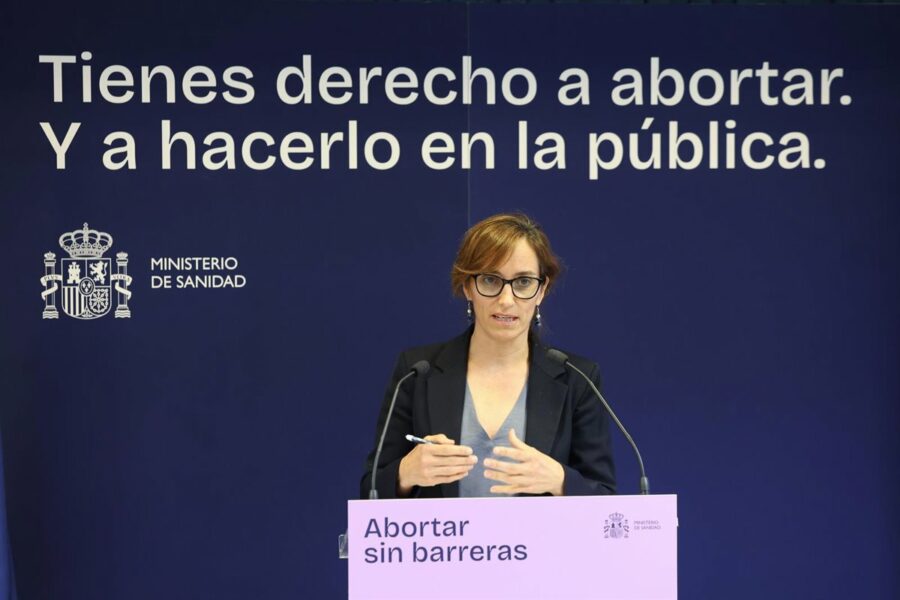
The Ministry of Health has presented an institutional campaign on abortion that condenses in two words an entire conception of “freedom” and the “good”: “it will be fine.” It does not matter whether a woman decides to continue the pregnancy or deliberately end the life of her conceived child; the government announcement offers the same approval in advance for both decisions: “Maybe you decide to have it. Or maybe not. Maybe you decide to have an abortion. And it will be fine.”
It is not the message of an abortion-rights association. It is a campaign of the Government of Spain, presented by the Minister of Health, Mónica García, in a country that recorded 106,172 abortions in 2024, the last year with complete national statistics.
The campaign was also presented at the same event in which García announced that the Ministry of Health has turned to the State Attorney’s Office to demand that the Community of Madrid effectively implement the register of healthcare professionals who are conscientious objectors.
The contrast sums up the day well: to the woman considering an abortion, the State assures her that “it will be fine” and demands that she be able to do so in a public hospital; to the doctor who considers it morally unacceptable to participate in the deliberate death of an innocent person, it requires that he or she declare the objection in advance and in writing and be entered in a register.
“Whatever you decide, everything will be fine”
The video begins at the moment a woman discovers she is pregnant: “You will hear two words that will change everything. You are pregnant.”
From there it lists possibilities. Nerves, excitement, conversations with the partner, friends or family, doubts and certainties. “Maybe they will try to make you feel guilty and make it difficult for you. Or maybe they will support you on the path and accompany you on it.”
Then comes abortion.
“Maybe you decide to have it. Or maybe not. Maybe you decide to have an abortion. And it will be fine.”
And finally the complete thesis: “Think what you think, feel what you feel and decide what you decide, everything will be fine. Because you have the right to have an abortion and to do it in the public system.”
The Ministry of Health thus guarantees an “absolution,” a “cleansing of conscience” with a campaign that aims to combat “the stigma and guilt surrounding abortion.” García maintained during her presentation that “there is not a single way to live and to tell the story of abortion” and that no woman has to “prove suffering” for her decision to be respected.
For objectors, a register
While the Government spreads that message for those who decide to kill their children, García announced at the same event that the Ministry of Health has asked the State Attorney’s Office to study the necessary measures to require Madrid to effectively implement the register of conscientious objectors.
According to the Ministry, on September 1 it verified that the Community “has not advanced beyond beginning the initial procedures for creating the register.”
“The sectarianism of a regional government can never become an obstacle to exercising a right recognized by law,” García stated.
The 2023 reform of abortion legislation establishes that directly involved professionals who wish to exercise their right to conscientious objection must declare it in advance and in writing. The Government maintains that the mechanism is necessary to organize the service within the public system.
Already in 2022, the president of Madrid rejected the creation of what she described as a “blacklist of doctors who do not want to perform abortions”, although she then defended a “legal and safe” abortion.
The pressure on Madrid also has a declared objective: to increase the number of abortions performed directly in public healthcare. Of the 106,172 abortions carried out in Spain during 2024, 83,609 —78.75%— took place in private centers and 22,563 —21.25%— in public centers. In Madrid, more than 99% were performed in private centers.
The paradox is complete.
A woman exercises her autonomy by ending the life of her child and the State tells her: “it will be fine.” A doctor exercises his or her conscience by refusing to participate in that death and the State demands that he or she declare it in writing and be listed in a register.