


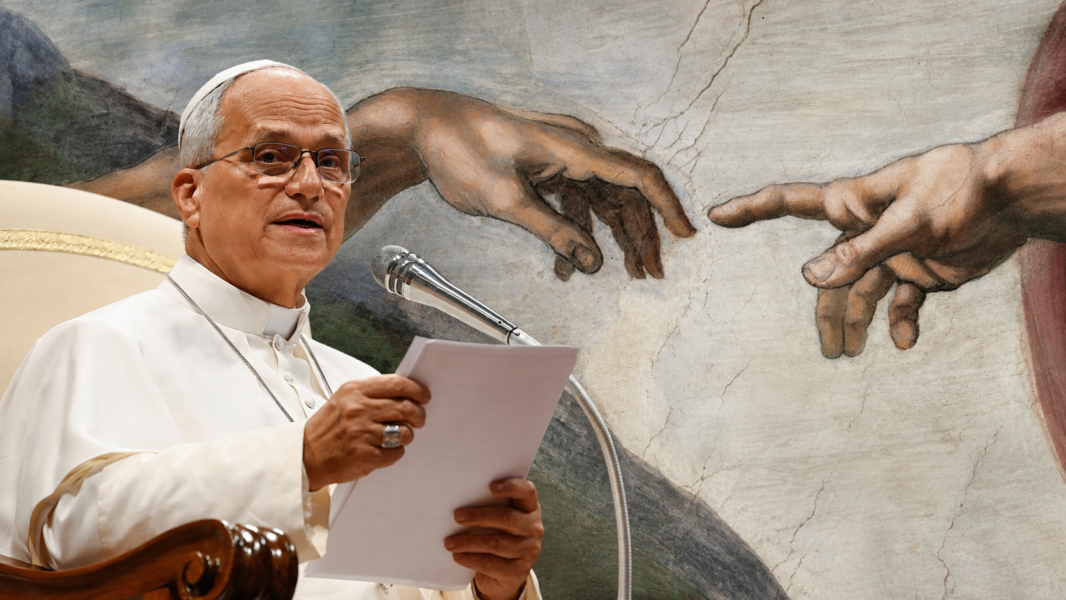
Pope Leo XIV warned this Wednesday against “post-Christian humanisms” that present God and man as rivals and recalled that scientific and technical progress can only be considered authentically human when it is guided by charity and placed at the service of the dignity of the person.
During the general audience held this 23 September in Saint Peter’s Square, the Pontiff continued his cycle of catechesis on the documents of the Second Vatican Council and devoted his reflection to Gaudium et spes and the meaning of human activity in the universe. Pope Leo XIV explained that Christianity does not set human achievements against the power of God and recalled that daily work can become a path of sanctification.
At the end of the catechesis, the Pope recalled the beatification of the Venerable Fulton Sheen, which will take place this Thursday in Saint Louis; he encouraged married couples to collaborate with the Creator “in the transmission of life”; he made an appeal in favour of migrants and refugees, especially minors; and he recalled the liturgical memorial of Saint Pio of Pietrelcina.
Below we reproduce in full the catechesis of Pope Leo XIV:
Brothers and sisters, good morning and welcome!
Continuing our journey through the Pastoral Constitution Gaudium et spes of the Second Vatican Ecumenical Council, we come to the third chapter of the first part, which bears an attractive title: “Human Activity in the Universe.” The fundamental question is this: what is the value of human activity in the world and, therefore, of technical, social and scientific progress? We may recall that, less than four years after the close of the Council, on the night between 20 and 21 July 1969, man would set foot on the Moon for the first time.
Created in the image and likeness of God, the human being is a subject of progress. With freedom and intelligence, he increases his knowledge, thereby advancing the whole of society. We see this easily when we consider the improvements in living conditions across generations. Indeed, the Document states, “many goods which in former times were looked for from heavenly powers, man now procures for himself by his own initiative and his own strength” (n. 33).
For this reason, some thinkers have presented technical-scientific progress as something that weakens the relationship with God, even making it seem superfluous, or even as antagonistic to the Christian faith. This reading has brought about a change in the way contemporary man looks at the world compared with earlier times. Such a prejudice is especially asserted in that part of Western culture that has lost its reference to Christian Revelation. In post-Christian humanisms, man and God are wrongly presented as rivals: in order to affirm his knowledge, his freedom and his progress, man would have to emancipate himself from God. In the end, however, by denying the relationship with God, the possibility of affirming the transcendent value of the human person is also lost. It is the “drama of atheistic humanism,” well described by an important theologian of the Second Vatican Council, Henri de Lubac.
The Council wishes to offer a clear response: “For the believer,” states Gaudium et spes, “one thing is certain: human activity, individual and collective—that is, the vast effort by which men throughout the centuries have sought to improve their living conditions—considered in itself, corresponds to God’s design” (n. 34). Moreover, the Constitution continues, “Christians are convinced that the triumphs of the human race are a sign of God’s greatness and the flowering of his own mysterious design” (ibid.). In short, God has placed in the hands of man and woman a creation still in statu viae, that is, on the way, in growth, so that they may bring it to fulfilment through their wise activity.
Here we find an important reference to the mystery of the Incarnation. Humanity—and with it work, progress and the autonomy of created realities—is not absorbed or annulled by the encounter with God, but is assumed in its entirety, continuing to be, in Christ, free and active: indeed, it is in Him that it finds full truth and freedom. Furthermore, in the celebration of the Eucharist, the fruit of human labour, represented by bread and wine, is placed each day upon the altar to be transformed into the Body and Blood of Christ.
From this perspective arises an important truth: in order to meet God, the human being does not have to abandon earthly occupations, but can fully live his vocation by performing his daily work well and sanctifying it. Christians share, like everyone else, in the building of the city of men, aiming at the end of all things and the encounter with God, and reminding those with whom they share the adventure of progress, science and life of this ultimate end.
Certainly, earthly progress must be carefully distinguished from the growth of the Kingdom of Christ; nevertheless, the Council affirms that “such progress, insofar as it can contribute to the better ordering of human society, is of vital concern to the Kingdom of God. […] All the good fruits of our nature and of our labour, after we have spread them over the earth in the Spirit of the Lord and according to his command, we shall find them again, cleansed of all stain, illuminated and transfigured” (n. 39).
Finally, let us remember that in order to become authentic human progress—that is, of the whole man and of all men—technical and scientific progress must be animated and guided by charity. Only in this way can it always be placed at the service of human dignity and promote the living conditions of all, especially the most disadvantaged.
Dear brothers and sisters, the Second Vatican Council invites us to share the bread of knowledge and know-how, so that every man and every people may develop their potential and together we may build, with the help of God, a better future.
Greetings
I greet the French-speaking pilgrims, in particular the group of pilgrims from France, the Sisters of Saint Paul of Chartres and the “Réseau du Cœur” group from Haiti. The Second Vatican Council invites us to share the bread of knowledge and know-how: may you generously develop your potential so that, together, we may build, with the help of God, a better future. May God bless you!
I greet all the English-speaking pilgrims and visitors taking part in today’s audience, particularly the groups from England, Ireland, Denmark, Norway, Malta, Tanzania, Australia, Hong Kong, India, Malaysia, Singapore, Thailand, Vietnam and the United States of America. Tomorrow, in Saint Louis, Missouri, the Venerable Fulton Sheen will be beatified. May the example and intercession of this holy bishop, known for his evangelising work through the media, inspire many others to find new ways of spreading the message of the Gospel with joyful enthusiasm. Upon all of you and your families I invoke the peace and joy of our Lord Jesus Christ. May God bless you!
I cordially greet the German-speaking pilgrims, in particular the numerous school groups on study trips. May this experience of the Eternal City encourage you to know ever better the treasures of our Christian culture and history, which do not belong only to the past but can also inspire the future. May God bless you.
I cordially greet the Spanish-speaking pilgrims. In the Eucharist we offer the fruits of the earth and of human labour so that they may become the Body and Blood of Christ. Let us also unite our life and our tasks to the Eucharistic sacrifice, so that the Lord may transform them into a living, holy and pleasing offering to Him. May God bless you. Thank you very much.
I address my cordial greeting to Chinese-speaking people. Dear brothers and sisters, I encourage you to love one another, as Jesus loves each one of you. I bless you from my heart.
Dear Portuguese-speaking brothers and sisters, welcome! In carrying out your activities, always defend human dignity, improve the living conditions of your neighbour and place all your hope in God alone. May the Lord bless you and your families!
I greet the Arabic-speaking faithful. Let us make our science and our work a service to man and his dignity, and let us contribute with love to building a better world for all. May the Lord bless you all and protect you always from every evil!
I cordially greet the Polish faithful. In these days, at Jasna Góra, spouses and families are gathering for their annual pilgrimage. They are accompanied by the motto: “Marriage generates life.” May prayer and the sharing of the Word of God strengthen the faith of spouses, so that they may generously collaborate with the Creator in the transmission of life and Christian values in that particular community which is the family. My blessing to all!
Appeal
Next Sunday, 27 September, the World Day of Migrants and Refugees is celebrated. My thoughts go to migrants and refugees, especially to minors forced to leave their homeland. Children and adolescents are the most vulnerable; they often suffer unspeakable hardships: violence, torture, exploitation, traumatic conditions and not infrequently lose their lives along migration routes. I appeal to the responsibility of all: may everyone feel involved in the lives of these young people, who must always be protected and assisted.
I extend my cordial welcome to the Italian-speaking pilgrims, especially the participants in the refresher course in canon law, promoted by the Pontifical University of the Holy Cross; the Financial Guard of Predazzo, Gaeta, Orvieto and Bari; the Military Academy of Modena and the “Prayers of Mothers” group.
I receive with affection you, pilgrims from the diocese of Rimini, together with Bishop Mons. Nicolò Anselmi, who have come here one month after my pastoral visit to your land. I renew my gratitude for the welcome you gave me and I encourage you to grow in faith, rooted in listening to the Word of God, so as to bear witness to all of the love of the heavenly Father.
My thoughts finally go to the young, the sick and the newly married. Today the Church celebrates the liturgical memorial of Saint Pio of Pietrelcina: may his witness of faith and charity be for each of you an invitation to trust always in the goodness and mercy of God.
To all, my blessing.