


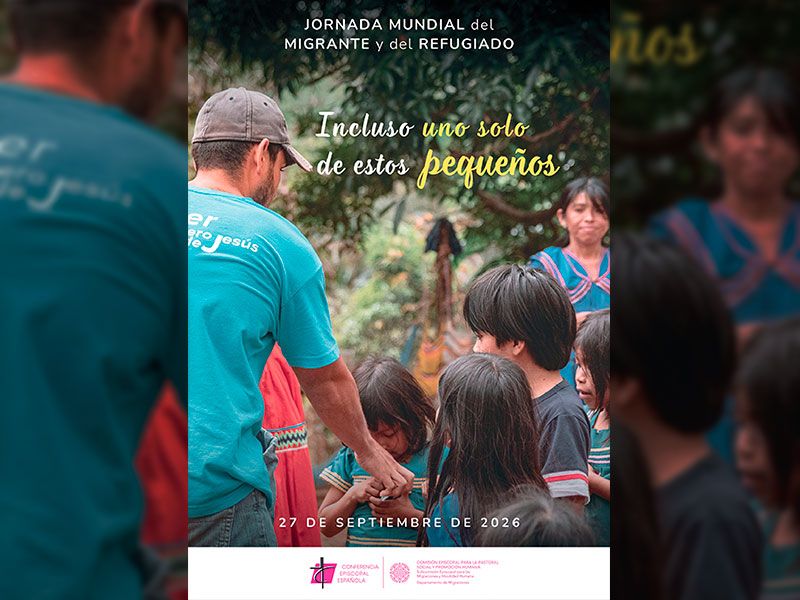
The Church will celebrate next Sunday, September 27, the 112th World Day of Migrants and Refugees, which this year focuses especially on minors under the motto “Even one of these little ones.” The Spanish Episcopal Conference has prepared materials for the celebration in the dioceses with a call to set aside statistics for a moment and recognize the concrete situation of each immigrant child and adolescent.
The Day includes the message of Leo XIV, dated August 11, in which the Pontiff calls for protection for displaced minors and maintains that “every child, every human being, possesses infinite dignity.” The Spanish campaign adds a reflection from the bishops themselves and different experiences of welcome developed by dioceses, congregations, and ecclesial organizations.
“It is not a question of numbers or statistics”
Leo XIV centers his message on the special vulnerability of minors who leave their homes because of war, poverty, violence, or disasters, with particular attention to those who have lost their families, suffer separations, or are exposed during the journey to trafficking, exploitation, sexual violence, or recruitment for armed conflicts. “It is not a question of numbers or statistics,” the Pope states, presenting the welcome of each child as a requirement that reaches both Christians and ecclesial communities as well as civil institutions.
In this latter sphere, he calls for effective legal instruments of protection, family reunification, and measures to prevent the traumas of separation. Leo XIV asks to “shift the focus of the debate from the mere management of migratory flows to the full and immediate protection of human rights” and concludes by entrusting immigrant and refugee minors to the Virgin Mary, Saint Joseph, and the Child Jesus, who knew “the cruelty of Herod’s violence and the drama of exile in Egypt.”
The Spanish bishops: “How many arrive, how many stay”
The message prepared by the Episcopal Subcommittee for Migrations and Human Mobility of the CEE starts from the same principle, although it transfers it more directly to the debate on immigration.
The bishops consider that flows are frequently analyzed on the basis of “figures, percentages, or political speeches” and point out that much of the discussion ends up reduced to questions about “how many arrive, how many stay, how many represent a cost or a benefit.” Against that logic, they call for looking “beyond the statistics” and recognizing “the unique and unrepeatable value of each migrant child or adolescent.”
“A single migrant child, with his or her story, fears, hopes, and wounds, deserves all attention, all protection, and all respect,” the bishops affirm. The document maintains that contemplating the minor as a concrete person changes the way of approaching the phenomenon: “It ceases to be a problem to manage and becomes a person to welcome and to encounter.”
The reflection expressly links this approach with the journey of Leo XIV to the Canary Islands, whose “gestures, speeches, and messages,” according to the bishops, moved their “consciences, commitments, and attitudes.”
The bishops acknowledge overwhelmed reception systems
The CEE document does not ignore the concrete difficulties that accompany immigration. In describing the situation of minors, it notes that some arrive in destinations where they encounter “legal, social, and ideological barriers” that hinder their integration and that others remain in “overwhelmed reception systems, without adequate accompaniment.”
The response proposed by the bishops involves transferring sensitivity toward minors into “concrete actions,” “just policies,” and structures capable of protecting their integral development. At the institutional level, they call for policies that guarantee “protection, defense, and integration, placing the dignity of the person at the center.”
The document itself also raises a question directly related to available resources: “To what extent are we willing to invest resources in their protection and development?” For the bishops, the answer must be measured by the way those in situations of greater vulnerability are treated.
It is when moving from the personal dignity of each minor to the institutional response that the most complex part of the debate appears. Recognizing that a child must be protected does not by itself resolve how to manage massive population movements, what reception capacity a community can assume, or how to reconcile that obligation with effective border control and the demands of the common good.
Welcome, borders, and integration
The issue has special relevance in Spain after the invasion of Ceuta on July 30.
Fernando García Cadiñanos, president of the Episcopal Subcommittee for Migrations and Human Mobility, has defended precisely the need to combine different principles. After the events in Ceuta, the bishop of Mondoñedo-Ferrol spoke of “the right not to migrate, the right to migrate, and the right of States to manage their borders and control flows for real integration.”
García Cadiñanos rejected presenting immigrants as a threat and questioned pitting their needs against those of the Ceutan population, although he also acknowledged the overload of available resources in the city.