


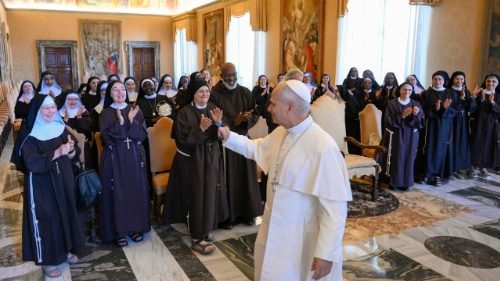
Pope Leo XIV received this Monday, September 21, at the Vatican Apostolic Palace the Assembly of the Federation of the Capuchin Poor Clare Nuns of Italy, to whom he delivered a speech focused on fidelity to the contemplative vocation, the decline in vocations, formation, and the value of enclosure in a society marked by “haste and noise.”
Faced with the numerical reduction of religious communities, the Pontiff urged not to respond out of fear or to rely on merely organizational solutions. “Vocations are not born from the application of organizational strategies, nor from campaigns studied on paper,” he stated, but “from prayer, from familiarity with the Gospel, from silence,” and from communities capable of authentically living communion.
Leo XIV also insisted on the radical nature proper to contemplative life: sobriety, detachment, obedience, and an existence that is “simple, yet also radical and demanding.” In this context, he presented the cloistered religious as silent witnesses of the Gospel and “living and prophetic memory of the Good News.”
Below, we leave in full the discourse of the Holy Father:
In the name of the Father, and of the Son, and of the Holy Spirit.
Peace be with you! And one may also say: peace and all good!
Dear sisters, brothers, good morning and welcome to all:
I am very happy to meet with you and to share this moment of reflection. We will take as our starting point today’s liturgy, the feast of Saint Matthew, apostle and evangelist.
In the Letter to the Ephesians, Saint Paul exhorts: “Lead a life worthy of the vocation to which you have been called, with all humility, gentleness, and magnanimity […] there is one hope to which you have been called, the hope of your vocation” (Eph 4:1-2,4).
It is an invitation to fidelity, to which your Federation responds according to the charism of Saint Clare and Saint Francis, through contemplative prayer, poverty, and total adherence to the Gospel. To this end, the work of reworking and updating the Constitutions that you have carried out is commendable, in which the contributions of many have been synthesized.
In them it is reaffirmed that “the first and principal duty of all religious is the contemplation of divine realities and constant union with God in prayer” (Constitutions, 60; cf. CIC, can. 663). As Saint Clare wrote to Saint Agnes of Bohemia: “Place your mind in the mirror of eternity, place your soul in the splendor of glory, place your heart in the figure of the divine substance and transform yourself entirely, through contemplation, into the image of His divinity” (Third Letter to Blessed Agnes of Bohemia, 12-13; FF 2888).
And it is precisely with the “mind in the mirror of eternity” that I invite you to look both at the present time, with its dramas and uncertainties, and at the challenges of your “small world,” rich in its past and called to look with hope toward the future.
The reduced number of vocations, in particular, could lead some to opt for withdrawal or enclosure. But I wish to repeat to you what I already said about the future of the dioceses and seminaries in Italy. Let us try to change perspective in considering this reality. Its difficulties, in fact, can help us to discover or rediscover unexpected potentialities, “not so much with regard to numerical strength, but to the quality of the proposal” (Address to the pilgrims of the Tuscan dioceses, October 11, 2025).
The Gospel of today reminds us of this, saying: “Those who are well have no need of a physician, but those who are sick” (Mt 9:12).
The numerical reduction of communities—and the fear that derives from it of losing one’s own autonomy—should not disturb or cause loss of hope, but rather should impel a renewal of one’s own life and an even greater commitment to the spiritual accompaniment of those who knock at the doors of the monasteries, in order to foster joyful and living communities, in which intimacy with God, kindness, communion, and authenticity in relationships are experienced.
Vocations are not born from the application of organizational strategies, nor from campaigns studied on paper, but from prayer, from familiarity with the Gospel, from silence, from knowing how to welcome one another with one’s own imperfections (cf. Gal 6:2), from feeling part of a whole that creates unity. And to do this, the Lord does not ask us to be impeccable, but to allow ourselves to be shaped by His grace, humbly, day after day.
This offers us the occasion to speak of another important theme: that of formation, both initial and ongoing. Be formed and form others for an enclosure lived with a spirit of profound communion among yourselves and with the Church; for a silence that, in a society dominated by haste and noise, makes one feel the need for times and spaces in which to pause, to discern, without fear of losing the “fleeting moment.”
Moreover, this is also the specific missionary dimension of the cloistered vocation. Psalm 18, likewise taken from today’s liturgy, says: “Without language, without words, without their voice being heard, their proclamation goes out through all the earth and their message to the ends of the world” (vv. 4-5).
Formed in the school of the Gospel, the Lord calls you to be His witnesses in silence and in contemplation, placing you in history as living and prophetic memory of the Good News.
As sisters of Saint Clare, moreover, you have a special message to announce, which passes above all through the observance of the Rule and of your Constitutions. It is part of your being and your mission to live the Gospel by leaving behind all that belongs to the world, totally and constantly oriented toward the first and only Love of your life.
This implies sobriety, detachment from things, self-giving in obedience, transparency, in a life that is simple, yet also radical and demanding, a precious sign of fidelity, especially in a globalized and restless world, in which the taste and capacity to “put down roots” seem to have been lost (cf. Francis, Ap. Const. Vultum Dei quærere, 35).
Therefore, dearest sisters, I would like to conclude by taking up a question from your federal assistant: “Can the cloistered women’s monasteries offer answers to the questions about the meaning of humanity today?”
To respond, he indicated four means that I consider important: mutual listening; koinonia, as communion of intentions, to avoid isolation; diakonia, to serve and work together; martyria, to bear witness to the Gospel. I leave them to you as sure paths for your journey.
Dear sisters, I thank you for what you do and for what you are: “torches, sentinels for the Church and for the world” (Francis, Message to contemplatives, November 21, 2018), signs of the presence of the Kingdom of God on earth.
I am glad to have met you and, invoking the intercession of Mary, of Saints Francis and Clare of Assisi, and of Blessed Maria Lorenza Longo, I cordially impart to you the Apostolic Blessing.