


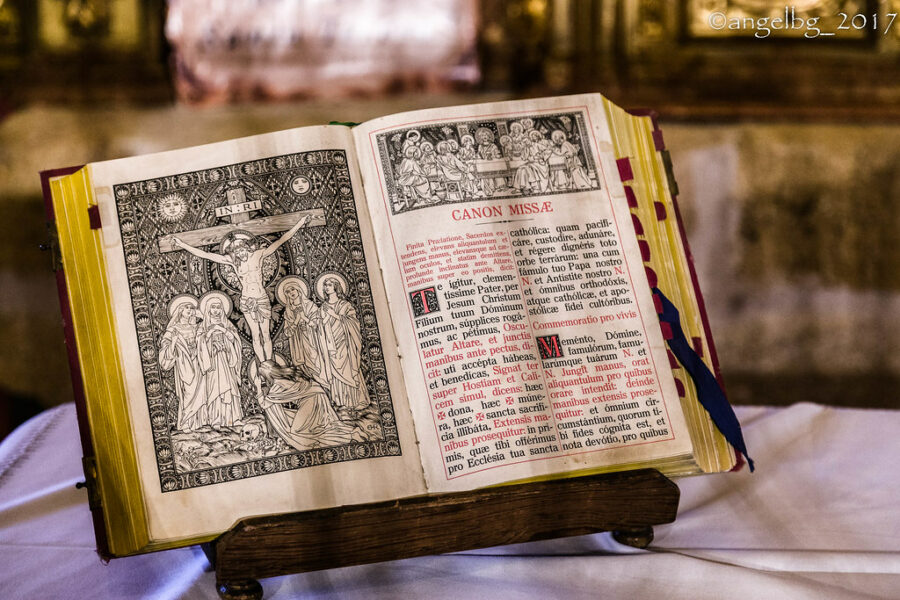
The official booklet of the apostolic journey of Leo XIV to France (September 25–28), published by the Office of Liturgical Celebrations of the Supreme Pontiff, confirms a trend that InfoVaticana has been reporting for months: the Roman Canon has disappeared from papal celebrations. The three Masses the Pope will preside over on French soil —at the Place de la Concorde in Paris, on the esplanade of the Lourdes Shrine, and at the Cathedral of Saint Stephen in Metz— use Eucharistic Prayer III, entirely in French.
The fact takes on special significance in Lourdes. This is the central celebration of the journey, an Ordinary Sunday before a multitude of pilgrims, with the Creed and Gloria sung in Gregorian chant and the Sanctus, Agnus Dei, and Our Father in Latin. In such a carefully prepared setting, Eucharistic Prayer I —the most ancient and venerable of the Roman rite, the only one of the Latin Church for fourteen centuries— would have been the natural choice. The organizers have once again preferred the anaphora composed in 1968, with the seventh Sunday preface on salvation through Christ’s obedience.
Three Masses, one single prayer
A review of the booklet leaves no doubt:
- Paris, Saturday 26. Votive Mass of the Virgin, Source of Salvation. Eucharistic Prayer III with the proper Marian preface. Sanctus and Agnus Dei in French; Gloria De Angelis and Our Father in Latin.
- Lourdes, Sunday 27. Twenty-sixth Sunday in Ordinary Time. Eucharistic Prayer III with the seventh Sunday preface. Ordinary in Latin, Creed III, and sprinkling with water from the grotto of Massabielle in place of the penitential act.
- Metz, Monday 28. Mass for peace and justice. Eucharistic Prayer III with the proper preface. Kyrie and Agnus Dei from the Cunctipotens Genitor Deus, Our Father in Latin.
The rest of the liturgical program is sober and rubrically impeccable. Vespers on Friday at Notre-Dame, before bishops, priests, consecrated persons, and seminarians, open with the Deus in adiutorium and the hymn Ave maris stella in Latin. In Paris and Metz the penitential act recovers the full formula of the Confiteor, with the double mention of the Virgin, the angels, and the saints, followed by the Kyrie. The consecration of the chalice retains the French translation pour la multitude, faithful to the pro multis of the original Latin.
A choice that is consolidating
Nothing in the Missal requires preferring one prayer over another. The General Instruction of the Roman Missal (n. 365) states that Eucharistic Prayer I may always be used and is particularly appropriate on Sundays and feasts with a proper Communicantes; Prayer III is likewise recommended for Sundays and feasts. Both are legitimate. The question is one of sensibility and of sign. The first months of the pontificate raised hopes of a recovery of the Roman Canon in papal liturgy, an emblem of continuity with the millennial tradition of the Church of Rome. Trip after trip that hope fades: Eucharistic Prayer III has become the default option of the Office of Liturgical Celebrations, even on the most solemn occasions.
The greater weight of Latin in the Ordinary of the Mass, visible in Lourdes and Metz, represents an advance compared to the previous pontificate that deserves recognition. It remains to be seen whether the reopening to the Gregorian treasury will one day reach the very heart of the celebration, the prayer with which Rome consecrated for centuries.
The complete booklet may be consulted on the Holy See’s website.