


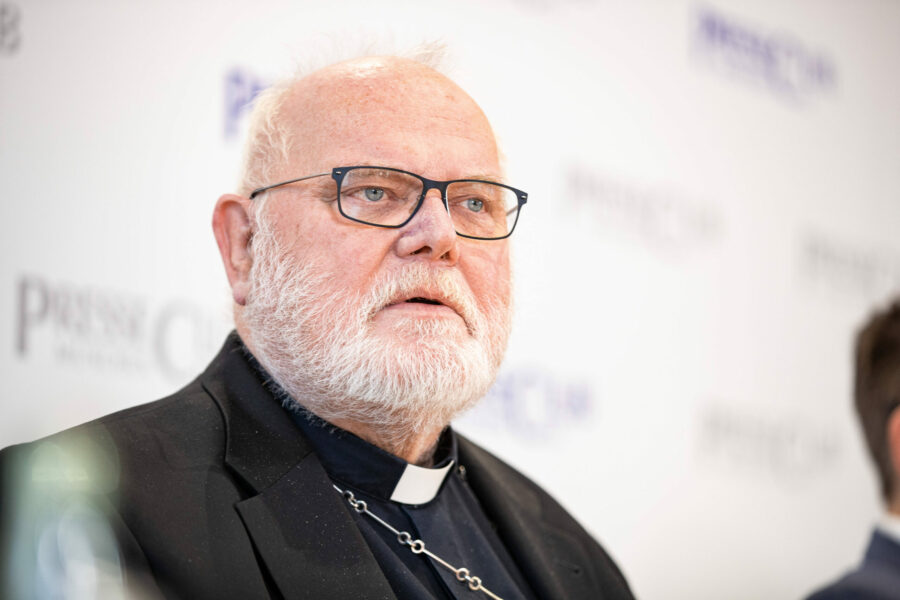
Cardinal Reinhard Marx, Archbishop of Munich and Freising, has once again defended the German Synodal Way and maintained that each particular Church must find its own path in communion with the others. At the same time, he rejected the idea that the future German Synodal Conference could be established as a supervisory body over the dioceses.
The statements appear in an interview published by Katholisch.de on the occasion of the 30th anniversary of his episcopal consecration. Marx was one of the promoters of the Synodal Way when he presided over the German Bishops’ Conference and considers, seven years after its launch, that the decision was the right one.
“Each particular Church must find its own path”
Addressing the relationship between particular Churches and Rome, Marx stated that “the Church is not structured like a pyramid with the Roman Curia at the top,” but is instead made up of particular Churches that together form the universal Church.
“The Pope is the guarantor that everything remains united, the foundation of unity,” he explained. From this perspective, he added that “each particular Church must find its own path, naturally in connection with the others.”
Marx once again linked the origin of the Synodal Way to the publication in 2018 of the MHG study on sexual abuse in Germany. The cardinal was then president of the Bishops’ Conference and participated, together with the Central Committee of German Catholics (ZdK), in launching the process.
Asked whether he still believes it was right to embark on that path, he replied: “Without any doubt.”
The statements come just days after the congress “The Synodal Bishop,” held in Munich to mark Marx’s episcopal anniversary. The gathering addressed issues such as episcopal authority, structures of participation, and “democratic culture” in the Church. The cardinal himself delivered a lecture entitled “Synodality as a Program for the Future.”
Neither a “list of demands to Rome” nor control over the dioceses
Marx believes the German process should not be reduced to forwarding demands to the Holy See.
“From my point of view, the Synodal Way cannot end by sending a list of demands to Rome,” he stated. “I want us here in Germany, as a Church, to also say: what do we want to be here? What do we want to promise to people? What is our mission?”
The cardinal placed the center of synodality in the particular Churches. “For me, the central place of the synodal Church is the diocese, the local Church, and not a national level,” he noted.
This distinction also applies to the future German Synodal Conference, whose configuration has been the subject of talks between the German episcopate and the Holy See. Marx considers a common national space necessary, but rules out the possibility that it could exercise a control function over the bishops.
“We do not need a Synodal Conference as a kind of higher supervision over all the dioceses,” he said. In his view, the structure should function as a “common space of resonance” to gather what is happening in the local Churches and to represent the Church in Germany.
The question of the competencies of the new German structures has been one of the issues addressed in recent years between Rome and the German episcopate. The Holy See stated in 2022 that the Synodal Way lacked the authority to oblige bishops and the faithful to adopt new forms of governance or new doctrinal and moral approaches, while subsequent conversations have focused, among other matters, on the configuration of the future synodal bodies.
Read also: The German Synodal Way and the latest news about the Church in Germany
“He is Leo, not Francis or Reinhard Marx”
Marx also referred to Leo XIV and the way he understands the exercise of the Petrine ministry. Asked about possible areas in which he would expect a more decisive stance from the Pontiff, he replied: “I think he is doing it completely right! He is Leo, not Francis or Reinhard Marx.”
The Archbishop of Munich described the Pope as “a person who listens a lot” and linked his assessment of the pontificate to his understanding of synodality.
“The Pope is not the autocratic ruler of the Church, but precisely the foundation of unity,” he stated. According to Marx, in a synodal Church it is the Pontiff’s role to ensure that many “can walk together on the path of the Church.”
The cardinal believes this issue constitutes “a great concern” for Leo XIV and noted that carrying it forward “certainly requires patience.” Finally, he highlighted the Pope’s “noble and great serenity.”