


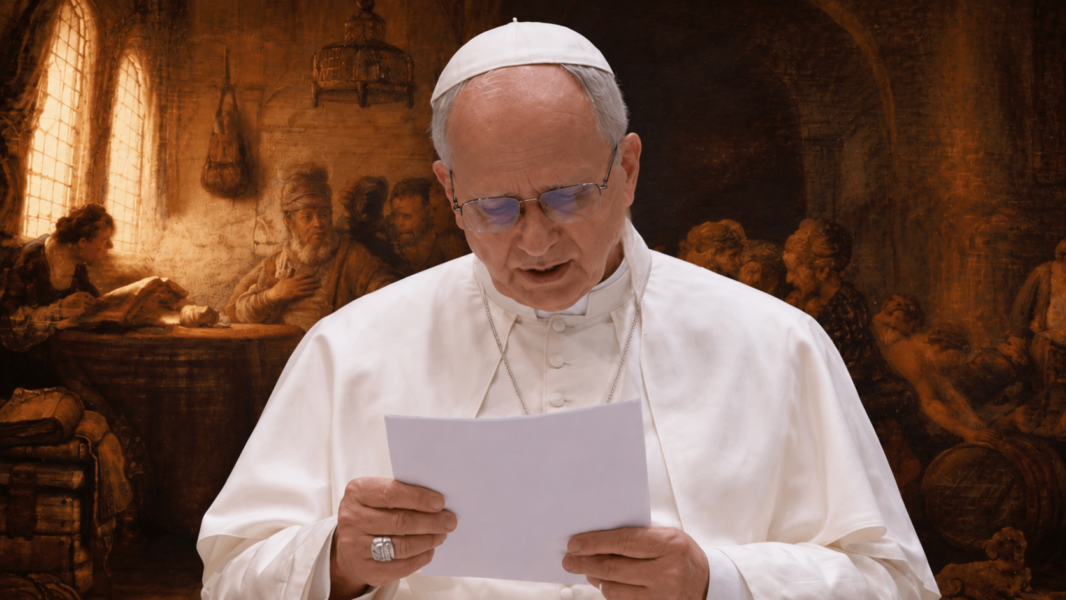
Pope Leo XIV recalled this Sunday that the logic of God’s mercy surpasses human calculations and called on Christians to abandon envy, rivalries, and the presumption of viewing grace as a deserved reward.
During the recitation of the Angelus from the window of the Apostolic Palace, the Pope reflected on the parable of the workers in the vineyard (Mt 20:1-16), in which those hired at the end of the day receive the same pay as those who worked from the first hour. Pope Leo XIV emphasized the landowner’s decision to make his generosity visible even to those who considered themselves entitled to different treatment.
“On the contrary, we all gain joy, intelligence, and future when the law of love interrupts the law of calculation, the experience of mercy extends that of merit, and the gift of peace halts rivalries and draws us close in gratitude,” he stated.
The Pontiff recalled that “it is a grace to be collaborators with God” and to work for His Kingdom of justice and peace: “There is no room for envy and division where the newness of God breaks in.”
After the Angelus, Pope Leo XIV also expressed his “great concern” for the humanitarian crisis in some areas of Somalia, worsened by episodes of violence and extreme weather events, and called for a generous intervention by the international community to ensure the necessary assistance to the population, especially women and children.
Below are the full words of Pope Leo XIV:
Dear brothers and sisters, happy Sunday!
In today’s liturgy, the Lord, through the mouth of the prophet Isaiah, gives us a great reason for hope, telling us that His thoughts are not our thoughts and His ways are not our ways (cf. Is 55:8). Yes, God’s designs are infinitely greater and, we might say, more “human” than those we, men and women marked by sin, can conceive and carry out. That is why the prophet’s call is more timely than ever: to abandon our crooked ways and return to the Lord, who is mercy and forgiveness (cf. vv. 6-7).
In the Gospel, Jesus’ parables describe the newness of what God has in store for us, but they also generally reveal the resistance we are inclined to raise against a more generous justice and a greater love. Today, in particular, we hear the story of the workers called to work in the vineyard (cf. Mt 20:1-16): some worked all day, others only a few hours, and others from evening onward. But the central point of the parable lies in the moment of payment, when the landowner, keeping his word, pays the first-hour workers according to the agreement, yet wants them to see his generosity and, before their eyes, treats the last ones in the same way.
Indeed, there is a detail we must not let pass unnoticed. The landowner gives the steward a precise order to follow: the workers must be paid “beginning with the last and ending with the first” (Mt 20:8). The negative reaction of those who had worked all day could easily have been avoided; however, it is intentional, because the revelation of God’s goodness is for everyone, not just a few. God has different ways and new thoughts even for those who consider themselves first and believe they have earned what they are, that they have deserved the results they have achieved. On the contrary, we all gain joy, intelligence, and future when the law of love interrupts the law of calculation, the experience of mercy extends that of merit, and the gift of peace halts rivalries and draws us close in gratitude.
Brothers and sisters, it is a grace to be collaborators with God, to work in His vineyard, to serve His Kingdom of justice and peace. There is no room for envy and division where the newness of God breaks in. Let us therefore seek the Lord while He may be found; let us call upon Him while He is near; let us abandon crooked ways and wicked thoughts (cf. Is 55:6-7).
Let us look to our Most Holy Mother: she is a creature like us, yet free from every stain; therefore she helps us to hope in God and to trust in His mercy, so that His ways may become our ways and His thoughts our thoughts.
After the Angelus
Dear brothers and sisters:
With great concern I continue to follow the news of the humanitarian crisis unfolding in some areas of Somalia, where episodes of violence and extreme weather events are worsening the already precarious living conditions of the population, especially women and children. I hope for a generous intervention by the international community so that the necessary assistance does not fail these brothers and sisters of ours.
And now, I extend my greeting to all of you, Romans and pilgrims.
I welcome the bishop and the faithful of the diocese of Toruń in Poland, who are visiting the sites of Eucharistic miracles in Italy; as well as the families from the diocese of Spiš in Slovakia.
I greet the Jesuit fathers who are beginning their new cycle of studies in Rome; and the group from the Roman parish of the Holy Family of Nazareth, together with Polisportiva Centocelle and the Oratory “San José Manyanet.”
I send my blessing to the people of Pescantina, near Verona, who today gather around the Monument to the Former Internees to remember those who were deported and imprisoned during the Second World War. I do so to emphasize that we must not forget, but learn from history so as not to fall back into the errors of the past.
Dear brothers and sisters, thank you for coming. Happy Sunday to all!