


I read the Note from the three dicasteries on the sixtieth anniversary of Nostra aetate the very day it was released, which is what a parishioner who wants to obey does: read what is commanded before it is explained. The Pope approved it in audience on June 22 and ordered its publication, so it is not an office paper. And in its number 49 it says something that seemed written for us: that the concrete initiatives of the local Churches, “which are on the front line,” must be valued, because they are the ones that develop “the most creative and courageous forms of encounter: dialogue commissions, joint projects, educational or humanitarian actions, shared celebrations.” And it adds that, by compiling those experiences and networking them, the universal Church will be able to “identify and guide new pastoral paths.” My parish is a local Church. It is on the front line, if by front line we mean the twelve o’clock Mass with forty people, two guitars, and heating that is turned on in Advent. We lacked a shared celebration to contribute to the network, and I have drafted a proposal for the pastoral council that I present here in case it is useful to someone.
The first question was with whom. The Note lists in its number 37 the followers of Hinduism, Buddhism, Jainism, Sikhism, Shintoism, Taoism, Confucianism, and Zoroastrianism, as well as traditional religions, particularly African ones, and in 42 it opens the door to new religious movements. I made the list with the catechist and it did not work out. In the village there are no registered Zoroastrians. The only Sikh has a shop with hours that do not match Sunday. Of traditional African religions there is a family that turned out to be Catholic and from Equatorial Guinea, and they were a little offended. We almost had a racial conflict, haha. But twenty minutes by car there is a chapel of the Priestly Fraternity of Saint Pius X, and there I saw it clearly. Paul VI described dialogue in Ecclesiam suam as concentric circles, and the Note celebrates that that geometry has proved programmatic. Well: the Fraternity is not in the outer circle nor in the middle one. It is inside the smallest, close to the center. They believe the entire Creed, the seven sacraments, transubstantiation, the Immaculate Conception, purgatory, hell, and the primacy of the Pope, which according to them they do not reject and so they wrote in July. They believe, in fact, more articles than some members of our pastoral council, which is where I have to defend this. Our difference with them consists in whether the Canon is said aloud and in what language. If dialogue has come to make room for a payment to the earth in Cusco, with an official of the Dicastery for the Doctrine of the Faith depositing coca leaves in a meeting that Vatican News presented as preparation for the Pope’s trip to Peru, I do not see why a Roman Canon in Latin, which at least is in the Missal, should not fit.
I already know what they are going to tell me, because the sacristan told me before I finished explaining it: that the Fraternity has been in schism since July 2. I know. I read Vida Nueva regularly. The decree was signed by Cardinal Fernández, countersigned by his two secretaries, declared the six bishops of Écône excommunicated, and in the explanatory note stated that the ministers of the Fraternity “are in schism and must be considered schismatics.” Precisely for that reason I extend my hand to them! Because I am ecumenical. Don Davide Pagliarani, the superior general, is not among the six excommunicated by name, but he falls into the category; he is a full non-Catholic. A periphery. I also know that the Pope had written to them on the eve begging them not to do it, and that they did it. Precisely for that reason I have chosen them. The Note asks, with the Council, “that, forgetting the past, they sincerely practice mutual understanding.” July 2 is past. July 1, even more so. And the Note says in its number 55 that he who before was perceived as “an enemy to be feared, respected from a distance or even destroyed, can become an interlocutor, an ally, a friend, even a ‘pilgrim of the truth’ with whom to share a stretch of the way.” The stretch I propose goes from the offertory to communion, which is not long. There is also a detail that gives me confidence. The Note was approved by the Pope nine days before Écône and was published eleven weeks after the decree: everything is from the same summer, from the same dicastery and from the same signature. If the cardinal has been able to move from schism to bridges in eleven weeks, my pastor can move from the ambo to the pew in eleven minutes. And observe. And be enriched.
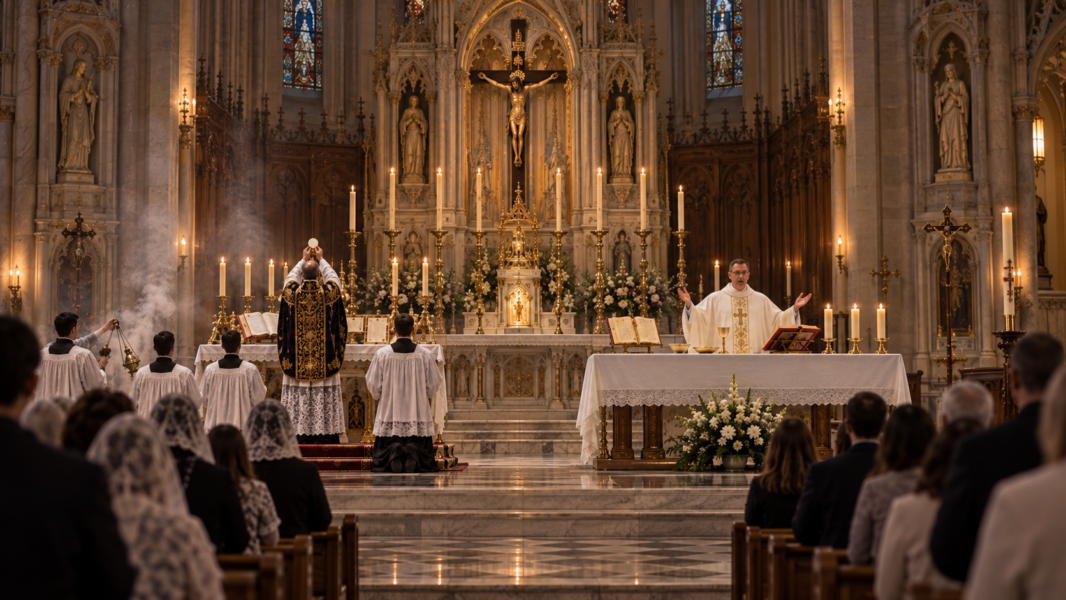
The plan is as follows. Until the offertory, everything is done by my pastor as usual. Entrance song with the guitars, because the Note asks for “imagination and creativity” and that is the instrument we have. It is what there is. The readings are done by the Tuesday lectors, in Spanish and with a microphone, which can be heard well from the back. Psalm sung by the choir. Gospel and homily, short, because the people from the Fraternity come from far away and the Note recognizes that dialogue requires “unending patience,” but it does not say how much. The Creed we all say: we in Spanish and they in Latin, at the same time, because it is the same Creed word for word and there is no possible discrepancy there. Then the offertory, with Dylan’s “you know the coming” over the bread and wine, the collection and the choir’s song. And at that moment my pastor steps aside, sits down, and out comes Don Davide.
Don Davide does the Canon his way. Roman Canon, in Latin, in a low voice, with his back to us and facing the high altar, which we keep because it was never torn down and on which we place the flowers and the Christmas star. Bells at the elevation. We will hear nothing, and that is exactly what the Note calls “invisible but fruitful” fruits, lived “in silence and discretion.”
Afterward the shared part returns. The Our Father has a problem: in their rite the priest says it alone and in ours we all say it. I have solved it: he says it in Latin and we in Spanish, and if the choir does not speed up we arrive together at “deliver us from evil.”
The sign of peace also has its thing, because they do not exchange it among the pews. We will shake hands and they will look at us, which is what the Note calls “a contemplative gaze directed at ‘the different other’,” number 50.
For communion there will be two lines, as in the airport: one kneeling and on the tongue, with a kneeler borrowed from the Carmelites, and another standing and in the hand, without anyone having to say which is the fast line. And here is the beautiful thing about the matter, what convinces me that this is not syncretism, which the Note excludes: it is a single consecration. What Don Davide consecrates with his formula is what my pastor distributes with his, and the Lord is the same in both lines. Which is, if I think about it, what we have been trying to explain to the Buddhists for sixty years without success, and here it would come out on the first try. At the end, “Ite, missa est” by Don Davide and “You may go in peace” by the pastor, and while one reads the Last Gospel, which they say and we do not, the other gives the notices: the rake, the catechesis excursion, that an umbrella has been lost and that you can bring croquettes to the ascending life meeting on Thursday.
The date is the most delicate thing, and I tell it because it explains better than anything why dialogue is needed. I wanted Christ the King, which is a feast of identity for both. But it turns out that they celebrate it on the last Sunday of October, which this year is the 25th, and we on the last Sunday of the liturgical year, which is November 22. We do not even coincide on when Christ reigns, gee. I propose this: we do it twice, once on each Christ the King, and the Note is satisfied doubly, for it itself says that dialogue is a polyhedron. If the council does not want two, there remains October 28, the anniversary of Nostra aetate, which falls on a Wednesday and is catechesis day. They also have catechism on Wednesdays, with that of Saint Pius X, which is shorter and comes with questions.
I move on to the objections, which I have noted all. First: Traditionis custodes does not allow the old Mass in parish churches. True, but this is not the old Mass. It is a shared celebration, which is another category, in the same way that a payment to the earth is not a Mass and therefore could be done. Second: canon 908 prohibits Catholic priests from concelebrating the Eucharist with ministers of communities that are not in full communion, and 1381 orders punishment with a just penalty for prohibited participation in sacred rites. Here I rely on the Note, which is subsequent to the Code and carries the Pope’s approval, which is what a layperson understands by derogation. It says in number 54 that “the intransigent defense of one’s own position and proselytism, as the only form of encounter with ‘the other,’ no longer make sense in a world that increasingly resembles a global village.” I do not know a more intransigent way to defend a position than a penal canon. And just in case I have an alternative: canon 933 allows a priest, with the Ordinary’s license and avoiding scandal, to celebrate in the temple of a community that is not in full communion. If my parish cannot, we go to their chapel, which moreover has the altar properly oriented. Third, and this one was raised by a catechist who has read a lot: that concelebrating with foreign ministers is one of the gravest offenses reserved to the Dicastery. I looked it up. It is when it involves ministers “who do not have apostolic succession.” Don Davide was ordained by Monsignor Fellay, Monsignor Fellay was consecrated by Monsignor Lefebvre, and Monsignor Lefebvre was consecrated in 1947 by Cardinal Liénart. Textbook apostolic succession, with a French cardinal at the beginning of the chain.
Fourth objection, my wife’s: that the Fraternity will not want to. That they reject the new Mass, that they will not put their Canon behind an offertory with guitars even if the Pope asks them, and even less now. It may be. But that is a prejudice, and the Note expressly asks to “overcome fears and prejudices” and to practice “the courage of otherness.” Moreover, Don Davide wrote to the Pope on July 3 that the sanctions are “objectively unjust and invalid” and that “nothing has changed and nothing will ever change.” I read it first as a problem and then I saw it as a guarantee: with someone who promises that nothing will ever change, a date can be set without fear that it will move. And if they say no, we are also covered, because the Note says that those who commit to dialogue should not be “naïve or blindly idealistic,” but “the heroes of the future,” and no one is a hero of anything if they are told yes the first time.
I have left the argument I consider definitive for the end because I found it last. The Note foresees, in its number 42, fraternal encounters “that cannot be understood either as ecumenical dialogue or as interreligious dialogue,” based “on the clarity of one’s own identity and on mutual respect.” It says it of the new religious movements, but the box fits us exactly. With the Fraternity there is no room for ecumenical dialogue, because they are not another Church, nor interreligious, because they are not another religion. They are the third thing. The Note invented a category and did not know for whom. I do.
I only lack one piece of data, and it is the only one the Note does not give: what a shared celebration is. It names it in number 49 and does not explain it in any. So I have written to the Dicastery for the Doctrine of the Faith, to the same address that replied to Écône in twenty-four hours, to ask if a Mass counts, and if it counts with a Catholic. If the response takes the same time, we will have it before Christ the King, the first one. And if the response is that it does not, I will have learned what the Note calls religious literacy, with its English name beside it: that a shared celebration can be anything but a Mass, and with anyone but a Catholic. I will note it in the catechism notebook, under “bridges, not walls,” which I noted last week.