


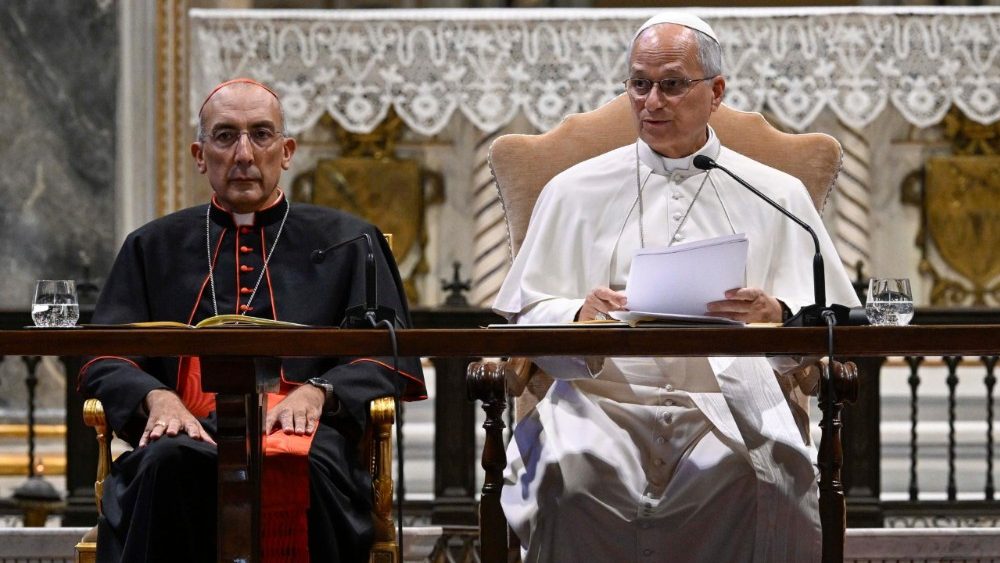
«The Church does not exist for itself, but to lead every person to the encounter with the Lord.» With this statement, Leo XIV has placed the encounter with Christ at the center of the pastoral path he proposes to the Diocese of Rome for the new term. During the Diocesan Assembly held in the Basilica of St. John Lateran, the Pope called for a review of the initiatives, structures, and activities of the communities based on a fundamental question: whether they truly lead to Christ and make the Gospel meet the concrete life of people.
The Pontiff did not present a new pastoral program, but a method of «pastoral verification» based on listening, discernment, and conversion. «It is not enough to ask whether an activity is well organized, whether it has participation, whether it has been going on for many years,» he warned. The review must allow recognition of «what must be maintained, valued, corrected, abandoned, or initiated,» without becoming a new burden: Leo XIV assured that this exercise even gives «permission to do less and better.»
Below, we offer the full text of the Holy Father’s address, translated into Spanish.
Dear brothers and sisters:
I would like to begin again with you from the morning of Easter, from a garden, from an empty tomb. Mary Magdalene is there, at dawn, when it is still dark, and the darkness in which she finds herself is not only that of the night that has not yet ended. It is the darkness of one who has lost someone, of one who seeks and does not find, of one who bends down and weeps. The Gospel, however, does not leave her in that weeping. A man approaches her, whom she mistakes for the gardener, and asks her two questions: «Why are you weeping? Whom are you seeking?» (Jn 20:15).
These two questions, dear brothers, I would like to inspire the next journey of the Diocese of Rome. I believe, in fact, that we can feel them addressed today to our Church and to the whole city: «Why are you weeping? Whom are you seeking?» They refer to the anxious search for hope that you perceive in the parishes, in the meetings, and in the environments of life, when you have set yourselves to listen to one another and to the people. Mary Magdalene is awake before dawn and has already run to the tomb, because in her there is life, there is expectation! Thus, in Rome there are many people who begin again each morning, but also the parish communities, associations, movements, groups, and ecclesial realities that work generously in evangelization, in charity, and in the service of liturgical prayer. Certainly, alongside this richness you have honestly recognized some difficulties. It is the bewilderment of one who no longer manages to find where the Lord is. An experience that we share with so many brothers and sisters, but that we too can come to live. Sometimes proposals, activities, and meetings multiply, and the center is lost, the evangelical meaning of what is done.
And behold, in the Gospel, a single word makes Magdalene turn: her name, «Mary!» (Jn 20:16). Thus one encounters Jesus Christ: by feeling called by name by Him, in the many ways this can happen. From here every pastoral action must begin again: not so much asking «what» to do, but rather «whom» and «how» to encounter. In our communities one can remain anonymous, invisible, and misunderstood, or be seen, known, and called by name. And whoever truly encounters Christ, like Mary Magdalene, feels their heart filled and then cannot remain still, runs and goes to announce. «I have seen the Lord!» (v. 18), the woman says to the disciples. Not a memory, not a private fact, but a deep joy that generates community.
For this reason, brothers and sisters, I do not hand you a new pastoral program today. We do not start from zero and nothing of what we have lived must be archived. The work on «spiritual illnesses» has taught us to recognize what, in our ecclesial life, asks to be healed, corrected, or converted. The Synodal Path has taught us how to listen and discern together, co-responsible for the one mission. Instead, I wish to propose that you develop a third dimension: that of pastoral verification.
To verify, under the light of the Holy Spirit, means to stop, to reread what has happened, to recognize what has borne fruit, to understand what has not worked, and to seek together the reasons. It means, in a word, to make truth. I invite you to carry out this verification by involving the whole community and, as far as possible, also listening to people who do not frequent it and see things, so to speak, «from outside.»
To practice pastoral verification, I indicate to you some attentions, which I distinguish but which form a single dynamism.
The first attention: to encounter Christ and to make others encounter Him. The Church does not exist for itself, but to lead every person to the encounter with the Lord; therefore, it is not enough to ask whether an activity is well organized, whether it has participation, or whether it has been carried out for many years; it is necessary to ask whether it truly leads to Christ, whether it makes the Gospel meet the concrete life of people.
The second attention: to generate community. From the Easter of Christ new, free, reconciled communities are born. Let us have the courage to care for what is essential, to leave space for true relationships, within which people feel part of a people: they feel welcomed, accompanied, valued, co-responsible. Let us commit ourselves to offering young people time and listening, within and outside initiatives.
The third attention: to inhabit and serve the city. Rome is not the indifferent stage of our communities: it is the place of our mission. The community generated by the Risen One cannot remain closed in on itself, but shares the hopes, fragilities, and questions of people; and learns to recognize, in what happens in the different environments of the city, the questions to which the Gospel can respond, if it is welcomed anew.
To these three attentions of verification is added a fourth, which runs through them all: the formation of the People of God. Do our activities make people grow in faith? Do they form missionary disciples? Do they help to mature ecclesial responsibilities? Do they generate an adult faith, capable of translating into concrete decisions of life and service?
The heart of the method I propose to you is, however, a very simple question: «why?». It is about stopping together and asking, before everything we do: why do we do it? What evangelical intention moves us, what real need do we intend to respond to, in what way does this choice correspond to the mission of the Church? And then, the second step: why do we obtain these results and not others? Why do some initiatives generate paths and others remain isolated? Why do some people participate and others remain on the margins? From the encounter between the reasons for our decisions and the reasons for their effects is born an authentic discernment, which allows recognition of what must be maintained, valued, corrected, abandoned, or initiated.
So that all this does not remain a good intention, the journey will have its own «rhythm,» and I thank the Cardinal Vicar and the other collaborators who have prepared some stages that will be presented to you.
I therefore ask you to give yourselves time to walk together—not a year, but a journey—so that it may be a true discernment and not an initiative added to the others. The Bishop does not ask you to program new activities: he proposes to you a common method of listening, discernment, verification, and conversion. The contents and priorities are entrusted to the responsibility of your communities, in the five areas that are catechesis and Christian initiation, youth, family, charity, and vocations, because the objective is to share a pastoral style, not to uniform experiences. And in this the prefectures are called to become more and more places of encounter, dialogue, and shared pastoral elaboration.
Dear brothers and sisters, it is true: a method, by itself, has never converted anyone. Therefore, so that what I have proposed to you does not remain something abstract, I also remind you of a face. I have joyfully approved the decision to take the necessary steps so that the diocesan investigation may begin on the life, virtues, and reputation of holiness of Don Luigi Di Liegro, a priest of this Church, who died on October 12, 1997. The gift he makes to our journey is not primarily in the works he carried out: Don Luigi, before building anything, wanted to «see.» In 1969 he commissioned an investigation on the religiosity of Romans, because he had learned that there is no incarnation of the message without listening to reality. In his last intervention, a few weeks before dying, Don Luigi said to his collaborators: «Discernment is this question: Lord, where are you?»
Dear brothers, this makes one think of the question of Mary Magdalene beside the tomb of Jesus. It is the question with which we begin again today. What signs of the Kingdom and what calls of the Holy Spirit emerge today from the life of Rome, and what form of Church is necessary to assume in order to recognize and serve them? Keeping this question within us will help us to be a Church in solidarity with the destiny of this city, in contact with its wounds, its hopes, and its transformations.
I would now like to say a word to you about the ordained ministry in Rome. But first I wish to say «thank you,» and not out of formality. Thanks to the Cardinal Vicar, to the auxiliary bishops, to the prefects, and to all who serve in the offices of the Vicariate. Thanks to the parish priests and parochial vicars; to the elderly and sick priests, to the chaplains of hospitals, prisons, schools, and universities; to the priests who have come from other Churches and other countries, who serve in this city as if it were their own. Thanks to the permanent deacons and their families. Thanks to the religious men and women; to those who in silence sustain Rome with their intercession; and to those who encounter it every day in schools, hospitals, reception centers, and peripheries. Thanks to the catechists, educators, and workers of charity. We know it: good makes no noise, the Lord knows it, and today I also wish to recognize it. Thank you!
I also know that pastoral service is more burdensome today than yesterday. I exhort you not to bear the difficulties alone. And I tell you clearly that the art of pastoral verification does not ask you to do more: it gives you, rather, permission to do less and better. If pastoral verification were to become another burden on your shoulders, we would have betrayed its meaning. I would then like to offer you some considerations on the face of the presbyters that Rome needs. The priest should be a man who listens before responding, who discerns before deciding. A person who remains before the Lord, because he cannot lead others to an encounter that he himself is not living. The question of «why?» is first of all a personal question of his: why am I a priest? Does my day still correspond to the reason for which the Lord called me by my name? The priest does not concentrate all responsibility in himself. He recognizes charisms, forms consciences, makes possible the co-responsibility of the laity: not for lack of strength, but out of fidelity to the nature of the Church. A community in which everything depends on the parish priest is a fragile community, and to preside does not mean to do everything. It means to generate communion, to value the energies of others, to connect people and realities, to guard unity. The priest, finally, inserts himself and wishes to belong to a community capable of reading its own neighborhood, of sharing its wounds and hopes, responsible for the life of all, including those who do not cross the threshold of the church. This is the form that charity assumes in pastoral presidency, and it is what prevents a parish from folding back into self-preservation.
No one is called to live all this alone. The presbyterate is not the sum of priests who meet for organizational needs: it is a fraternity, and it is the first place in which to verify whether what we do truly generates communion. I desire that the prefectures be, rather than instruments of coordination, effective places of priestly fraternity, where one can also express one’s own weariness without shame. Together with you, the deacons remind the whole Church that it exists to serve; and the religious men and women, with the gratuitousness of their lives, remind Rome that no efficiency saves man and that primacy belongs to God.
A particular thought goes to our seminarians. Dear young people, you are preparing to be priests of this diocese. I invite you to participate, already now, in this path of verification, learning to assume it as a style during the years of formation. And allow yourselves to be formed both by books, which are necessary to find good teachers, and by faces: by the poor, by the sick, by the people of our parishes. To you and to your formators I express my gratitude and my trust. Young people are not handed over to a role, but follow men and women who seem happy to be what they are.
I know that this path of verification will require patience and perhaps also the courage to leave behind something to which we are attached. But it is the same courage of Mary Magdalene, who had to abandon the desire to hold on to the Lord in order to run, instead, to announce Him. From this pastoral discernment will be born, I hope, a phase of exchange of renewed experiences and then the construction of a common path that prepares us, together, for the Jubilee of the Redemption of 2033.
Dear brothers and sisters of Rome, do not be afraid to let yourselves be called again by your name! The living Lord allows Himself to be found by those who, like Mary on the morning of Easter, keep the courage to seek Him, even among tears, even in the darkness. May the Mother of God, Salus Populi Romani, accompany you, who was the first to believe and gave birth to Christ for the world. And may my blessing reach all of you, your communities, and this city.