


Spain records a new indicator of the advance of secularization. 17.1% of Spaniards declare themselves atheists, compared to 15.9% who define themselves as practicing Catholics, according to the September 2026 Barometer of the Sociological Research Center (CIS). The survey, conducted on a sample of 4,042 people, thus places atheists 1.2 points above practicing Catholics.
The data, however, does not mean that atheists are more numerous than Catholics in Spain. Another 38.5% define themselves as non-practicing Catholics, so practicing and non-practicing together account for 54.4% of respondents. Added to these are 3.2% of believers of other religions, while agnostics represent 12.2% and the indifferent or non-believers, 11.3%.
17.1% declare themselves atheists and 15.9% practicing Catholics
The classification comes from a self-definition question. The CIS directly asks the interviewee if they consider themselves «practicing Catholic, non-practicing Catholic, believer of another religion, agnostic, indifferent or non-believer, or atheist.» It does not, therefore, establish a prior criterion of Mass attendance to decide who belongs to the category of practicing Catholic.
The complete distribution reveals the magnitude of the distance between Catholic identity and religious practice. Of the 4,042 interviewees, 642 declared themselves practicing Catholics and 1,556 non-practicing Catholics, compared to 692 atheists, 495 agnostics, 458 indifferent or non-believers, and 129 believers of other religions.
The barometer also offers a marked difference according to ideological self-placement. Among those who place themselves on the far left of the scale, 28.6% declare themselves atheists and 8% practicing Catholics. On the far right, the percentages are 9.9% and 47.6%, respectively.
More than half of believers never or almost never go to Mass
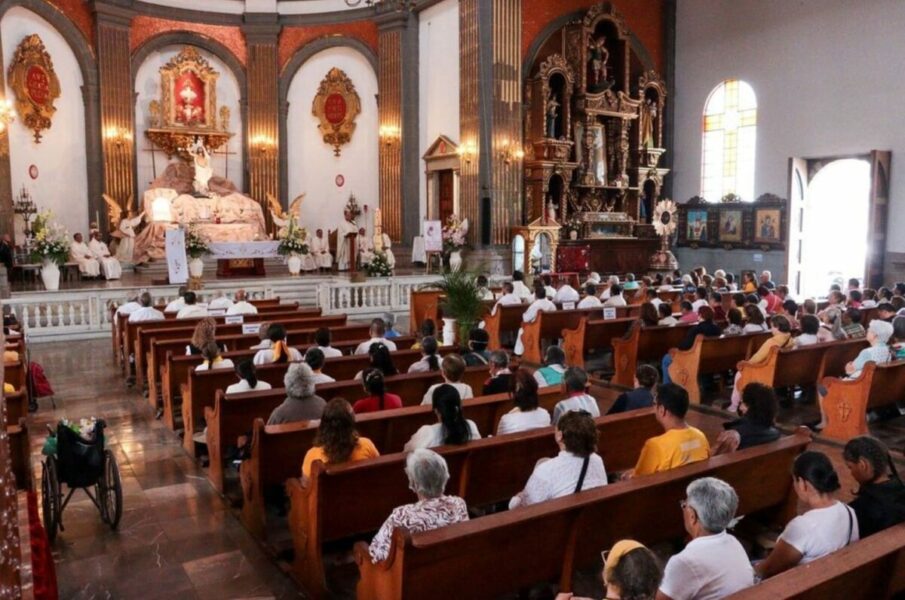
The CIS subsequently asks those who have defined themselves as Catholics or believers of another religion about their attendance at Mass or other religious services, excluding weddings, communions, funerals, and other ceremonies of a social nature. Of that group of 2,327 people, 26.2% respond that they never attend and another 26.4% that they do so almost never. 23.6% attend several times a year and 8.8% two or three times a month. Only 10.4% say they attend every Sunday and holiday and 3.8% several times a week.
The breakdown by religious identification is particularly significant. Among those who define themselves as practicing Catholics, 33.4% claim to attend every Sunday and holiday and 10.3% several times a week. Another 22.9% do so two or three times a month and 23.7% several times a year. Even within this group, 3.6% admit to never attending and 5% almost never.
Among non-practicing Catholics, on the contrary, 34.8% never attend and 35.8% almost never. Barely 1% claim to attend every Sunday and holiday.
Practicing Catholics have a more aged profile
Age shows another considerable difference between the different groups. Those over 75 years of age constitute 27% of all respondents who declare themselves practicing Catholics, despite representing 13.5% of the total sample. Among atheists, that age group accounts for only 5.6%.
The relationship is reversed among the youngest. People aged 18 to 24 represent 7% of the total practicing Catholics and 12.5% of the total atheists. Among those aged 25 to 34, the percentages are 7.4% and 16.4%, respectively.
The new barometer therefore paints a Spain in which Catholic identity continues to be the majority, but with a considerable gap between belonging and practice.