


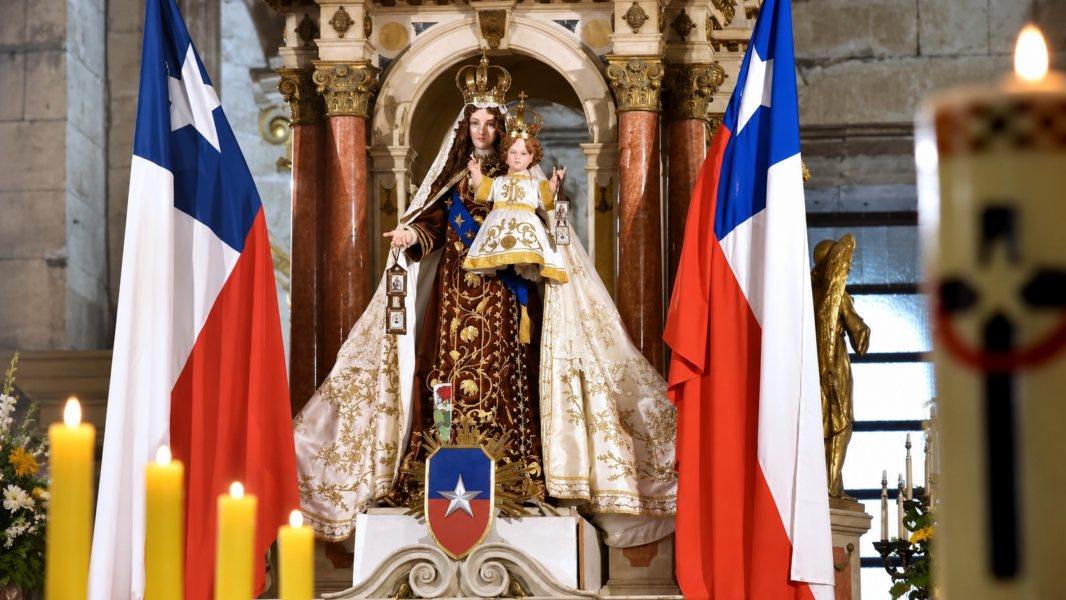
Chile premieres this Friday, September 18, during the traditional Te Deum of Fiestas Patrias at the Metropolitan Cathedral of Santiago, a new hymn dedicated to the Virgin of Carmen. Estrella de Chile, the work of composer and organist Julio Garrido Letelier, was born in the year marking the centenary of the coronation of Our Lady of Carmen as Queen and Patroness of the country.
The composition won the Hymn Composition Contest in Honor of the Virgin of Carmen, convened by the Pontifical Catholic University of Chile and the Metropolitan Chapter of Santiago within the framework of the project Cultura Migrante: Música, Arquitectura e Historia de la Catedral de Santiago. The call sought a choral work dedicated to the Virgin of Carmen and required that it could be performed both a cappella and accompanied by organ or string orchestra.
But Estrella de Chile does not intend to be merely a commemorative piece. Its lyrics speak of the Rosary, the scapular, holiness, salvation, and the Christian vocation of the homeland, and present the Virgin as Queen who leads her people toward Jesus Christ.
In statements to InfoVaticana, Garrido explains that initially he did not even grasp the historical connection his work would have with the centenary. “Only when it was selected did I realize that this composition would also occupy a small place in the history of devotion to Our Lady of Carmen in Chile,” he notes.
“It is a reality that surpasses any of my dreams, and I receive it as a gift from Our Lady and her Divine Son, for without them nothing could have been done.”
The star of the flag turned into a hymn
The starting point of the composition was a prayer to the Virgin of Carmen proposed as inspiration in the contest guidelines. In it, Mary is invoked as the “Star of Chile” who presides over the flag and lights the way during “stormy nights.”
The image captivated Garrido. “The national banner is a symbol that continues to unite Chileans, and I liked being able to think of its star as a figure of the bright beacon that is Our Lady for Chile,” he explains.
From there, the content was born first, and then the music. From the earliest drafts, the composer wanted to introduce a recurring refrain that the faithful could take up:
Star of Chile, Queen and Patroness,
Virgin of Carmen, Mother of love.
Keep shining on our flag,
Guide your people toward the Savior.
Behind that image also lies a concern for the loss of faith. Garrido wanted to ask the Virgin “to keep shining on our flag, that her light not be extinguished in our consciences, even in these times when the practice of the Catholic faith has deeply weakened.”
The music itself changed during the creative process. The initial plan was to write in 3/4 time, following the style of Virgen del Carmen Bella, a popular Chilean Marian hymn. The first draft ended up turning the composition into a hymn in 4/4.
For Garrido, that change gave it “a regal and solemn character,” fitting for the recipient of the work: a Queen “who, in this case, is nothing less than Queen of all visible and invisible creation.”
“The vocation of the homeland is that of holiness”
One of the stanzas introduces an idea that runs through the religious meaning of the composition:
When night clouds the eyes,
the homeland forgets its vocation,
be our refuge, bright beacon,
lead us back, Mother, to salvation.
Be the hope of your nation.
What does it mean that a homeland can forget its vocation? Garrido explains it in explicitly supernatural terms: “The vocation of the homeland is that of holiness. God calls us to be holy, and that is the highest aspiration a people can reach.”
The composer thus brings to the level of society as a whole a reality proper to Christian life. “The Christian battle is daily,” he notes, and amid temptations it is easy to lose “the supernatural perspective” and forget “the call God makes to us to be holy on earth and to journey toward the life of eternal beatitude.”
The Virgin then appears as the one who points the way again: “Our Lady is the beacon that leads us back to the path that leads to eternal happiness, which is Jesus Christ through his Church.”
A Virgin who is not “a relic of our ancestors”
That perspective also explains one of the central verses of the work: “Lead us back, Mother, to salvation.”
For Garrido, the centenary could not be limited to recalling an episode in Chilean history. “The coronation of Our Lady of Carmen as Queen and Patroness of Chile in 1926 is a historical event. Nevertheless, the reality of the reign of Mary Most Holy is always current, as is the destiny to which She leads us.”
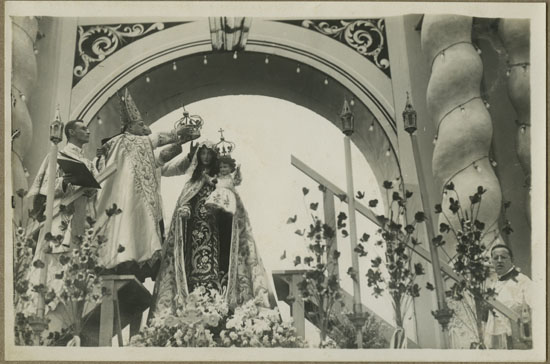
The composer wanted the hymn to serve as “a renewal of this virtuous alliance between Chileans and Our Patroness” and to remind that Mary continues to guide toward eternal life.
Faced with a conception of religion reduced to private conscience, Garrido deliberately places the hymn “from another framework of thought”: “in the conviction that the Passion and Death of Jesus Christ opened for us the possibility of reaching Heaven, and that the Catholic Church, founded by Him, has the fullness of the means of salvation to reach that endless happiness.”
That is why he rejects understanding devotion to the Patroness of Chile solely as cultural heritage or an identity element.
“Our Lady of Carmen, then, is not just another figure within the national imagination, like a relic of our ancestors or a cultural manifestation,” he affirms. “She is truly Queen, present at every moment, and with her maternal protection and guidance, she disposes our hearts to draw near to her Son Jesus Christ.”
“May all Chile wear the scapular and pray the Rosary”
The content of the hymn also does not hide the traditional forms of Marian piety. From the beginning, Garrido was clear that, in addition to the reign of the Virgin, he wanted to incorporate the Holy Rosary and the scapular.
Regarding the first, he warns that “we live in an age in which vocal prayer is viewed with distance even in some sectors within the Church,” a situation that, in his judgment, has led to “a certain contempt for the Rosary.”
In response, he recalls its constant recommendation by the pontiffs and the fruits of holiness linked to this prayer throughout the centuries. In Estrella de Chile, the Rosary appears as a “sweet prayer and school of love,” whose mysteries must lead the Church to resemble Christ.
Something similar occurs with the scapular, which the composer considers “inseparable from devotion to the Blessed Virgin of Mount Carmel” and recalls that many Chileans receive or renew it each July 16.
“I wanted to include explicitly in the hymn these two elements that continue to play such a significant role in popular devotion to our Queen and Patroness, and that are means of sanctification that draw us to God so effectively,” he explains.
And he sums up his desire in a phrase: “May all Chile wear the scapular and pray the Rosary.”
“This music came from Her”
The selection of Estrella de Chile has an especially personal dimension for Garrido. His Marian devotion was formed over the years, marked particularly by reading the Treatise on True Devotion to the Blessed Virgin by St. Louis Marie Grignion de Montfort, and by the practice of the Rosary.
His specific relationship with the devotion of Carmel came gradually: first he received the scapular; later he worked preparing a volunteer choir at the parish of Our Lady of Carmen in El Salto, in Recoleta; and years later he began serving periodically as organist and cantor at the parish of Our Lady of Carmen in Ñuñoa.
“One could say that Our Lady of Carmen called me to her side and prepared me to dedicate this composition to her,” he affirms.
For the composer, the Patroness of Chile represents “the triumph of the Sacred Heart of Jesus in Chile, the banner and the beacon that invites us to live constantly in Christian hope,” but also a call to build the country “with true justice, order, and the common good,” without losing direction or contravening the law of God.
This Friday, the hymn will leave the page for the first time to resound publicly in the Metropolitan Cathedral of Santiago, during the Te Deum of September 18. Garrido receives it as something that exceeds his own work: “To be able to dedicate this composition to her is an honor that surpasses my merits and talents. My impression is that this music came from Her, and will be for Her and for the glory of her Divine Son.”
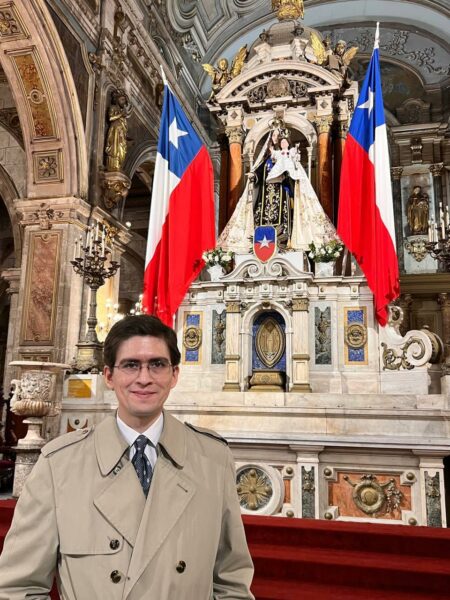
Estrella de Chile: Hymn in Honor of Our Lady of Carmen
Text and music: Julio Garrido Letelier (2026)
REFRAIN
Star of Chile, Queen and Patroness,
Virgin of Carmen, Mother of love.
Keep shining on our flag,
Guide your people toward the Savior.
VERSES
1. Your scapular is a holy habit,
Sign of covenant and fidelity.
Thus clothed in Jesus Christ,
May Chile attain eternity,
always longing for holiness.
2. When night clouds the eyes,
The homeland forgets its vocation,
Be our refuge, bright beacon,
Lead us back, Mother, to salvation.
Be the hope of your nation.
3. May the Rosary be on our lips
A sweet prayer and school of love.
May each mystery inspire the Church
To resemble Christ the Lord.
To Him be glory and honor forever.