


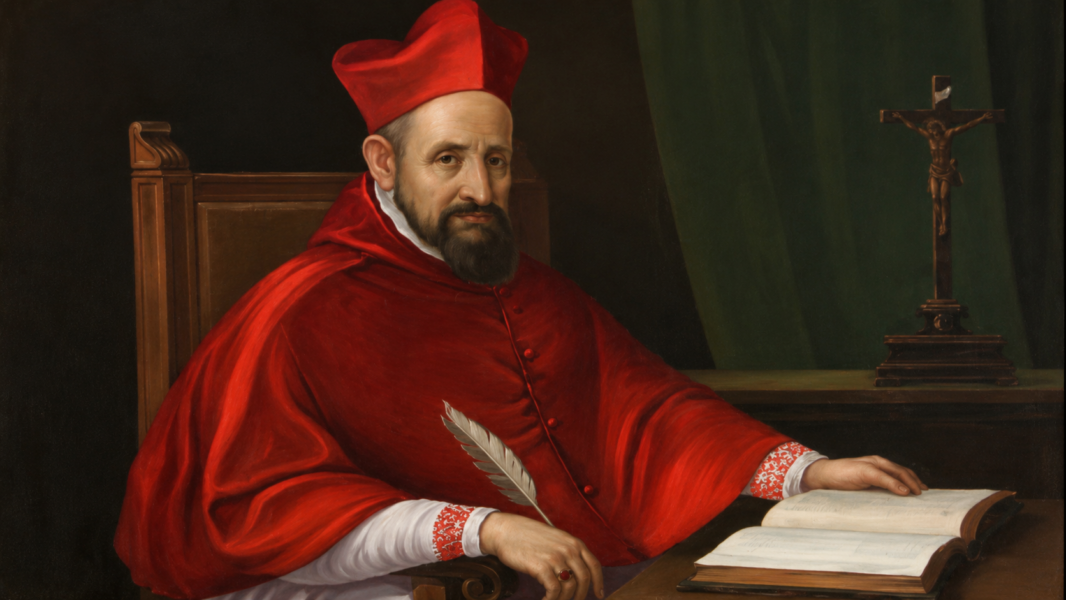
The Church celebrates this September 17 the memory of Saint Robert Bellarmine, cardinal, bishop, and Doctor of the Church. A theologian of extraordinary erudition, an apologist against the Protestant Reformation, author of catechisms and servant of the Holy See, he lived in one of the moments of greatest religious confusion in Western Christendom. His response did not consist in lowering the disputed truths to make them more acceptable, but in knowing them better, explaining them with clarity, and living them with holiness.
More than four centuries after his death, Bellarmine reminds us of something particularly necessary: doctrinal clarity is not the enemy of charity. Truth can be defended without aggression, but it cannot be defended by concealing it. And a Church that ceases to teach with certainty what it has received ends up depriving precisely of that good those whom it intends to welcome.
A saint for a Church shaken by division
Robert Bellarmine was born in Montepulciano, near Siena, on October 4, 1542. He entered the Society of Jesus in 1560 and was formed philosophically and theologically at the Roman College, Padua, and Louvain, with particular attention to Saint Thomas Aquinas and the Church Fathers. Ordained a priest in 1570, he soon stood out as a professor and controversialist.
He lived through the immediate consequences of the Protestant rupture. Entire nations had separated from Rome, and fundamental questions about Revelation, the Church, the sacraments, justification, and authority were under discussion. The Council of Trent had just concluded, and the Church needed to form priests capable of knowing and explaining the faith it had defined against the errors of the time.
Bellarmine took on this task from the chair of Apologetics at the Roman College. From his lectures emerged the celebrated Disputationes de controversiis christianae fidei, the Controversies, one of the great works of Catholic apologetics of the period. Benedict XVI would recall centuries later that they continued to constitute “a still valid point of reference” for Catholic ecclesiology in matters such as Revelation, the nature of the Church, the sacraments, and theological anthropology.
As Benedict XVI himself highlighted, Bellarmine defended Catholic doctrine through reason and the Tradition of the Church, but avoided personal aggression against those who held the doctrines of the Reformation. The controversy was doctrinal because what was at stake was the truth; it did not therefore need to become personal enmity.
The doctrine had to reach the people as well
His work did not remain confined to the disputes of theologians. Bellarmine understood that a doctrinally weak Church often begins as a Church whose faithful do not know what they believe.
That is why he wrote the Short Christian Doctrine, a catechism intended to transmit in a simple way the fundamental truths of the faith. The work achieved enormous diffusion and was translated into numerous languages.
For Bellarmine, apologetics and the catechism sprang from the same concern: that the Catholic know what he believes and why he believes it.
Cardinal, bishop, and pastor
Clement VIII appointed him pontifical theologian and consultor of the Holy Office before creating him cardinal in 1599. Three years later he was named archbishop of Capua.
His time in the diocese showed that the great intellectual did not conceive of the episcopate as an honorary dignity. He preached in the cathedral, visited the parishes weekly, celebrated three diocesan synods, and convened a provincial council. Later he would return to Rome to serve in various congregations of the Curia and carry out missions in defense of the rights of the Apostolic See.
He was also the spiritual director of Saint Aloysius Gonzaga, whom he accompanied during his years at the Roman College. Behind the polemicist and the man of government there was a profound interior life. In his final years he wrote several spiritual works born of his own annual retreats and of the ever-closer awareness of death.
Truth without pride, charity without relativism
The relevance of Saint Robert Bellarmine does not consist in mechanically transferring the controversies of the sixteenth century to the twenty-first. It consists in recovering a conviction that ran through his entire life: the Church is not the owner of the truth it proclaims, but its depositary.
That is why he was able to combat errors without making controversy the center of Christian life. Doctrine was not for him an instrument of power nor an identity banner. It had to lead to God, and precisely for that reason it deserved to be studied, taught, and defended.
Benedict XVI, dedicating one of his 2011 catecheses to him, emphasized that Bellarmine’s spirituality was deeply oriented toward Christ. The saint taught that whoever listens to the Lord and meditates on his word receives criteria to guide his actions and can acquire a wisdom from which the reform of one’s own life is born. External controversy, therefore, could never replace interior conversion.
Doctor of the Church
Saint Robert Bellarmine died in Rome on September 17, 1621. Pius XI beatified him in 1923, canonized him in 1930, and the following year proclaimed him Doctor of the Church.
Four centuries later, his work preserves an uncomfortably simple question for every generation of Catholics: if we believe we have received a truth we did not invent ourselves, are we willing to know it sufficiently in order to be able to transmit it?
Bellarmine’s answer occupied his entire life. To study the faith, to teach it without mutilations, to defend it without hatred, and to strive to live in accordance with it.