


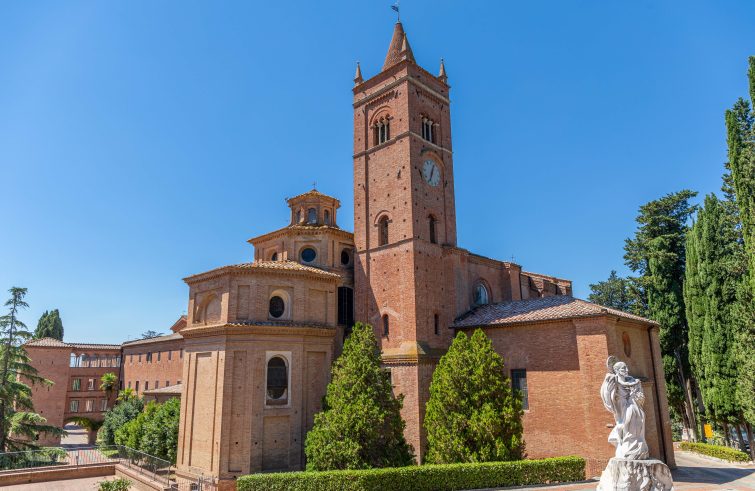
The appointment of a new abbot for Monte Oliveto Maggiore, in the Italian region of Tuscany, carries a significance that extends far beyond the internal governance of a monastery. Leo XIV has confirmed the election of the Guatemalan Benedictine Dom Antonio Bran Tecun as ordinary abbot of a territorial abbey, a unique ecclesiastical circumscription in which the abbot exercises over a territory functions of governance similar to those of a diocesan bishop.
The Holy See announced on September 17 the confirmation of the election previously carried out by the General Chapter of the Olivetan Benedictine Congregation. Bran Tecun thus comes to govern not only a historic monastic community, but also one of the few territorial abbeys still existing in the Latin Church.
An abbey that also functions as an ecclesiastical circumscription
A territorial abbey is not simply a monastery granted a special dignity. Canon 370 of the Code of Canon Law defines it as a specific portion of the People of God, territorially delimited, whose pastoral care is entrusted under special circumstances to an abbot who governs it as its proper pastor, in a manner similar to a diocesan bishop.
The territorial abbot is therefore ordinary of the place. His jurisdiction is not limited to the religious of his monastery: it also extends to the priests, parishes, and faithful belonging to the territory entrusted to the abbey. Canon Law expressly includes territorial abbeys, together with dioceses and other circumscriptions, among the particular Churches.
This does not necessarily make the abbot a bishop. He may exercise the power of governance proper to his office without having received episcopal consecration, while acts reserved to the episcopal order must be performed by a bishop.
An institution with deep medieval roots
The figure of the territorial abbey has its roots in the expansion of monasticism. For centuries, some great monasteries were not only centers of prayer and community life: they evangelized territories, founded churches, served populations, and eventually exercised true ecclesiastical jurisdiction over the lands surrounding them.
From this reality emerged the ancient abbeys known as nullius dioecesis, that is, territories that did not depend on the jurisdiction of the bishop of a nearby diocese, but directly on their own abbot and, ultimately, on the Holy See.
With the progressive reorganization of dioceses, especially during the 19th and 20th centuries, many of these circumscriptions disappeared or lost their territory, which was incorporated into ordinary dioceses. That is why territorial abbeys today constitute an exception within the usual organization of the Latin Church.
Monte Oliveto Maggiore, mother house of the Olivetans
Monte Oliveto Maggiore is located near Asciano, in the province of Siena, and is the mother house of the Benedictine Congregation of Santa Maria di Monte Oliveto. Its origins date back to the 14th century and are linked to Saint Bernard Tolomei, a Sienese nobleman who abandoned secular life to retire with several companions and later embraced the Rule of Saint Benedict.
The community received papal recognition in the 14th century and gave rise to the Olivetan branch of the Benedictine family. The monastic complex of Monte Oliveto Maggiore continues to be the spiritual and historical center of the congregation.
Its status as a territorial abbey also explains why the appointment of its abbot requires papal intervention. In this case, the General Chapter of the Olivetan Benedictine Congregation elected Bran Tecun and Leo XIV confirmed the election and formally appointed him ordinary abbot.
A Guatemalan at the head of the historic abbey
Antonio Bran Tecun was born on June 25, 1973, in Villa Canales, Guatemala. He made his temporary profession at Monte Oliveto Maggiore on December 8, 1995, and his solemn profession on March 21, 2000, so his relationship with the Italian abbey spans more than three decades.
He pursued his philosophical and theological studies at the Pontifical Archiepiscopal Seminary Pius XII in Siena. In 2002 he was assigned to the conventual priory of San Bernardo Tolomei in Guatemala and received priestly ordination on June 8 of the same year in his native country.
His career combines religious formation with an uncommon dimension. He is a graduate in Mathematics and Physics, has taught both subjects at the Olivetan College, and has served as director of the agricultural estate of the monastery of Monte Oliveto Maggiore.
Bran Tecun succeeds Dom Diego Gualtiero Rosa and now assumes a responsibility that retains something of the ancient territorial configuration of Western monasticism: he will be superior of the community of Monte Oliveto Maggiore, but also proper pastor of the ecclesiastical circumscription entrusted to the abbey. A figure today exceptional that recalls the time when some monasteries not only safeguarded contemplative life, but also articulated the Christian life of entire territories.