


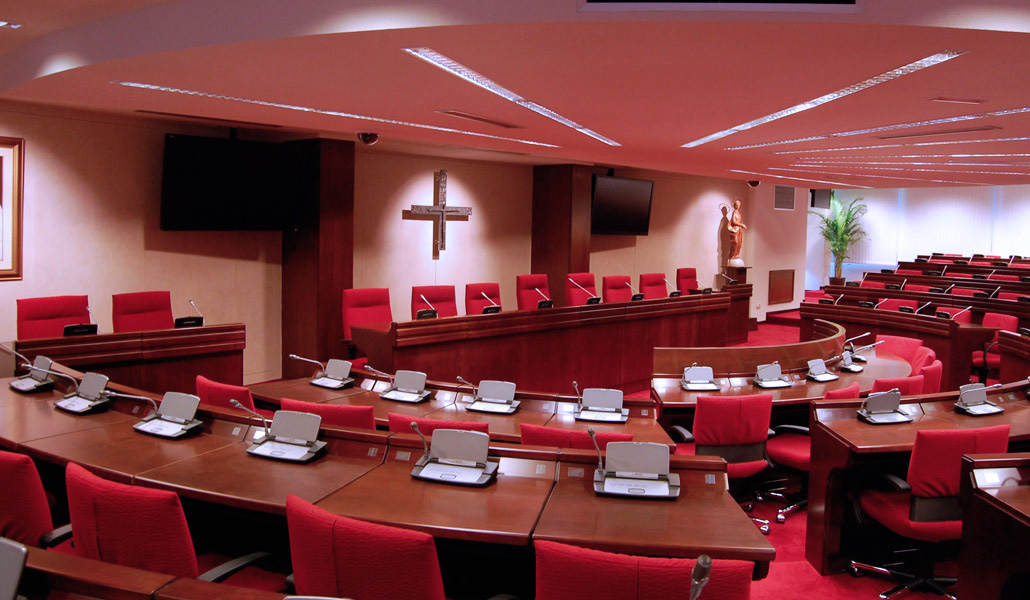
The Compliance Regulatory Body of the Spanish Episcopal Conference (OCN-CEE) will hold its IV Compliance Regulatory Meeting on October 6 and 7 in Madrid, as announced by the Conference itself in a note published on September 14. The event will bring together those responsible for this matter in dioceses and ecclesial institutions to delve deeper into compliance systems and their application within the Church.
The list of speakers reveals the importance the CEE wants to give to the meeting. It will open on Tuesday the 6th with Monsignor Luis Argüello, president of the Conference, followed by the apostolic nuncio, Monsignor Piero Pioppo. The presentation will be given by Alfredo Dagnino, director of Regulatory Compliance and president of the OCN-CEE.
Two Deans of the Rota
The inaugural session will be led by Monsignor Alejandro Arellano, dean of the Tribunal of the Roman Rota and president of the Court of Appeal of the Vatican City State, with the lecture «The Good Governance of the Church and the Response of Law,» presented by the secretary general of the CEE, Monsignor Francisco César García Magán. He will be followed by Monsignor Carlos Manuel Morán Bustos, dean of the Tribunal of the Rota of the Apostolic Nunciature, who will speak on «The Principle of Legality in the Administrative and Judicial Sphere of the Church.»
The simultaneous presence of the deans of the two Rotal tribunals, the Roman and the Spanish, in a forum dedicated to economic and administrative governance is an eloquent fact: good governance is approached from canon law, not only from business technique.
Whistleblower Channels and Child Protection
A large part of the first day will be devoted to internal information and investigation systems: procedures, protocols, guarantees, sanctioning regime, and data protection. Speakers will include Dagnino, Jaime Rossell, and Jesús Miguel López Nieto, members of the OCN-CEE, and Teresa de Jesús Sánchez Armas, director of the Instruction Department of the Independent Authority for the Protection of Whistleblowers (AIPI), a state body created by Law 2/2023, who will explain the relationship between the public external channel and the Church’s internal systems.
In the afternoon, Monsignor Jesús Rodríguez Torrente, head of the Coordination Service of the Diocesan Offices for the Protection of Minors, will present the experience of these offices, the results of the PRIVA (Comprehensive Reparation Plan for Victims of Abuse), and the new system derived from the agreement between the CEE, CONFER, the Ministry of the Presidency, Justice and Relations with the Courts, and the Ombudsman.
Diocesan Experiences and Cobo’s Closing
Wednesday the 7th will focus on practice. A first panel, moderated by Carlos López, undersecretary for General Affairs of the CEE, will address the configuration of compliance bodies with Paula Alió, general administrator of the CEE, and José María Albalad, delegate for Economic Affairs of the Archdiocese of Madrid and director of Sustainability of the CEE. A second panel will bring together the compliance officers from Jaén, Sergio Ramírez, and from the Canary Islands, Lino Chaparro.
The lectures will conclude with Jesús Pindado, director of Regulatory Compliance and Operational Risk Control at UBS Spain and treasurer of ASCOM, with recommendations to dioceses and parishes on economic, financial, and budgetary management.
The closing will be given by Cardinal José Cobo, archbishop of Madrid and vice president of the CEE, who will speak on «the importance of transparency, objectivity, and good governance in the life and mission of the Church.»
The meeting takes place at a time when the Spanish Church has de facto assumed a large part of the framework of civil regulatory compliance, from whistleblower channels to data protection. The fact that reflection is carried out hand in hand with the canonical tribunals and not only with external consultants is, for many observers, the guarantee that the Church will not lose its own legal logic in the process.