


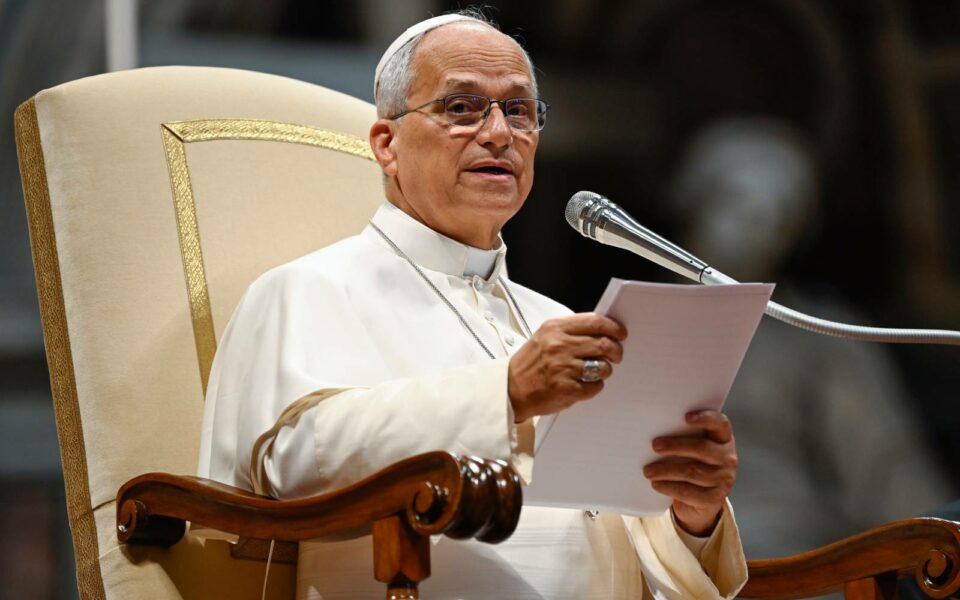
Pope Leo XIV warned this Wednesday, September 16, about the risk that technological development and the growing use of artificial intelligence could lead to increasingly “less personal” relationships and that man might end up becoming accustomed to “delegating to algorithms decisions that belong only to the human conscience.”
During the general audience held in St. Peter’s Square, the Pontiff continued his cycle of catechesis dedicated to the documents of the Second Vatican Council and addressed the chapter of the pastoral constitution Gaudium et spes devoted to “the human community.” Leo XIV recalled, among other points, the conciliar condemnation of abortion, euthanasia, and voluntary suicide as acts “against life itself,” and pointed to the dignity of the person, social justice, and free participation in building the common good as criteria for evaluating current social and political projects.
Below we leave the complete catechesis of Leo XIV:
Brothers and sisters, good morning and welcome:
By dedicating the second chapter to the “human community,” the Constitution Gaudium et spes (GS) invites us to consider the “multiplication of relationships among men” as “one of the most important aspects of the present world” (n. 23). However, this reality needs to find its fulfillment “more deeply in the community of persons,” for which “a reciprocal respect for their full spiritual dignity” is indispensable (ibid.).
These are statements that, in our days, have acquired even greater urgency. On the one hand, technological development, the spread of the mass media and social networks, and the increasing use of artificial intelligence open new possibilities, breaking down barriers and distances; on the other, relationships tend to become increasingly less personal, more virtual, and there is a risk of becoming accustomed to delegating to algorithms decisions that belong only to the human conscience. Ensuring that social relationships have real consistency and personal depth is, in this regard, the contribution that the Christian community seeks to offer.
The Council invites us to draw criteria and strength from God’s creative plan, who willed that “all men form one family and treat one another as brothers”; therefore, “love of God and neighbor is the first and greatest of the commandments,” which in Christ had its full revelation and complete fulfillment (cf. GS, 24).
The perfection of the human person and the development of society must be considered closely interdependent: to oppose or separate them would mean frustrating them. History, even the most recent, clearly confirms this truth and, therefore, we must not tire of repeating with the Fathers of Vatican II that “the human person, who by his very nature has absolute need of social life, is and must be the principle, subject, and end of all social institutions” (GS, 25).
From this perspective, Gaudium et spes affirms that the diversity of persons and peoples of the world should not be considered a danger or a threat, but a possibility of enrichment and growth. Confrontation, which sometimes degenerates into violence, is the fruit of the power of sin and how it conditions mentalities and actions, at all levels, causing destruction and death. It is necessary to open ourselves more and more to the logic of reciprocity, sharing, and care, as also happens among the different members of the human body (cf. 1 Cor 12,21-25).
At this point, the pastoral Constitution also offers a synthetic definition of “common good,” recalling that it consists in the “sum of those conditions of social life which allow both groups and each of their members to achieve their own perfection more fully and easily” (GS, 26). At the same time, recognizing the interdependence among peoples, it affirms that “every group must take into account the needs and legitimate aspirations of other groups, and even the common good of the entire human family” (GS, 26).
From this approach, the conciliar Fathers then indicate some “practical consequences of greater urgency” (GS, 27). First of all, respect for the human person. Gaudium et spes says: “Everything that is opposed to life itself, such as any kind of homicide, genocide, abortion, euthanasia, and even voluntary suicide; everything that violates the integrity of the human person, such as mutilations, tortures inflicted on body and mind, psychological coercion; everything that offends human dignity, such as subhuman living conditions, arbitrary arrests, deportations, slavery, prostitution, the trafficking of women and young people, or also the ignominious conditions of work, in which workers are treated as mere instruments of profit and not as free and responsible persons: all these things and others like them are certainly shameful” (ibid.).
Second consequence: respect and love also toward adversaries or toward those who have ways of thinking and acting different from one’s own (cf. GS, 28).
Third: the fundamental equality of all men, which requires social justice. The Document says: “Every form of discrimination in the fundamental rights of the person, whether social or cultural, on grounds of sex, race, color, social condition, language, or religion, must be overcome and eliminated as contrary to God’s design” (GS, 29).
Finally, the conciliar Fathers exhort us to overcome the individualistic mentality and to assume an attitude of responsibility and participation (cf. GS, 30-31).
Dear brothers and sisters, this vision of humanity as a “community of persons” is a precious heritage that the Second Vatican Council has left us. It helps us all to carry out personal and communal discernment, to responsibly evaluate today’s social and political projects, according to the criteria of the dignity of the human person, social justice, and free participation in building the common good. Because the future of humanity depends on the commitment of each one to collaborate with God and with brothers in building a more human world (cf. GS, 30).
Greetings
I greet all French-speaking pilgrims and, in particular, the group of pilgrims from Paris. “Love of God and neighbor is the first and greatest of the commandments”: be protagonists of relationships and fraternity. May God bless you!
I extend a cordial welcome to all English-speaking pilgrims and visitors taking part in today’s audience, especially those from England, Scotland, Norway, Ghana, South Africa, Uganda, Australia, India, Israel, the Philippines, Vietnam, Canada, and the United States of America. Upon each of you and your families I invoke the joy and peace of our Lord Jesus Christ. May God bless you all!
I address a cordial greeting to the German-speaking pilgrims. As we celebrate these days the “Time of Creation,” we are invited to lift our gaze to contemplate creation, praising and adoring the Creator, and to understand ever better the wonderful plan of God and our responsibility in the care of our Earth.
I cordially greet the Spanish-speaking pilgrims. In these days, many Latin American countries celebrate their national feast. Let us ask the Lord that, valuing the identity of our homeland, the Gospel may open our minds and hearts to recognize that we are part of a greater divine project, that we are part of the human family created by God. May the Lord bless you. Thank you very much.
I address my cordial greeting to Chinese-speaking persons. Dear brothers and sisters, may the God of peace and consolation fill your hearts with his grace. I bless you from my heart.
A cordial greeting to the Portuguese-speaking pilgrims, especially the groups from Brazil and Portugal. Dear brothers and sisters, may the “New Commandment” of Jesus in your communities be transformed into concrete gestures of welcome, compassion, and unity, to be a reflection of this love in the world. May God bless you!
I greet the Arabic-speaking faithful, in particular those from the parish of the Annunciation in Nazareth. We are called to respect every person and to care for one another, to build a more human world. May the Lord bless you all and protect you always from every evil.
I cordially greet the Poles, in particular the pilgrims and seminarians of the diocese of Płock, together with their bishop, who have followed the footsteps of Saint Stanislaus Kostka from Vienna, through Dillingen, to Rome. In the year of the third centenary of his canonization together with Aloysius Gonzaga, let us not cease to pray for young people that, through the intercession of these patron saints, they may not fear making courageous decisions in their lives, placing themselves at the service of God and neighbor. I bless you all.
I cordially greet the participants in the XX national pilgrimage of the Ordinariate of the Armed Forces of the Slovak Republic, led by the military ordinary and by representatives of Slovak public institutions, together with their families. Yesterday you celebrated in Slovakia the feast of Our Lady of Sorrows, your principal patroness. Renew always your faith through veneration of the Mother of Jesus. Ask her with confidence and humility for her help to bear witness to Christian values in daily life and invoke her maternal intercession so that justice, fraternity, and peace may reign in the world. I bless you from my heart. Praised be Jesus Christ!
I address my cordial welcome to the Italian-speaking pilgrims, especially the priests of the Pontifical Mexican College and the seminarians of the Pontifical Urban College “de Propaganda Fide”: while expressing my best wishes for your studies, I assure you of my remembrance in prayer.
I also greet the religious of the Hospitalier Order of Saint John of God, encouraging them in following Christ and in service to the most fragile persons; the faithful of the parish of the Most Holy Annunciation of Buonabitacolo, who have come to have the statue of the Virgin of Mount Carmel blessed, wishing for each one a renewed devotion to the Mother of God; and the participants in the course of pharmaceutical assistance, exhorting them to integrate scientific competence, closeness, and an integral vision of the human person.
I receive with affection the chaplains of Italian prisons, accompanied by the director general, Don Raffaele Grimaldi. Dearest ones, I express to you my deep gratitude for your important apostolate in these places of human suffering: be always a living presence of the Gospel and of Christian hope.
In particular, I thank the General Inspectorate of Chaplains and all of you for the valuable collaboration you offer to me and to the Secretariat of State in spiritually assisting the troubled lives of so many brothers and sisters detained who write to the Pope to recount their dramas and their wounds.
My thought finally turns to the young, the sick, and the newly married. In recent days, the liturgy has made us meditate on the mystery of the Cross and on the sorrows of the Mother of the Lord. May the cross of Christ and the example of the Sorrowful Virgin illuminate your existence, dear young people; sustain you in daily trials, dear sick ones; and be a stimulus for you, dear newlyweds, to lead a family life consistent with the principles of the Gospel.
To all, my blessing.