


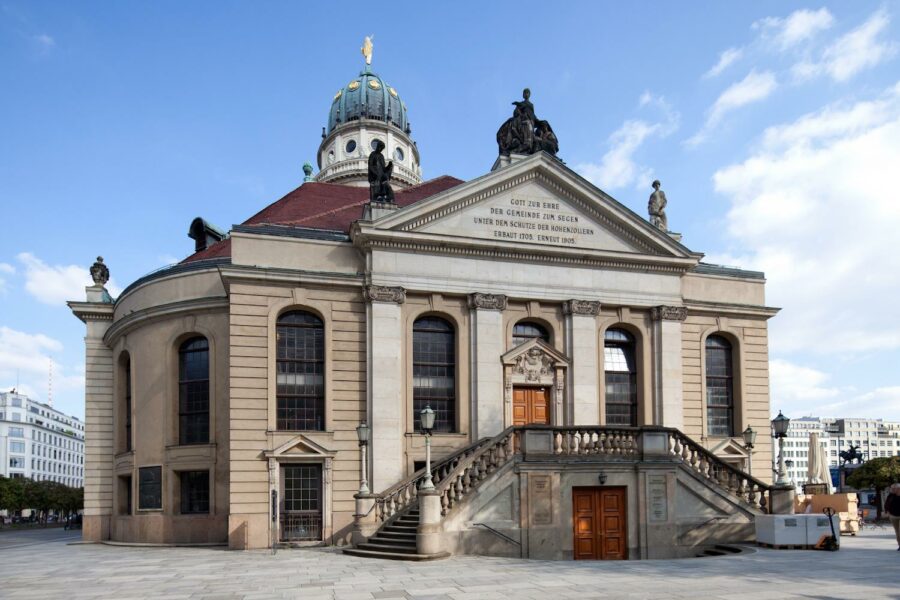
Representatives of eighteen member churches of the Working Group of Christian Churches in Germany (ACK) signed the revised version of the Charta Oecumenica, the reference document for cooperation among Christian denominations in Europe, on Tuesday, September 15 in Berlin. The signing took place during a solemn service at the Französische Friedrichstadtkirche, the church of the Huguenot community in Gendarmenmarkt, according to Katholisch.de citing the Protestant agency epd.
A 2001 text brought up to date
The original Charta Oecumenica was approved in April 2001 in Strasbourg, at the conclusion of a “millennium summit,” by the Conference of European Churches (CEC), which brings together the Protestant, Anglican, and Orthodox denominations of the continent, and by the Council of European Episcopal Conferences (CCEE), the Catholic body. It sets out guidelines and commitments of the churches for their mutual cooperation, and in 2003 sixteen ACK churches endorsed it at the first ecumenical Kirchentag held in Berlin.
The revised version was sealed at the European level last November in Rome, and is now being transferred to the German context. It incorporates new sections on peace, migration, new technologies, and the role of youth, while keeping the churches’ commitments at the center. As the report itself notes, the Charter has no magisterial or canonical pretensions; it is a document of practical commitment, not a doctrinal declaration.
Against the “political instrumentalization of Christianity”
The president of the World Council of Churches, Heinrich Bedford-Strohm, former Lutheran bishop of Bavaria and former president of the Council of the Evangelical Church in Germany (EKD), urged the churches not to regard their ongoing division “as something normal” and highlighted the revised text’s clear stance against the “political instrumentalization of Christianity,” an expression in the German debate usually directed against the use of Christian references by the political right.
The president of the ACK, the Anglican Reverend Christopher Easthill, described the signing as a new beginning: “Take this text in your hands, read it as a map of hope.”
Ecumenism of gestures in a country of accelerated de-Christianization
The renewal of the Charter comes at a delicate moment for German Christianity. Catholics and Protestants together now make up less than half the country’s population, with more than half a million departures each year from both denominations, and the Catholic Synodal Way has strained relations between the German Church and Rome. In this context, much of institutional ecumenism has shifted from the dogmatic issues that divide the denominations (ministry, the Eucharist, the papacy) toward an agenda of shared social causes.
The document signed in Berlin clearly reflects this shift: peace, migration, and technology now occupy the space that in 2001 was still shared with the search for visible unity in faith. A map of hope, in Easthill’s words, that says much about where European churches are looking today and far less about how they intend to overcome what separates them.