


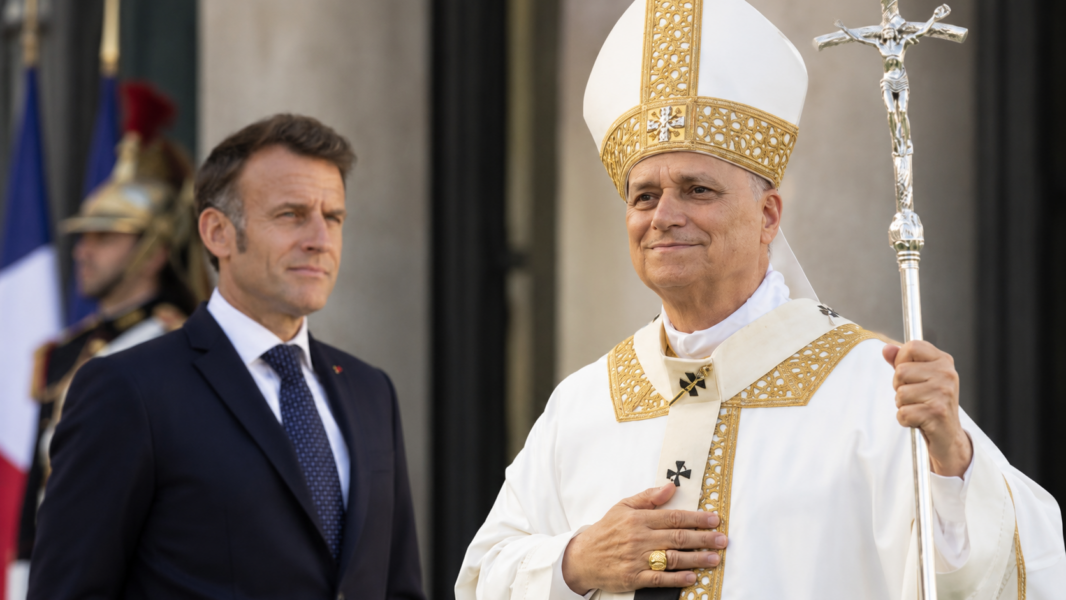
A few days before the apostolic journey of Pope Leo XIV to France, scheduled for September 25–28, the Vatican has rejected several of the protocol gestures with which the Élysée had intended to frame the visit: from the awarding of the Grand Cross of the Legion of Honor to the Pope to a state lunch or dinner with Emmanuel Macron.
According to journalist Mickaël Corre in La Croix, talks between Paris and the Holy See have resulted in a noticeably more sober reception than the one initially proposed by the French Presidency. Rome has scaled back the military ceremonial and has also prevented the Pope’s visit to Notre-Dame from becoming a presidential presentation of the cathedral’s restoration works.
No Legion of Honor or State Dinner
France had planned to award Pope Leo XIV the Grand Cross of the Legion of Honor, the country’s highest decoration, but the Holy See declined the distinction. There will also be no state lunch or dinner between the Pontiff and Macron.
The welcome ceremony was likewise subject to negotiation. According to La Croix, the Vatican requested that the deployment of the Republican Guard and its drums be avoided.
The sobriety requested by Rome does not eliminate institutional meetings. Pope Leo XIV will be received by Macron at the Élysée Palace and will later meet with authorities, representatives of civil society, and the diplomatic corps. Diplomatic courtesy will therefore have its place, but without making it the centerpiece of a visit whose character is fundamentally religious and pastoral.
Notre-Dame: Macron Wanted to Personally Present the Restoration
Another point of discussion concerns Notre-Dame de Paris. Macron had wanted to have several dozen minutes with the Pope to personally show him the restoration works of the cathedral, rebuilt after the fire of April 2019 and reopened in December 2024.
The program finally approved does not include that presidential visit. Pope Leo XIV will go to Notre-Dame on Friday, September 25, to preside over Vespers with the bishops, priests, deacons, consecrated persons, and seminarians.
The French State owns the building and played a decisive role in its restoration. But Notre-Dame was not built as a monument to the Republic or as a showcase for a presidency: it is a Catholic cathedral. Pope Leo XIV will enter it as the Successor of Peter to pray and celebrate with the French Church.
The Contrast with Euthanasia
Rome’s decision to keep republican honors in the background also takes on special significance given the moment France is experiencing. Emmanuel Macron promulgated on August 18 the law establishing a “right to assistance in dying”, introducing euthanasia and assisted suicide under certain conditions.
The same State that wanted to receive the head of the Catholic Church with the Legion of Honor, the Republican Guard, and a state meal has just incorporated into its legislation a practice directly contrary to Catholic teaching on the inviolability of human life.
Before the law’s final approval, the Bishop of Bayonne, Marc Aillet, had expressed the hope that Pope Leo XIV’s visit would serve to remind France of “the inalienable dignity of every human life.” After its promulgation, the Archbishop of Paris, Laurent Ulrich, called on Catholics not to avail themselves of the new “right to die” and recalled that the response to illness and frailty must be to accompany and care for.
A Journey Marked by the Pastoral Agenda
The official program combines diplomatic commitments with a primarily ecclesial agenda. In addition to Notre-Dame, Pope Leo XIV will take part in a vigil with young people, meet with catechumens and neophytes, and celebrate Mass in the Place de la Concorde.
A large part of the trip will be dedicated to Lourdes, where he will pray at the Grotto of Massabielle, celebrate Mass, visit the sick, and meet with the French bishops.