


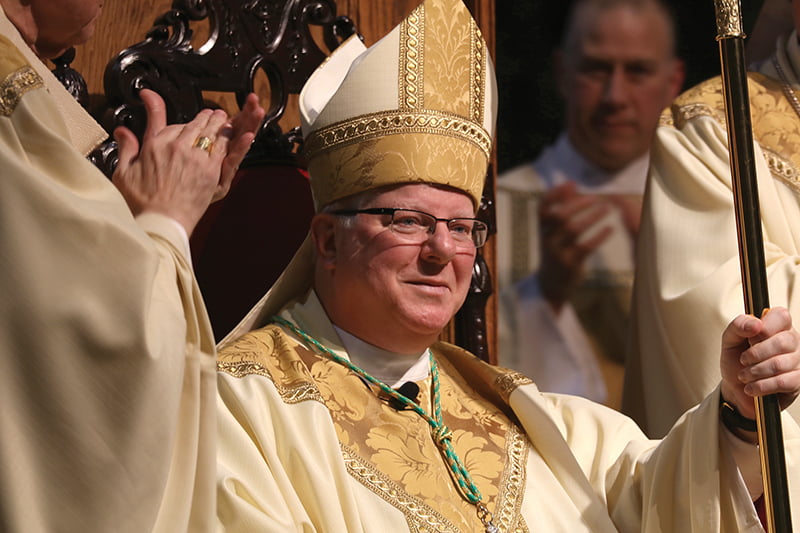
Pope Leo XIV has accepted this Tuesday the resignation of Msgr. Francis Ignatius Malone from the pastoral governance of the diocese of Shreveport, in Louisiana, United States. The prelate, who turned 76 last September 1, leaves the governance of the diocese after a little more than six years of episcopate and a priestly trajectory particularly linked to the promotion of vocations and eucharistic adoration.
Before becoming a bishop, Malone served for 19 years as pastor of Christ the King in Little Rock, a community that had not produced priestly vocations when he arrived in 2001. The priest then decided to establish perpetual adoration of the Blessed Sacrament, 24 hours a day and seven days a week.
Since then, as Malone himself recounted this year, 14 men from that parish have been ordained priests.
“That cannot be a coincidence,” he stated.
From no vocations to 14 priests
Malone arrived at Christ the King in 2001 and found a parish with no history of priestly vocations. Convinced of the relationship between eucharistic life and the emergence of new vocations, he proposed to his parishioners to begin perpetual adoration.
More than 90 people initially signed up to cover the various shifts.
“Almost immediately we began to have vocations,” the bishop recalled in an interview given in March to Catholic World Report.
Malone explained that the relationship between both phenomena became especially evident to him when some nighttime adoration shifts began to remain empty. During that period, he assured, vocations also decreased.
The parish then launched a new campaign to recover the shifts before the Blessed Sacrament and managed to incorporate new adorers. Shortly afterward, another vocation appeared.
“When I started, we had no vocations in the parish; in the following years, we had 14 ordained priests. That cannot be a coincidence,” Malone summarized.
The promotion of vocations was not limited to adoration. During his time as pastor, he also promoted a parish vocations committee, involved the school students in prayer for seminarians, and expressly encouraged young people to consider the priesthood and religious life.
When he was sent as bishop to Shreveport, he brought with him the same model of eucharistic adoration. This year he noted that the small diocese had six seminarians, a figure he considered positive given its size.
“Go to Mass and go to confession frequently”
Asked this year what he would recommend to Catholics, especially young people, to grow spiritually and remain steadfast in the faith, he responded: “Go to Mass and go to confession frequently”.
He added to this perpetual adoration, Catholic devotions, and active participation in the life of a parish.
The prelate has explained that a large part of his own vocation developed within a deeply Catholic family. Born in Philadelphia in 1950, he was the fourth of nine siblings and grew up in a home where the Rosary was part of family life.
He was ordained a priest on May 21, 1977, for the diocese of Little Rock and exercised his ministry there for more than four decades.
Pope Francis appointed him bishop of Shreveport in November 2019, when Malone was 69 years old. He was ordained and installed as the third bishop of the diocese on January 28, 2020.
The five priests who remained when everyone fled
Another of the projects that mark Malone’s episcopate is the promotion of the cause of canonization of the Martyrs of Shreveport, five priests who died attending to the victims of the yellow fever epidemic that devastated the city in 1873.
The priests Jean Pierre, Isidore Quémerais, Jean-Marie Biler, Louis Gergaud, and François Le Vézouët were originally from France.
When the epidemic spread through Shreveport and numerous inhabitants abandoned the city, the five remained there to attend to the sick and dying. One after another they contracted the disease and eventually died.
On December 8, 2020, Malone formally recognized the five priests as Servants of God, giving impetus to their path to the altars.
The diocesan investigation concluded on August 28, 2025, and all documentation was sent to Rome. On October 9 of that same year, Malone and the episcopal delegate for the cause, Father Peter Mangum, went to the Dicastery for the Causes of Saints to formally open the Roman phase of the process.
The five priests are presented in the cause as “martyrs of charity”: men who voluntarily offered their lives by remaining with those who suffered despite knowing the risk they ran.
Malone has expressed his desire to see them recognized as venerable.
A retirement after almost half a century of priesthood
The acceptance of his resignation by Leo XIV comes when Malone has accumulated 49 years of priesthood and after having exceeded the canonical age of 75 to present his resignation from the governance of a diocese.
The bishop had already explained before knowing the Pope’s decision that his intention for retirement was simple: to continue helping parishes on weekends and to have more time to visit his family in Philadelphia.
He leaves Shreveport after six years of episcopate, but also with a pastoral experience that began long before receiving the mitre: a parish without vocations that, after establishing perpetual adoration, ended up producing 14 priests.
For Malone, the explanation remains the same that he has repeated for years: “That cannot be a coincidence.”