


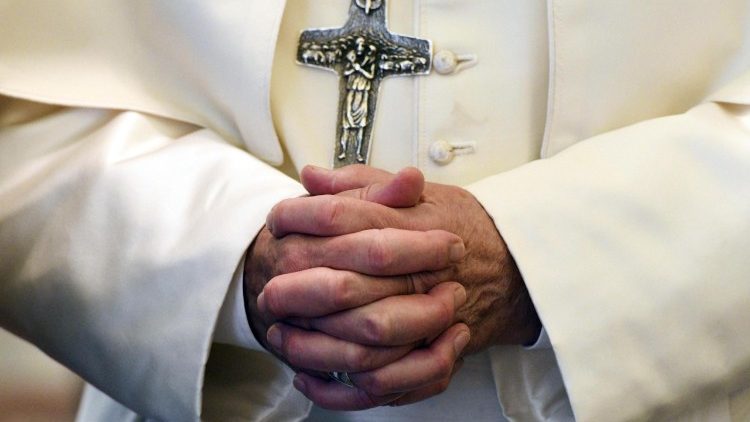
All Catholics have a Christian duty toward the Roman Pontiff: to pray for him.
Not only when we like the Pope. Not only when we agree with his decisions, understand his gestures, or feel represented by his words. Prayer for the successor of Peter does not depend on the sympathy aroused by the man who occupies the Chair of Rome, but on the office that Christ entrusted to Peter and that remains in his successors.
And there is something particularly significant in this obligation: the Church does not pray for the Pope because it assumes that everything he does is assisted by a permanent grace. It prays for him precisely because he constantly needs the grace of God, just as we all need it.
He needs wisdom to govern, strength to confirm his brothers, prudence to make decisions, holiness so as not to place himself above the will of God, and fidelity to safeguard what he has received.
That is why we pray for the Pope.
Christ prayed for Peter
On the eve of the Passion, Our Lord said to Peter:
«Simon, Simon, behold, Satan has demanded to sift you like wheat. But I have prayed for you, that your faith may not fail. And when you have turned again, strengthen your brothers» (Lk 22:31-32).
The phrase contains the two realities that will accompany the Petrine ministry: an extraordinary mission and a man in need of help.
Peter must «strengthen» his brothers, but first Christ has prayed for him.
After the Resurrection, the Lord will once again entrust him with a singular mission: «Feed my lambs», «tend my sheep» (Jn 21:15-17). And when Herod imprisons the Apostle, the first Christians do exactly what the Church will continue to do in the following centuries: «the Church prayed earnestly to God for him» (Acts 12:5).
Saint John Paul II saw in that episode the beginning of an «uninterrupted chain of supplications» by the Church for the successors of Peter.
Before the Oremus pro Pontifice, therefore, there was the Christian community praying for Peter. And even before that, there was Christ saying: «I have prayed for you».
The Mass is also offered for the Pope
This prayer was deeply incorporated into the liturgical life of the Church.
In the Roman Canon, the priest says:
«una cum famulo tuo Papa nostro N.»
«Together with your servant, our Pope N.».
The Pontiff is named at the very heart of the Sacrifice as a man who serves God and for whom the Church intercedes. His presence in the Eucharistic Prayer also expresses the communion of the Church that celebrates the Sacrifice with its visible head.
The Pope is not an oracle from whom grace has removed the human condition. Nor is he simply the president of a religious organization. He is the successor of Peter, invested with a singular authority and, at the same time, a living man for whom the Sacrifice is offered and for whom God is asked.
«Oremus pro Pontifice nostro»
For generations, this obligation also took a form that many Catholics still know:
V. Oremus pro Pontifice nostro N.
R. Dominus conservet eum, et vivificet eum, et beatum faciat eum in terra, et non tradat eum in animam inimicorum eius.
«Let us pray for our Pontiff N. May the Lord preserve him, give him life, make him happy on earth, and not deliver him into the power of his enemies».
The 1910 edition of the Raccolta, the ancient collection of indulgenced prayers and pious works, includes this prayer under number 449 and notes that Pius IX granted on November 26, 1876 an indulgence of 300 days for reciting it once a day and a plenary indulgence monthly under the established conditions.
Those «300 days» did not mean 300 days less in Purgatory, as is sometimes interpreted. It was the old way of expressing partial indulgences in reference to canonical penances.
The discipline changed with Paul VI. Since 1967, partial indulgences have no longer been quantified in days or years.
But the prayer did not disappear.
The current Enchiridion Indulgentiarum continues to grant a partial indulgence to the faithful who, with a spirit of filial devotion, recite a prayer legitimately approved by the Supreme Pontiff, and cites precisely the Oremus pro Pontifice as an example.
The discipline changed. The supplication remained.
What should we pray for the Pope?
Ancient Catholic piety was not limited to asking that the Pope have health or a long life.
The Raccolta contains, for example, a prayer for Saint Pius X in which God is asked for the Pontiff greater light of supernatural wisdom and growth in charity. Another practice recorded in the same book proposed offering the Masses celebrated during the day by the whole Church and «principally for its visible Head, the Supreme Pontiff».
If we ask for wisdom for the Pope, it is because he needs wisdom. If we ask for strength, it is because he can be tested. If we ask for prudence, it is because he has difficult decisions to make. If we ask for fidelity, it is because he too must remain faithful. If we ask for holiness, it is because no man receives holiness automatically upon being elected Roman Pontiff.
And here appears a distinction worth remembering.
Infallible does not mean impeccable
The Church teaches the infallibility of the Roman Pontiff. But it teaches something much more precise than what is sometimes understood by that word.
The First Vatican Council defined that the Pope enjoys infallibility when he speaks ex cathedra: when, exercising his office as pastor and doctor of all Christians and by virtue of his supreme apostolic authority, he defines a doctrine of faith or morals that must be held by the whole Church.
The Raccolta offers here a particularly curious document. Just a few months after Vatican I, an Act of Faith approved by Pius IX on January 10, 1871 incorporated practically the conciliar definition of papal infallibility into a prayer intended for the faithful.
The Church wanted Catholics to believe in infallibility.
But infallibility never meant impeccability.
Nor does it mean that any interview, improvised comment, appointment, diplomatic decision, administrative choice, or prudential judgment of a Pope is infallible.
The opposite error must also be avoided. That something is not an ex cathedra definition does not automatically mean that it lacks authority. The Church distinguishes different degrees of teaching. Lumen gentium recalls, for example, the «religious assent of the will and intellect» due to the authentic magisterium of the Roman Pontiff even when he does not speak ex cathedra.
Not everything carries the same weight. Not everything is infallible, nor is everything merely a matter of opinion.
The Pope cannot invent a new faith either
There is a phrase from Vatican I that should always accompany its definition of infallibility.
Pastor aeternus explains that the Holy Spirit was not promised to the successors of Peter so that, through a revelation, they might make known a new doctrine, but so that, with his assistance, they might sacredly guard and faithfully expound the Revelation handed down by the Apostles, the deposit of faith.
The Pope’s authority is enormous. But it is not the authority of an owner over something that belongs to him.
The Church belongs to Christ.
Benedict XVI expressed it with a clarity difficult to improve when he took possession of Saint John Lateran in 2005:
«The Pope is not an absolute sovereign, whose thinking and willing are law».
His ministry, he explained, must guarantee obedience to Christ and to his Word. The Pontiff is not called to proclaim his own ideas, but to submit himself and lead the Church in obedience to the Word received.
The Pope possesses true, supreme, and universal power over the Church, but he does not receive power to fabricate a new Revelation. He is the successor of Peter to safeguard, teach, govern, and confirm his brothers in the faith received from Christ.
That is also why he needs our prayers.
Praying for the Pope does not oblige us to flatter him
Praying for the Pope does not mean approving everything he does.
Saint Paul recounts in the Letter to the Galatians that, when Peter was in Antioch, «I opposed him to his face, because he stood condemned» (Gal 2:11).
The same Peter to whom Christ had entrusted his sheep could be corrected by Paul in a concrete action.
Saint Thomas Aquinas dealt expressly with the episode when studying the correction of superiors. The Angelic Doctor explains that, when there is danger to the faith, a prelate may be publicly corrected by a subject, as Paul did with Peter. At the same time, he requires that such correction preserve the proper form and the respect due to authority.
Neither does authority make all correction impossible, nor does correction by itself destroy authority.
Saint Catherine prayed for the Pope and also spoke to him plainly
Perhaps no saint embodies this attitude better than Saint Catherine of Siena.
Her devotion to the Papacy could hardly be described as lukewarm. She spoke of the Roman Pontiff as the «sweet Christ on earth», prayed for him, and understood his ministry from a profound supernatural awareness of the Church.
And it was precisely she who wrote to Gregory XI with filial frankness.
She begged him, exhorted him, asked him for strength, spoke to him of his obligations, and worked tirelessly to bring him back from Avignon to Rome.
She saw no contradiction in this.
Saint Bernard of Clairvaux had done something similar centuries earlier with Eugene III, his former disciple. In writing to him, he united a profound reverence for the successor of Peter with the freedom of one who seeks his spiritual good. He even explained to him that he admonished him not as a teacher, but «as one who loves».
Catholic tradition never forced a choice between flattery and rebellion.
Legitimate correction does not arise from contempt for the Pope, from the desire to humiliate him, or from turning the Church into a partisan battle. It arises—when it is truly necessary—from the same principle that should move prayer: love for Christ and the good of the Church.
Saint Catherine could pray for Gregory XI and exhort him because she wanted him to be a holy Pope.
Saint Paul could correct Peter without denying that Peter was Peter.
Pray more, not less
The greater a faithful person’s concern for the Pontiff’s decisions, the more reasons he has to pray for him. The greater he considers the danger, the greater his supplication should be. And the more convinced he is that the Pope needs prudence, strength, or clarity, the more sense it makes to ask God precisely for those graces.
Prayer does not oblige us to pretend that problems do not exist.
But it prevents criticism from turning into hatred.
And it reminds us of something even more important: the Church does not ultimately depend on our opinions about a Pope, but on Jesus Christ.
Oremus pro Pontifice nostro
Oremus pro Pontifice nostro Leone.
May the Lord preserve him and give him life.
May he grant him wisdom to govern, strength to resist whatever might turn him away from his mission, prudence in his decisions, holiness of life, and fidelity to the deposit received.
May he confirm his brothers.
May he tend the sheep that Christ has entrusted to him.
And when the burden becomes particularly heavy, may that scene of the first Christians also be fulfilled in him: while Peter faced the trial, «the Church prayed earnestly to God for him».
That continues to be our duty.
Let us pray for the Pope.