


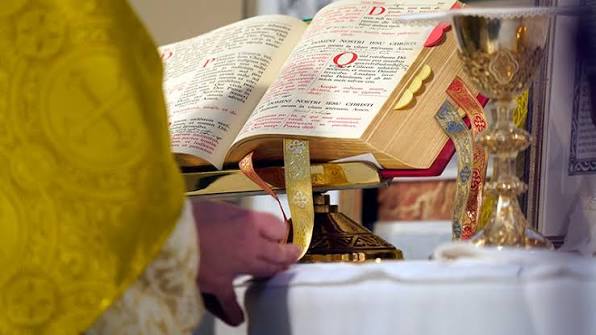
The Dicastery for Divine Worship publishes the Summarium Decretorum for 2025. Among the more than three thousand ecclesiastical circumscriptions worldwide, only 34 received Roman permission for the traditional Mass to be celebrated in a parish church. Compared with the census of the Latin Mass Directory, which records nearly fifteen hundred approved locations in 64 countries, the Vatican figures portray a regime designed to let the ancient liturgy die slowly, with the courtesy of biennial extensions.
The Dicastery for Divine Worship and the Discipline of the Sacraments has made public the Summarium Decretorum for 2025, the annual index of decisions adopted by the body headed by Cardinal Arthur Roche. The document reveals that, over the past year, the Holy See granted permission to celebrate Mass according to the 1962 Roman Missal in parish churches of 34 dioceses. Seven of those decrees are dated from the pontificate of Francis; the remaining 27 were signed after the election of Leo XIV on 8 May.
The fine print of the index deflates any benevolent interpretation. Twenty-nine of the 34 decrees are simply renewals, for the usual two-year period, of authorizations that already existed. Only a handful of communities obtained a new permission. According to the count by the British weekly The Catholic Herald, the set of decrees affects 55 parish churches spread across 33 dioceses, between 16 January and 12 December 2025.
A drop in the ocean of the universal Church
The Annuario Pontificio counts 3,041 ecclesiastical circumscriptions in the Catholic world, including dioceses, archdioceses, prelatures, vicariates and ordinariates, with some 1.4 billion baptized. The 34 dioceses favored in 2025 represent just over one percent of the Church’s sees. Twenty-four of those 34 decrees correspond to the United States, with dioceses such as Sacramento, Seattle, Nashville, Lincoln, Davenport or Cleveland. The rest of the planet, from Latin America to Africa and Asia, appears practically blank.
In 2022, the first full year of the motu proprio in force, permissions were granted to 35 dioceses and jurisdictions, 20 of them North American. In 2023 the figure rose to 55 decrees, then fell to 34 in 2024 and remained at that same number in 2025.
What the independent census says
The Latin Mass Directory, the international census that since 2015 records exclusively Masses according to the 1962 Missal celebrated with episcopal approval, offers the necessary counterpoint. Its database currently lists nearly fifteen hundred places of worship in 64 countries, with the United States (446), France (224), Poland (117), Italy (117), the United Kingdom (98), Brazil (92) and Germany (87) at the top; Spain has 36.
The two figures, side by side, sketch the true profile of Traditionis Custodes. The 55 parish churches in the Summarium represent barely three to four percent of the approved locations recorded in the directory. The vast majority of authorized traditional Masses are already celebrated outside parish churches—in chapels of institutes, oratories, cemeteries, schools, halls or rented premises—exactly where the motu proprio intended to confine them. Article 3 §2, by prohibiting the use of parish churches, did not reduce the number of faithful; it expelled them from the heart of diocesan life and turned them into precarious tenants of their own Church.
The directory also quantifies the damage. In 2022, the first year of full application, 232 places of worship were marked as suppressed, 96 of them explicitly because of Traditionis Custodes. The United States, the country with the largest number of faithful attached to the ancient rite, has lost 71 places since 2021, a 14 percent drop, with declines of 65 and 52 places in 2022 and 2023. The United Kingdom has fallen 27 percent; Australia, 22 percent; the Netherlands, 24 percent. Peru, the homeland of Leo XIV, saw its three only authorized centers cancelled in 2022 and today retains none. China, Costa Rica, Latvia, Malaysia and Sri Lanka likewise stand at zero. As InfoVaticana already reported in July, fourteen countries on three continents lack a single place to attend the traditional Mass without the shadow of canonical irregularity.
In countries where bishops have resisted Roman pressure, the picture is different. France has grown 29 percent since 2021 and now totals 224 locations; Germany has risen from 36 to 85, a 136 percent increase; Poland has risen 67 percent; Italy, 102 percent; Switzerland, the land of Écône, has doubled its offering. Where the ordinary has wished it, the traditional liturgy has flourished despite the motu proprio. Where the ordinary has applied the text zealously, it has disappeared. Traditionis Custodes has unified nothing: it has turned the fate of the faithful into an episcopal lottery.
A compromise designed to die
Traditionis Custodes, promulgated by Francis on 16 July 2021, did not order the liturgical life of a minority: it placed it under tutelage. It prohibited the traditional Mass in parish churches, banned the erection of new personal parishes, required priests ordained after the motu proprio to obtain a license from the Holy See to celebrate it, and reserved to Rome the dispensation of every prohibition. The Responsa ad dubia of Cardinal Roche, issued in December of that year, completed the encirclement: the dispensation is granted only when it proves impossible to find another church, oratory or chapel; the Mass may not appear in the parish schedule; it must not coincide with community activities; and the permission will be withdrawn as soon as an alternative venue appears. No other ecclesial reality, no association, no movement, no Eastern rite, has been subjected to such a regime of suspicion.
The biennial extensions, presented as a gesture of pastoral benevolence, are the most perverse piece of the mechanism. Every two years the bishop must justify to Rome the attendance, the steps taken toward the reformed liturgy and the “spiritual good” of faithful who are presumed to be at fault. The declared objective is not stability but extinction. Bishop Mark Eckman of Pittsburgh confessed this with disarming frankness when he announced in August the end of the only traditional diocesan Mass, celebrated at St. Titus Church for nearly twenty years: the permission “was intended only as temporary” and the Holy See’s expectation was that the need for that dispensation “would eventually come to an end” and that the faithful would be “led toward the celebration of the post-conciliar rite.” The last Mass took place on 4 September. The St. Titus entry in the Latin Mass Directory was updated only a few days ago.
Such is the compromise offered to Catholics attached to the liturgy of their fathers: an expiring authorization, conditioned on periodically demonstrating that it is no longer needed. A compromise of death, with an expiration date renewable at the discretion of the prefect of the moment. Knoxville forced three churches to switch entirely to the 2002 Missal on 1 January 2026. Owensboro closed the Earlington Mass on 28 June because the diocese “could not satisfy the conditions imposed by the Holy See,” including measures aimed at guiding the faithful toward the reformed liturgy. Camden closed the one at Santa Gianna Beretta Molla the same day. None of these closures appears in the Summarium; the index records only the graces granted, never those allowed to expire.
The underlying incoherence
The apparatus is grotesquely disproportionate. A dicastery of the Roman Curia devotes personnel, reports and numbered decrees to deciding whether in Akron, in San Angelo or in a rural parish in Kentucky a monthly Mass with the Missal of St. John XXIII may continue to be celebrated, while the chapels of the Priestly Fraternity of St. Pius X—whose four bishops were excommunicated this year after consecrations without pontifical mandate—welcome without asking anyone’s permission the faithful expelled from their parishes. In Peru, in Costa Rica, in Kenya, in Sri Lanka, the only remaining traditional Mass is that of the Fraternity. Traditionis Custodes, issued in the name of unity, has turned out to be the best recruiting agent for Écône.
Archbishop Paul Coakley of Oklahoma City and president of the U.S. bishops’ conference himself acknowledged in August that Catholics attached to the traditional liturgy face a “dilemma” and confessed he was not sure the “last word” had been heard from Leo XIV. In Germany, according to responses gathered by CNA Deutsch, dioceses such as Hamburg, Cologne, Regensburg or Passau confirmed they have no intention of expanding the offering, even though the Roman tone has softened. Other pastors, such as the bishop of Oslo, Fredrik Hansen, or the bishop of Aberdeen, Hugh Gilbert, have extended schedules.
A pontificate that has yet to speak
Leo XIV keeps Traditionis Custodes in force and has announced no modification. Vatican sources agree that the Dicastery for Divine Worship is more receptive to requests for dispensation and that the conditions are less burdensome in practice. The 27 decrees issued after 8 May, compared with the seven from the final stretch of the previous pontificate, point in that direction. A kinder tone does not repeal an unjust norm; it merely administers it with better manners.
A normative instrument designed for a universal Church governs with police-like meticulousness a statistically negligible reality: 34 dioceses out of 3,041, 55 parish churches out of a universe of more than two hundred thousand parishes, fifteen hundred approved locations on the entire planet for more than one billion four hundred million Catholics. If the purpose was to contain a threat to unity, the figures show that the threat never existed on the scale attributed to it. If the purpose was to accompany a faithful minority, the trickle of closures, the fourteen emptied countries and the humiliating mechanics of the extensions show that the model has served the opposite end.
The Summarium Decretorum for 2025 portrays, with the coldness of an administrative index, the disproportion between the apparatus deployed and the reality it claims to govern. The faithful are not asking for privileges: they are asking to be allowed to pray as the Church prayed for centuries, in their parish church, without having to ask forgiveness every two years for existing. The ball remains on Leo XIV’s desk.