


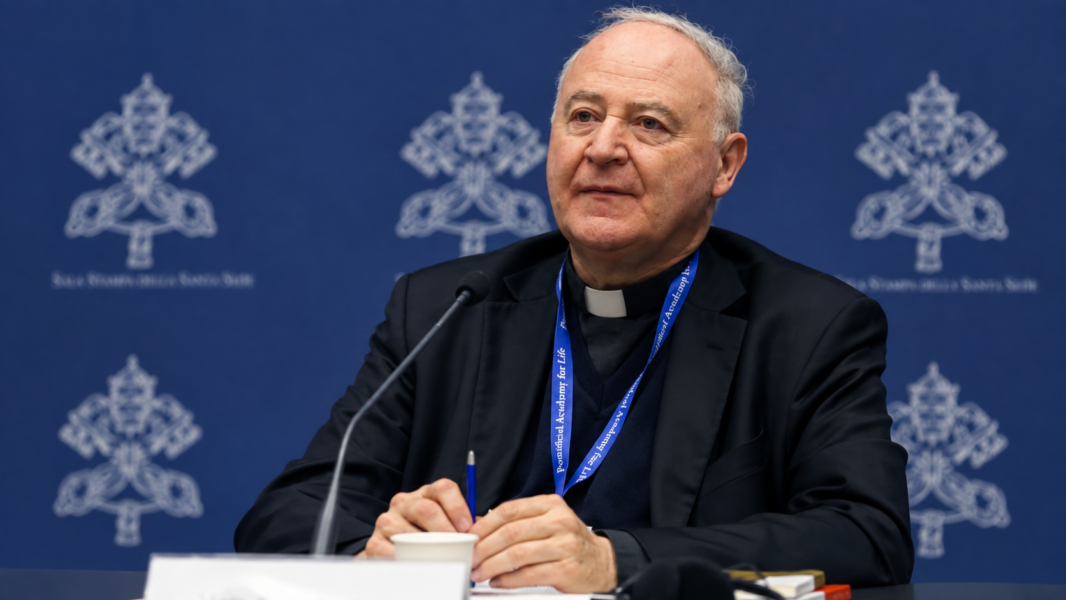
Archbishop Renzo Pegoraro, president of the Pontifical Academy for Life, has insisted on the advisability of the Italian Parliament legislating on end-of-life issues in light of the advance of regional regulations governing assisted suicide. The prelate maintains that “we have reached a point where decisions must be made” and proposes national regulation after having defended the possibility that Catholics may give their assent to an “imperfect law” if it can prevent “more permissive and libertarian” laws.
In an interview granted to the Corriere del Veneto and fully reproduced by the Pontifical Academy for Life, Pegoraro considers the recent law approved in Veneto to regulate the healthcare procedures for medically assisted suicide a “mistaken political signal.” In the face of the proliferation of regional regulations, he proposes that the parties bring the matter before the Italian Parliament: “There must be a decision at the national political level.”
Pegoraro insists on bringing the issue to Parliament
The approach continues the position Pegoraro had previously set out in an interview with Avvenire. At that time, he recalled that in Italy “there is no right to assisted suicide” and stated that, from a Catholic perspective, it would be necessary to assess whether a possible national law could be considered an “imperfect law” to which it would be morally permissible to give assent in the face of the risk that Parliament might approve “more permissive and libertarian” laws, much more harmful to the dignity of the patient and the value of life.
In his statements to the Corriere del Veneto, the president of the Academy now specifies the political path he proposes. Asked directly whether the time has come to draft a national law, he replies: “We have reached a point where decisions must be made.”
Pegoraro notes that Veneto and other regions have chosen to legislate, but questions whether that is the only alternative. He proposes “pressing the parties themselves so that Parliament discusses a law on end-of-life issues,” rather than allowing the regions to continue acting separately and reducing the matter to an administrative issue.
“End-of-life is not only a procedural problem,” he maintains. According to Pegoraro, it affects the conception of life, medicine and healthcare and must be addressed with respect for the person, their dignity and “the value of human life, which must always be safeguarded.”
A “mistaken political signal” from Veneto
The statements come after the Regional Council of Veneto, in northeastern Italy, approved on September 2, by 32 votes in favor, 14 against and five abstentions, a popular initiative on regional healthcare procedures for medically assisted suicide. Veneto thus became the fourth Italian region to adopt this type of regulation, after Tuscany, Sardinia and Emilia-Romagna.
Pegoraro, a native of Padua, precisely questions the message conveyed by the approval of a regional law on this matter.
The prelate acknowledges as positive that Veneto’s legislation includes palliative care and psychological support, although he recalls that the former should already be guaranteed. In response, he proposes a “third way” between “doing nothing” and approving regional laws: calling on political parties to promote national regulation.
“Let us ask ourselves what political message a regional law conveys,” he states. In his view, limiting oneself to regulating the consequences of a judicial ruling means settling for “the minimum,” when the issue should be addressed as a whole. “It is complex, very much so, but there must be a decision at the national political level.”
Pegoraro also contrasts the prominence given to assisted suicide with other problems in Italian healthcare. He questions whether the population is more concerned about this issue or about difficulties in accessing treatments, waiting lists, urgent tests delayed for months or the lack of home medical care.
“Stopping does not mean actively collaborating” to cause death
The president of the Pontifical Academy for Life accompanies his legislative proposal with an explicit rejection of medical intervention aimed at causing death.
Pegoraro recalls that medicine may discontinue treatment against the patient’s will, while always maintaining pain therapy and accompaniment. The refusal of disproportionate treatments or therapeutic obstinacy does not, according to Church teaching, equate to deliberately causing death.
“Stopping does not mean actively collaborating in accelerating the process or causing the patient’s death through medically assisted suicide. That is the whole difference,” he states.
Pegoraro expressly invokes Evangelium vitae by Saint John Paul II and recalls that the value of human life must be safeguarded even when medicine recognizes its own limits and can no longer cure.
In his interview with Avvenire he had been equally explicit in stating that every healthcare professional must commit to saving life, accompanying the patient during the final stage of their existence and never causing their death or collaborating in their suicide. “Suicide has always been something to be prevented, never supported,” he maintained.
An “imperfect law” and the case of Evangelium vitae
Pegoraro’s proposal, however, introduces another issue. The president of the Academy does not limit himself to calling for a restrictive application of existing jurisprudence, but proposes that the parties promote a national law on a matter that in Italy continues to be regulated by the Penal Code and the rulings of the Constitutional Court.
In Avvenire, Pegoraro had explained the criterion from which he contemplates this possibility. “From a Catholic perspective,” he stated, it would be necessary to assess whether a possible law could constitute an “imperfect law” to which it would be morally permissible to give assent in the face of the possibility that Parliament might approve “more permissive and libertarian” laws.
The approach refers to number 73 of Evangelium vitae. Saint John Paul II contemplates there the case of a parliamentarian who, when it is not possible to avoid or completely repeal an abortion law, may licitly support proposals aimed at limiting its negative effects, provided that their absolute personal opposition to that unjust law is clear and known.
The encyclical thus refers to a situation in which an unjust law already exists or it is not possible to achieve its complete repeal, allowing action to limit its harmful effects without that vote being interpreted as moral approval of the practice in question.
The Italian situation presents specific elements. Assisted suicide continues to be a crime and there is no national law recognizing a general right to assisted suicide. Constitutional Court ruling 242/2019 established certain cases of non-punishability and called for legislative intervention. Pegoraro himself, however, has pointed out that Parliament is “sovereign and free” and that the approval of a new law cannot be taken for granted.
It is in this scenario that the president of the Pontifical Academy for Life now proposes that the parties press for Parliament to discuss a national law, rather than allowing the regions to continue approving their own regulations.