


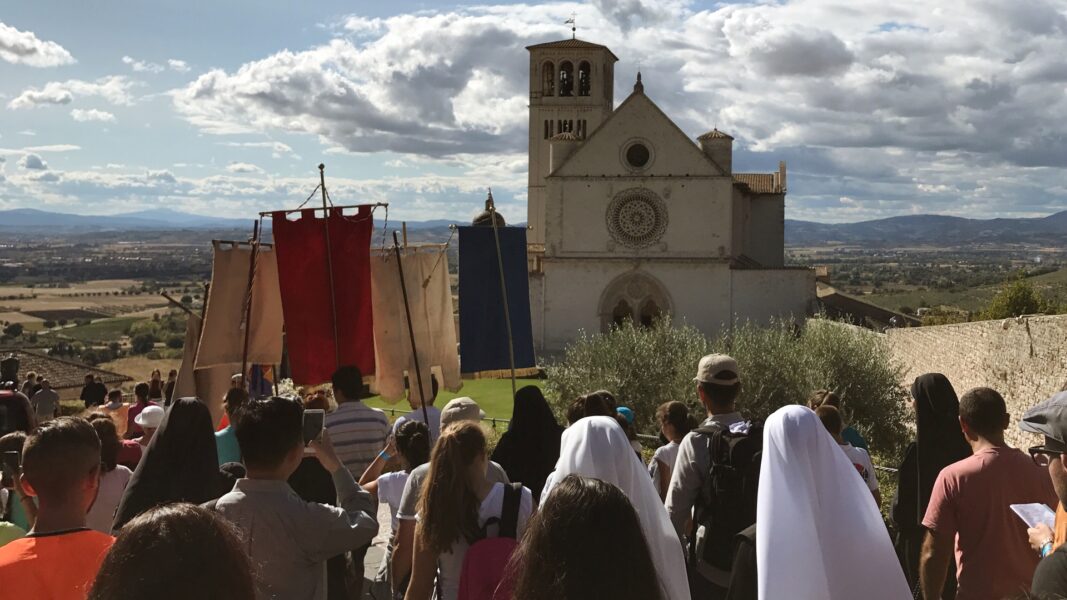
The Priestly Fraternity of Saint Pius X (FSSPX) had to conclude its traditional pilgrimage from Bevagna at the doors of the Basilica of Saint Francis of Assisi in Italy last weekend. Pilgrims were allowed to enter the church individually or in small groups to pray privately, but the Fraternity was not granted permission to enter as a community and publicly conclude the day with the singing of the Creed.
This decision adds to the restrictions the FSSPX has faced in recent weeks in Lourdes and Mariazell, following the episcopal consecrations in Écône on July 1 and the confirmation of the excommunication by Rome.
In Assisi, the Basilica authorities justified the measure citing the Fraternity’s canonical situation and the rules governing public prayers inside the church. The FSSPX, for its part, questions being prevented from praying publicly in a city that, within a few weeks, will once again host a major ecumenical and interreligious gathering.
The Creed, at the Doors of the Basilica
The FSSPX’s national pilgrimage had begun on Saturday, September 5, and followed the route between Bevagna and Assisi, in the Italian region of Umbria. This year’s gathering was themed around a phrase from Saint Francis’s third Admonition: “Even if you do not obey him, do not abandon him.”
Upon arriving at the Basilica of Saint Francis on Sunday, the Fraternity intended to conclude the pilgrimage by singing the Creed inside. According to a statement later issued by the FSSPX’s Italian District, priests and faithful were informed that they could enter in small groups to pray privately, but not as a community to perform a public prayer.
The superior of the Italian District, Father Gabriele D’Avino, delivered the final exhortation at the doors of the Basilica, and the pilgrims sang the Creed there.
The FSSPX Highlights the Contrast with the Interreligious Gathering
D’Avino devoted much of his address to the upcoming 40th anniversary of the interreligious gathering in Assisi, originally convened by Saint John Paul II on October 27, 1986.
The Italian superior contrasted the impossibility of the Fraternity publicly concluding its pilgrimage inside the Basilica with the upcoming presence in Assisi of representatives from various Christian denominations and religions.
D’Avino described the latter as “false cults” and specifically mentioned Islam, Judaism, Eastern and animist religions, as well as Protestant denominations.
“Once again, everyone is welcome—even the most remote pagans of the globe—but not those who wish to remain children of the Roman Catholic Apostolic Church without compromise,” he stated.
The priest also maintained that representatives of other religions “will pray publicly in the churches of the city of Assisi,” as occurred during the 1986 event.
The Franciscans Explain the Refusal
The Conventual Franciscan friars of the Sacred Convent of Saint Francis of Assisi responded to the FSSPX’s statements and offered their own explanation of the decision.
Friar Giulio Cesareo, on behalf of the community, acknowledged “the displeasure and disappointment” of the pilgrims for not being able to conclude the day as planned.
Cesareo explained, however, that inside the Basilica “no one may pray publicly in an autonomous manner,” since the church has scheduled public celebrations. He added that, as a Catholic place of worship, only liturgical celebrations and public prayers by faithful belonging to the Catholic Church “in full communion with the Roman Pontiff” are permitted.
The Franciscans Also Respond Regarding Other Religions
The Sacred Convent also addressed the comparison raised by D’Avino with the interreligious gathering in October.
The Franciscans state that during the commemoration of the 40th anniversary of the 1986 gathering, the churches of Assisi—and in particular the Basilica of Saint Francis—will not host public prayer moments by members of non-Christian religions.
They do anticipate that moments of ecumenical prayer among Christian faithful of different denominations, including Catholics, may be held to ask God for “the gift of peace, unity, and full ecclesial communion.”
This clarification thus contradicts D’Avino’s claim that representatives of non-Christian religions will pray publicly inside the churches of Assisi during the upcoming gathering.
After Lourdes and Mariazell, Assisi
The decision by the Basilica of Saint Francis is not the first of its kind since the episcopal consecrations in Écône.
In Lourdes, France, Bishop Jean-Marc Micas withdrew in August the FSSPX’s authorization to publicly celebrate Mass, administer sacraments, and organize public prayers inside the Shrine. Priests and faithful may still enter and pray privately.
The Fraternity later announced that it would maintain its international pilgrimage to Lourdes scheduled for October, although it will have to adapt it to the new restrictions.
In early September, a second restriction became known in Mariazell, Austria. The Diocese of Graz-Seckau denied the FSSPX access to the basilica this year to hold the public act of its traditional Rosary pilgrimage, scheduled for October 4. In this case, neither the celebration of Mass nor the administration of sacraments was planned: the program included the Rosary, the Litany of Loreto, Marian hymns, and a blessing.
Read also: After Lourdes, Mariazell: the FSSPX also unable to hold its annual Rosary at the Austrian shrine
The pilgrimage to Assisi now adds a third episode to this series of restrictions on the Fraternity’s public acts. Unlike Lourdes and Mariazell, where the upcoming pilgrimages have yet to take place, in Assisi the measure has already been applied: the annual journey between Bevagna and the city of Saint Francis ended on Sunday at the doors of the Basilica, where the pilgrims sang the Creed they had intended to sing inside.