


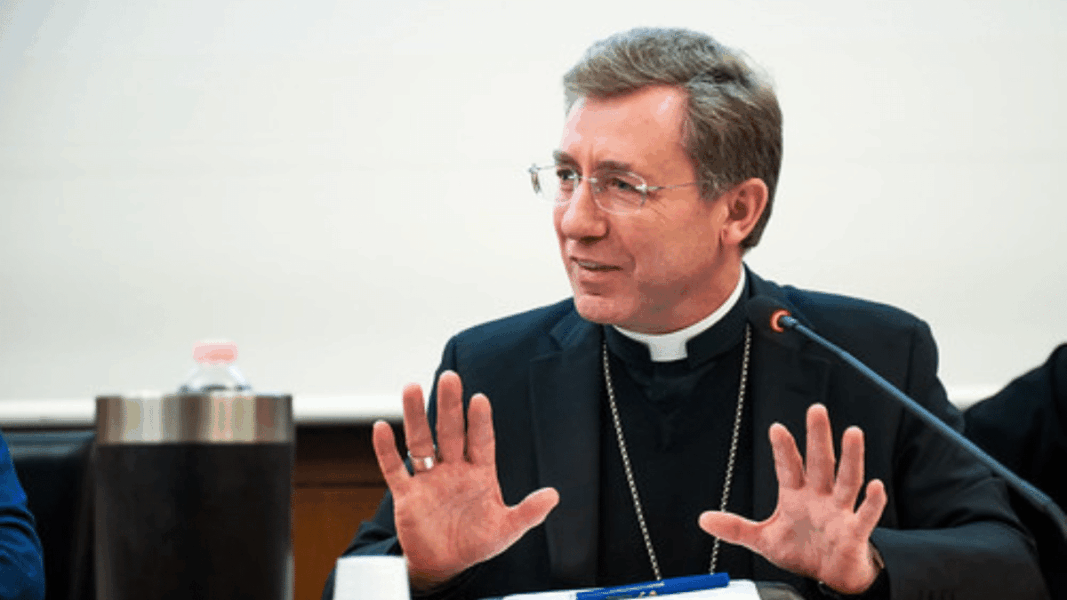
The Vatican has recalled that the inculturation of the liturgy does not allow for the arbitrary introduction of cultural elements into celebrations nor does it justify syncretism, folklore, or permanent innovation. This was stated by Monsignor Aurelio García Macías, Undersecretary of the Dicastery for Divine Worship and the Discipline of the Sacraments, during an address to 49 recently appointed bishops gathered in Rome.
“The liturgy does not belong to the priest who celebrates, to the group that prepares it, or to the particular community that participates in it. The liturgy belongs to Christ and to the Church,” the Spanish prelate affirmed.
García Macías addressed the issue of inculturation during the formation course organized in Rome for the new bishops under the Dicastery for Evangelization, coming from mission territories. His intervention focused on the criteria that should govern liturgical adaptation and on the limits imposed by the very nature of the liturgy.
“It is not enough to add a traditional song or introduce a dance”
The Undersecretary of the Dicastery for Divine Worship warned against a superficial conception of inculturation based simply on incorporating certain elements of local cultures into the celebration.
“It is not enough to add a traditional song, introduce a dance, use a local musical instrument, or translate a text,” García Macías noted.
According to him, true inculturation requires a deeper encounter between the Gospel and each culture. It can bring elements that are true, good, and beautiful, but it must also allow itself to be judged and transformed by the Christian faith.
“No culture is the Gospel,” he recalled.
The prelate summarized this process by stating that “the Gospel welcomes and purifies, assumes and transforms, confirms and corrects, elevates and, when necessary, calls for a rupture.”
In this way, inculturation does not mean placing cultural customs and Revelation on the same level. Nor does it imply considering European culture as a universal standard: all cultures, he noted, contain valuable elements, but all are also affected by sin and need to be enlightened by the Gospel.
Neither syncretism nor folklore
García Macías particularly insisted that the celebration of the sacraments cannot become a display of cultural elements.
“The liturgy is not a cultural performance,” he affirmed.
The criterion for incorporating an element proper to a given culture must therefore be that it helps to express the mystery being celebrated, fosters the interior participation of the faithful, and is compatible with the faith of the Church.
In this context, the Vatican official pointed out three risks that must be avoided: unnecessary innovation, syncretism, and folklore.
Syncretism introduces into Christian worship beliefs or rites incompatible with the faith; folklore can reduce the celebration to a manifestation of cultural identity, while constant innovation ends up making the liturgy dependent on the preferences of the celebrant or a particular group.
For this reason, García Macías emphasized that inculturation “cannot be improvised.” Its development requires prayer, discernment, competence, a process of maturation, and the approval of the corresponding Church authority.
This principle is also set forth in the conciliar constitution Sacrosanctum Concilium, which establishes that the regulation of the liturgy belongs to the authority of the Church and that deeper adaptations must be studied by the competent territorial ecclesiastical authority and proposed to the Holy See for introduction with its consent.
“Neither a museum of immutable forms nor a permanent laboratory”
The Undersecretary of the Dicastery for Divine Worship also rejected the two extremes that may arise regarding the development of the liturgy.
It, he affirmed, must not become either “a museum of immutable forms” or “a permanent laboratory.” The liturgy maintains an organic continuity precisely because it transmits a received faith and celebrates a mystery that does not belong to each particular community.
Even when the Eucharist is celebrated in distant places or in very different cultures, García Macías recalled, it remains an action of the whole Church and is celebrated in communion with the bishop, with the Roman Pontiff, and with the universal Church.
Cultural diversity can enrich that communion, but not fragment it.
The words of the Vatican official are in continuity with a principle reaffirmed by Francis in Desiderio desideravi, where he recalled that “the celebratory action does not belong to the individual, but to Christ-Church,” and with the teaching of Sacrosanctum Concilium, which defines every liturgical celebration as the work of Christ and of his Body, which is the Church.
García Macías concluded his intervention by summarizing the principle that, in his view, should guide any process of inculturation: “The liturgy is not our work. It is Christ who continues to act in his Church.”