


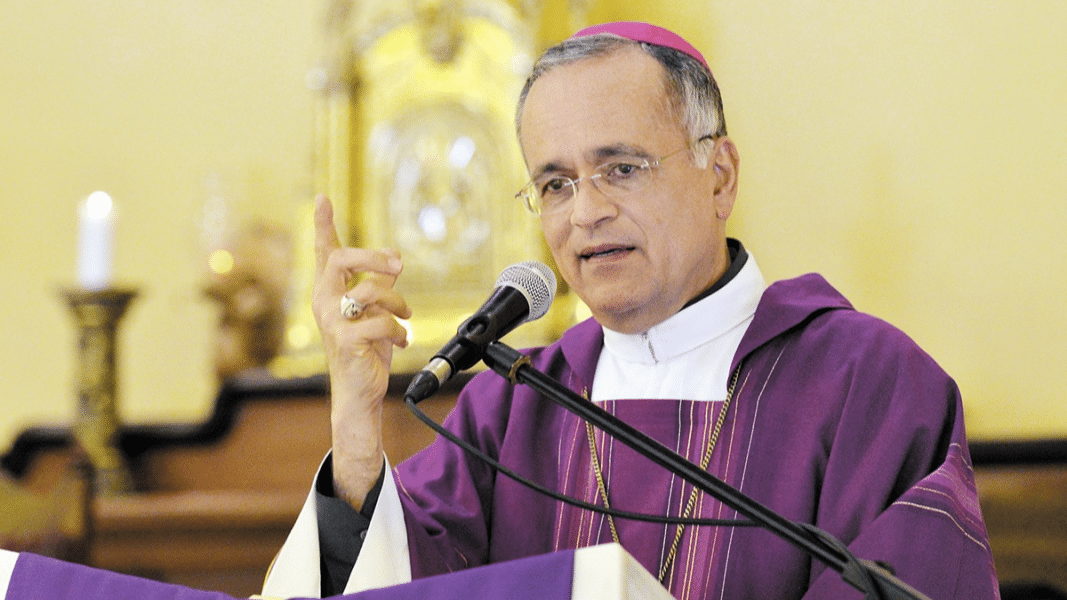
Auxiliary Bishop of Managua, Monsignor Silvio Báez, has called on Christians not to remain passive in the face of dictatorships and abuses of power and has warned that remaining silent in the face of injustice can turn the person who does so into an accomplice. The Nicaraguan prelate, exiled in the United States, spoke these words during the Mass he presided over on Sunday, September 6, at the parish of Santa Agatha in Miami.
“We cannot be passive spectators while dictatorships impose abusive political structures that not only destroy democracy, but also attack the freedom of the people and their right to be the subject of their own history,” Báez stated during the homily, according to ACI Prensa.
His words come just days after the National Assembly of Nicaragua, controlled by the regime of Daniel Ortega and Rosario Murillo, approved in its first legislative session a new constitutional reform that extends the presidential term and establishes new restrictions to prevent electoral participation by those considered “traitors to the homeland.”
“Peoples need sentinels”
Báez structured his reflection around the biblical figure of the sentinel found in the book of Ezekiel. According to his explanation, the prophet has the responsibility to listen to God, denounce evil, and warn of its consequences even when doing so may bring persecution.
“A prophet listens to what God tells him and does not remain silent: he denounces evil, warns of its consequences, and calls for conversion, even knowing that this mission may cost him persecution and even his life,” he noted.
The bishop added that “peoples need sentinels who denounce evil when it becomes entrenched in power” and warned against indifference in the face of abuses.
“Remaining silent in the face of injustice to avoid conflicts or looking the other way so as not to get involved makes us accomplices, just like the sentinel who sees danger coming and does not sound the alarm,” he maintained.
The auxiliary bishop of Managua insisted that denouncing political abuses should not be confused with incitement to confrontation. “Denouncing these arbitrary acts is not a speech of hatred nor an attack on peace. Called by God to be sentinels of history, Christians denounce injustice as a requirement of faith and love.”
A new constitutional reform by the regime
Although Báez did not directly mention Ortega and Murillo in that passage of his homily, his words come at a time of renewed political hardening in Nicaragua.
The National Assembly approved last week, in its first legislative session, a partial reform of the Constitution that extends the presidential term from six to seven years and establishes that those considered “traitors to the homeland” may not participate in electoral processes. The reform must be approved again in the next legislative session to come definitively into force.
The measure has received criticism both inside and outside the country and adds to the process of power concentration developed in recent years by Ortega and Murillo.
Báez personally knows the consequences of confronting the regime. The auxiliary bishop of Managua left Nicaragua in 2019 after receiving threats against his life. The prelate himself revealed years later that it was Pope Francis who ordered him to leave the country because he did not want “another martyred bishop” in Central America.
Since then he has resided in the United States and exercises his pastoral ministry from Miami, without having ceased to be auxiliary bishop of Managua.
Fraternal correction
Political denunciation was part of a broader homily in which Báez also reflected on the responsibility of Christians toward others and on fraternal correction.
The bishop maintained that this should be exercised “with frankness but with mercy, with promptness but with patience” and not with the intention of imposing oneself on the other.
“A brother who is recovered is a treasure that no other gain can equal. Correcting to win over the brother requires delicacy: speaking without humiliating, dialoguing and listening, seeking his good and not his condemnation, trying to convince him rather than defeat him,” he stated.
“Whoever truly loves us knows how to correct us; whoever does not love us only knows how to wound us or flatter us,” he concluded.