


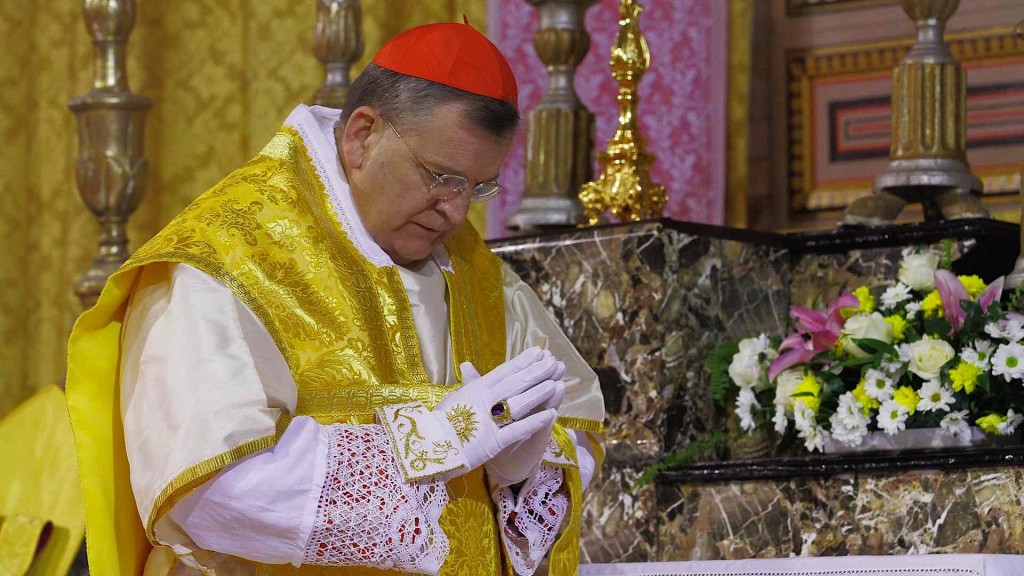
Cardinal Raymond Leo Burke has publicly defended the title of Mary Co-redemptrix, months after the Dicastery for the Doctrine of the Faith established in the note Mater Populi fidelis that its use is “always inopportune” to express the Virgin’s cooperation in the work of Redemption.
Burke spoke on Sunday at St. Bavo’s Cathedral in Haarlem (Netherlands) during an address dedicated to the Virgin Mary’s cooperation in Christ’s salvific work. According to The Catholic Herald, which claims to have received a copy of his address from the cardinal’s office, Burke explicitly stated: “The Blessed Virgin Mary is Co-redemptrix, that is, she participates in a unique way in the salvific work of Our Lord”.
The cardinal immediately clarified the sense in which he uses the term and subordinated it to the sole Redemption accomplished by Christ. “We, by virtue of Baptism and Confirmation, are co-redeemers, that is, we participate in the salvific work of Our Lord by sanctifying the portion of his vineyard that He has entrusted to our care,” he noted.
Burke also insisted that this cooperation does not presuppose any insufficiency in Christ’s sacrifice. “It is not that the Sacrifice of Our Lord is in any way defective. It is perfect and bestows divine grace and eternal life on all who unite themselves to Our Lord in his Sacrifice,” he explained.
“The only thing lacking is our wholehearted participation in the Sacrifice of Our Lord, taking up the Cross each day and following him,” he added.
Burke: Mary cooperates in an “irreplaceable” way in the Redemption
Throughout his address, Burke drew on Scripture and theological tradition to explain the Virgin’s singular place in the economy of salvation.
Commenting on the prophecy of Isaiah, he maintained that the divine promise “is fulfilled, first and most perfectly, in the life of the Blessed Virgin Mary through her irreplaceable cooperation in the Mystery of the redemptive Incarnation.”
This cooperation, he added, is also meant to continue in the lives of Christians: “It must be fulfilled in each of our lives as collaborators, with the Virgin Mother of God, in the work of Redemption of her divine Son.”
Burke’s words take on special relevance after the publication, on November 4, 2025, of Mater Populi fidelis, the doctrinal note of the Dicastery for the Doctrine of the Faith on certain Marian titles related to Mary’s cooperation in salvation.
The document was approved by Leo XIV on October 7, 2025 and ordered for publication. The note expressly acknowledges that the title Co-redemptrix appeared in the fifteenth century, that it was used by some popes, and that St. John Paul II referred to Mary as Co-redemptrix “at least seven times”.
It also recalls that during the pontificate of St. Pius X the term appeared in documents of the Congregation of Rites and the Holy Office, and records the use of the title by Pius XI.
Mater Populi fidelis: the title is “always inopportune”
Despite acknowledging these precedents, the Dicastery presided over by Cardinal Victor Manuel Fernández reached a conclusion contrary to the advisability of continuing to use the title.
“Taking into account the need to explain Mary’s subordinate role to Christ in the work of Redemption, the use of the title Co-redemptrix to define Mary’s cooperation is always inopportune,” states number 22 of Mater Populi fidelis.
The Dicastery for the Doctrine of the Faith argues that the term “risks obscuring the unique salvific mediation of Christ” and may cause “confusion and an imbalance in the harmony of the truths of the Christian faith.” According to the note, when an expression requires constant explanations to avoid incorrect interpretations, it ceases to render adequate service to the faith of the People of God.
The document does not, however, deny Mary’s cooperation in salvation. On the contrary, it affirms that her “yes” was not a merely passive condition and describes her motherhood as “fully active” and united to Christ’s salvific mystery as an instrument willed by the Father.
The difference therefore centers on the appropriateness of the title Co-redemptrix and on the way of theologically expressing this Marian cooperation.
Ratzinger and Francis, among the note’s arguments
Mater Populi fidelis also records the position of Joseph Ratzinger. In 1996, as prefect of the then Congregation for the Doctrine of the Faith, he responded negatively to a proposal to define Mary dogmatically as “Co-redemptrix” or “Mediatrix of all graces,” considering that the precise meaning of those expressions was not sufficiently clear and that the doctrine contained in them was not mature for a dogmatic definition.
Subsequently, in 2002, Ratzinger publicly expressed his reservations about the term, considering that it departed excessively from the language of Scripture and the Fathers and could give rise to misunderstandings.
The note also records the repeated objections of Pope Francis, who rejected the title on several occasions and maintained that Christ “is the only Redeemer.” The Dicastery for the Doctrine of the Faith uses these interventions to reinforce its argument in favor of preserving with absolute clarity the uniqueness of the redemptive mediation of Jesus Christ.
Burke’s intervention now stands in a different direction regarding the appropriateness of employing the title, although the cardinal expressly formulates Mary’s cooperation as subordinate to the perfect and sufficient work of Christ.
The debate will likely continue in Rome. Burke will participate at the beginning of October in a mariological conference in which, according to the organizers cited by The Catholic Herald, the question of Mary Co-redemptrix is expected to be explored once again.