


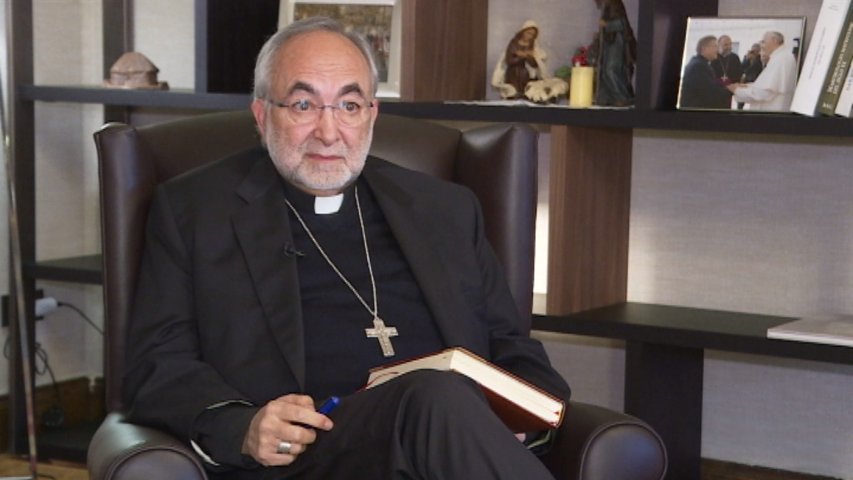
The Archbishop of Oviedo, Jesús Sanz Montes, has once again referred to the invasion suffered in Ceuta on July 30 and rejected the idea that it can be interpreted simply as a migratory phenomenon. In his latest weekly letter, published on Sunday under the title After an Unforgettable Summer, the prelate maintains that it was «a calculated stalking» that exposed the vulnerability of Spanish and European borders.
Sanz Montes devotes part of his reflection to the balance of a summer marked by wars, natural disasters, and «dictatorial governances» that threaten «freedom and coexistence». In that context, he places what happened in Ceuta and warns that Melilla and the Canary Islands also remain «in the crosshairs».
«It is not just a migratory flow, as some insisted on saying, but a calculated stalking that has brought to light our weakness in the geopolitical landscape of our Spanish borders, which are also Europe’s», the archbishop states.
The prelate describes what happened as «a true avalanche that has invaded us» and speaks directly of «a hybrid war» with «almost eighty thousand people —mostly young—» who entered the autonomous city. According to Sanz Montes, the situation left the Ceuta population «besieged between fear, rot, intimidation, and the rape of minors».
«It was known, they hid it, and they weighed the benefit of such a tragedy that has claimed many lives in the attempt and has disrupted that corner of Spain under extortion and threat with incalculable daily consequences», he adds.
The words extend the position that Sanz Montes has maintained since the invasion. Last week, from Covadonga, the archbishop appealed to «reconquest» against the «Moroccan pretension» and the «inanition of a failed governance». Previously, he had compared the mass entry to a «new Green March» and spoken of a «sad premeditated invasion».
Read also: The Archbishop of Oviedo appeals from Covadonga to «reconquest» against the «Moroccan pretension»
«Those young invaders are also victims»
The Archbishop of Oviedo combines his denunciation of the geopolitical background of the invasion with a call to attend to those who participated in it. «Those young invaders are also victims who should be properly accompanied», he states.
Sanz Montes points out that many come from countries where they suffer lack of freedom, poverty, absence of opportunities, and religious radicalisms. «We know that so many of them come fleeing from political hells that cut short their dreams of the future by not allowing them to glimpse tomorrow when they are denied freedom, the most basic rights, work, dignity, and hope», he writes.
The prelate also speaks of those who come from situations of hunger or «escape from religious radicalisms that stifle their conscience in the name of a false and tyrannical god that crushes them». These circumstances, he maintains, push many to see Spain and Europe as a possibility to «restart the life that others destroy».
Sanz Montes, however, directs part of his criticism at the countries of origin and, particularly, at Morocco. In his view, these states «benefit from that tremendous stampede», and he alludes to «Morocco’s schemes, its blackmail with well-kept secrets» and the funds they receive from Spain and European institutions instead of addressing the problems that push their citizens to leave.
The memory of León XIV’s words in the Canary Islands
In his letter, the archbishop also recalls the words spoken by León XIV during his recent apostolic visit to Spain, specifically in the Canary Islands, where the Pontiff referred to those who undertake migratory routes.
«They are people with a family and a home left behind; with dreams that no one has the right to despise… Their life must be protected. Do not hand over your existence to those who trade with it. Do not believe those who promise easy paradises in exchange for the body or money, silence or your freedom», Sanz Montes recalls, quoting the Pope.
The archbishop also echoes León XIV’s call for this drama to become an «examination of conscience» for the countries of origin and transit and for «Europe, which cannot proclaim human dignity and become accustomed to the Mediterranean and the Atlantic being cemeteries without tombstones».
The situation of immigrants and the Ceuta population has generated various interventions within the Spanish Church in recent weeks. From the autonomous city itself, the vicar of Ceuta, Francisco Fernández Alcedo, called for preventing the tension arising from the invasion from leading to confrontations between communities and defended the Church’s role as a guarantor of coexistence.
Sanz Montes concludes his letter by taking stock of León XIV’s visit to Spain and presenting it as a sign of hope in the face of an international panorama that, in his words, leaves people «orphaned of hope» and darkens «the horizon of peace and coexistence».
«With him we raise our gaze discovering that there is someone who knows our names, who makes our tears his own and with us toasts to the joy that lifts us up», the archbishop writes.
«Raising our gaze we discover a God who never disappoints us. That is why there is hope that allows us to move forward with our dreams awake and peace in our souls», he concludes.