


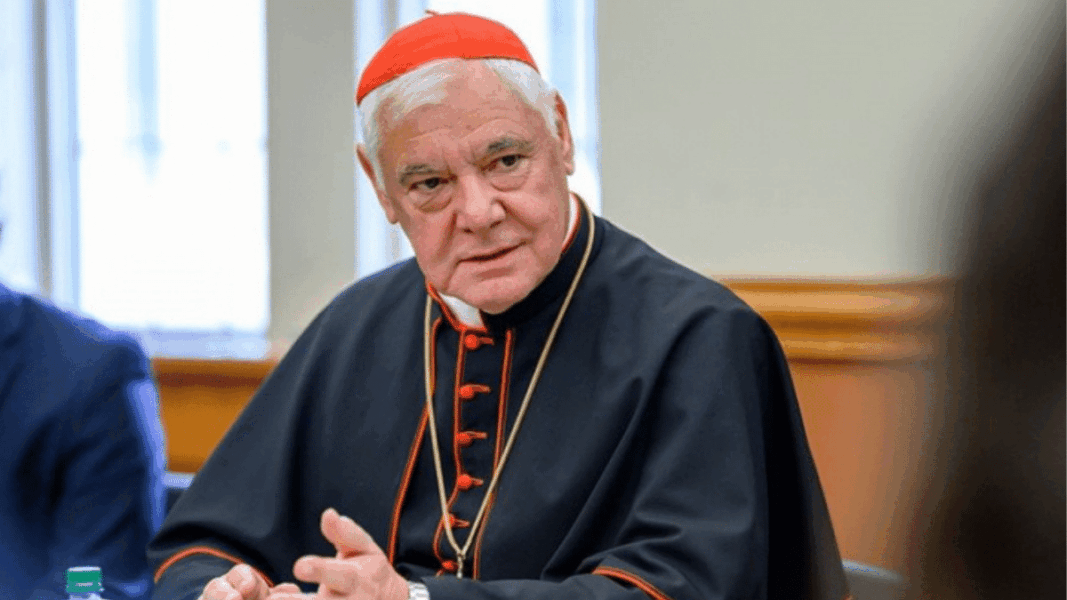
Cardinal Gerhard Ludwig Müller, prefect emeritus of the Congregation for the Doctrine of the Faith, has questioned the interventions of some German bishops regarding the vote for Alternative for Germany (AfD) and has defended that the spiritual authority of pastors cannot be used to favor or harm a political party.
In an article published this Monday by Kath.net under the title Exhortation to Political-Partisan Neutrality, Müller maintains that “some disconcerting statements by German bishops on the occasion of federal, regional and municipal elections require clarification from a theological point of view.”
The intervention comes after statements by various members of the German episcopate against AfD. Among them, the Archbishop of Berlin, Heiner Koch, recently stated that the Church should assume the risk of losing members who vote for this party.
The issue has taken on a new dimension following AfD’s result in Saxony-Anhalt, where the party obtained 44% of the vote. InfoVaticana analyzed on Sunday both the episcopal interventions and the possible consequences that the party’s electoral advance could have for the Kirchensteuer, the German system of church financing through a tax collected by the State.
Müller starts from the proper mission of the episcopate to establish the limits of its political intervention. The apostles and their successors, he recalls, were instituted to proclaim the Gospel, call sinners to conversion and communicate the life of grace through the sacraments.
For this reason, he maintains that bishops and priests “must in no case place their spiritual authority on the scales” in the legitimate competition for the electoral majority of a democratic State “for or against a particular political party.”
“That would be an abuse of spiritual authority for political purposes”, Müller states.
The former head of the Doctrine of the Faith distinguishes this partisan intervention from the obligation to apply moral principles to public life. The Church, he points out, must defend human rights against ideologies contrary to the dignity of the person and speak out on issues that transcend the particular interests of States, such as peace, social justice or human dignity.
Müller rejects attributing a racist ideology to AfD voters
The cardinal recalls that the Christian conception of man leads to rejecting any classification of persons according to “estates, classes, castes and races.” However, he considers that this cannot automatically be deduced to mean that voters of a particular party share a racist ideology.
Attributing in advance to a party and its voters an “ethnic-racial” way of thinking constitutes, according to Müller, “an unproven statement of fact”.
The prelate adds that it is “difficult or impossible to understand” that millions of German citizens have embraced an ideology that would openly violate natural moral law and Christian anthropology. If that had really happened, he maintains, one would also have to ask about the responsibility of the Church itself—in families, parishes and religious education—in the formation of consciences.
“A bishop cannot accept the loss of AfD voters”
Müller expressly addresses the consequences that episcopal statements may have on Catholics who vote for AfD.
“A Catholic bishop, who is expected not only to know the Church’s doctrine but also to present it correctly, cannot in any case accept the ‘loss of AfD voters’,” he maintains.
The statement directly responds to the debate sparked by Koch’s words. When asked whether the Church should assume the risk of losing members who vote for AfD because of its political stance, the Archbishop of Berlin replied: “Yes, we must take that risk.”
Müller warns that these faithful may end up feeling “misunderstood, betrayed and rejected” by the Church because of what he describes as “purely hypothetical assumptions.”
For the cardinal, membership in the Church is not determined by partisan preference. The Christian is incorporated into it through faith in Jesus Christ and Baptism, by which he becomes part of the Body of Christ.
At the same time, the prelate acknowledges that the Magisterium has “the right and the duty” to warn a Catholic when he endangers his salvation by denying essential truths of the faith or gravely violating the commandments. He expressly includes among these cases the “illegal and inhumane” treatment of foreigners, even those who are in Germany irregularly.
However, he maintains that this spiritual authority does not extend to imposing a particular electoral choice on Catholics who disagree with a bishop’s personal political preferences.
“Every Catholic has the right” to decide their vote
Müller then formulates one of the central principles of his article: “In democratic elections, every Catholic has the right to give his vote to the party he considers capable of solving the country’s problems better than the other parties”.
He introduces, however, a limit: that freedom presupposes that the elected government “does not resort to immoral means nor flirt with them.”
The cardinal also distinguishes between the pastoral authority of the bishop and his condition as a citizen. In the political and electoral sphere, he maintains, a prelate is a citizen with the same rights as everyone else.
“Which party obtains the majority should be left calmly in the hands of the voters and the protection of democracy in the hands of the competent state bodies,” he states.
Müller summarizes this distinction by contrasting the functions of civil institutions and those of the hierarchy: “The guardian of democracy in the name of the people is the Federal Constitutional Court; the bishops, on the other hand, are in the name of Christ pastors of souls and models for the flock of God”.
This does not exclude, he clarifies, that bishops urge those competing politically not to treat their opponents as enemies and to respect them as persons, with the aim of preserving the basic consensus of a democratic society.
“The bishops are pastors of souls”
In the final part of his reflection, Müller considers it “a grave scandal” that bishops, priests, associations or Catholic institutions appear alongside “political-ideological agitators” when this causes the Church to end up presenting itself as a political actor.
In his view, this identification can blur the Church’s proper mission as “the sacrament of God’s universal salvific will.”
The cardinal finally turns to the Second Vatican Council and cites Lumen gentium, recalling that the Church “was not instituted to seek earthly glory,” but to continue Christ’s mission and serve especially those who suffer.
“To keep a temporarily elected government in power or to satisfy the power aspirations of parties and coalitions, a bishop must never endanger the eternal salvation of those Catholics who do not vote as he would like,” Müller concludes.