


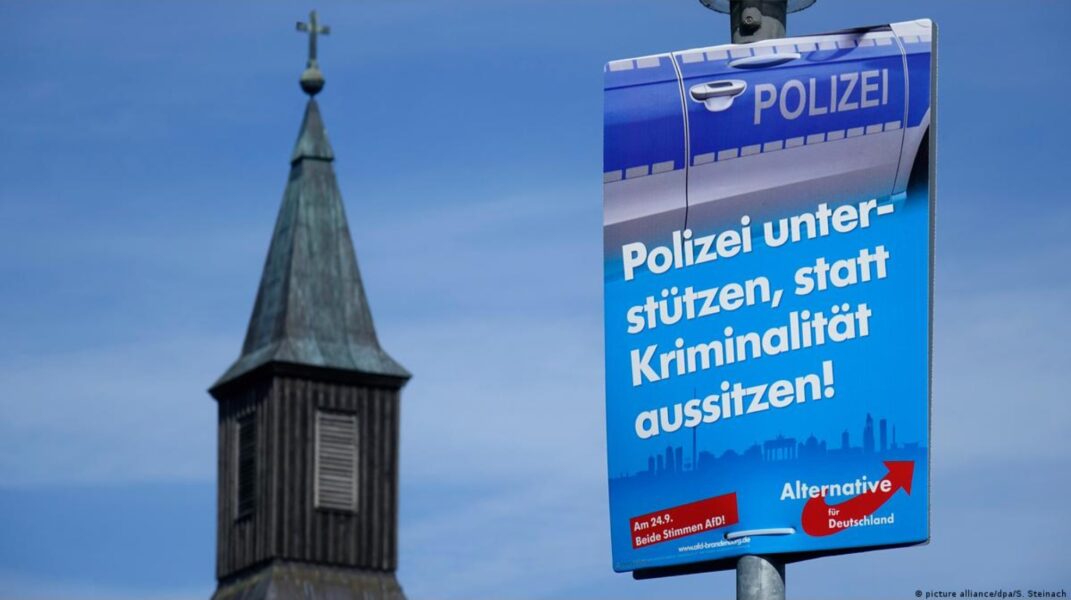
COPE, the radio station of the Spanish bishops, has given a sympathetic platform this Sunday to the statements of the Bishop of Magdeburg, Gerhard Feige, on the eve of regional elections in Germany. The prelate calls for a vote against a specific party and, faced with the possibility that citizens may not obey him, slips in the phrase that sums up the aggressive arrogance with which prelates judge political issues: “not everyone who is elected democratically is a democrat.”
“Gerhard Feige has called for a vote against extremism in the elections being held this Sunday in the German state, recalling that being a Christian today means ‘resisting the xenophobic spirit’”.
COPE, Universal Church — José Melero Campos, 6 September 2026
Alternative for Germany is growing unstoppable: the second national force in the last federal elections, first in polls in much of the east of the country and now, according to surveys, close to an absolute majority in Saxony-Anhalt, with 43% of the estimated vote. Faced with this rise, the German episcopate has opted for open belligerence: collective statements declaring the party ineligible for a Christian, bans on its members holding church positions, electoral homilies. A Church with ever-emptying temples has decided to take to the hills of party politics, and it has done so against the party that millions of its baptized members vote for.
Uttered by a mitred pastor forty-eight hours before the ballot boxes, that sentence has little of academic reflection on Weimar and much of the anticipated delegitimization of a result that is expected to be adverse. If millions of Saxons vote badly, the problem will be with the voters themselves, “seduced,” morally underage, in need of episcopal tutelage.
The Catechism clearly recognizes the right of nations to regulate their borders and subordinates the duty of welcome to the common good. Defending limited, orderly and rational immigration, with the return of those who enter or remain illegally, is a position as legitimate as it is Catholic. Presenting it as a “xenophobic spirit” that the Christian must “resist” means sacralizing a specific political option, exactly what the hierarchy has been reproaching for years when the need to support parties that defend the non-negotiable principles of family and life is put on the table.
Reality, stubborn and verifiable, refutes the model that is offered to us as the only morally admissible one: the immigrationist vision of the hierarchies. The great European capitals that tried unlimited reception without serious demands for integration—from the Parisian suburbs to the neighborhoods of Brussels or Malmö—today show deep social fractures, entrenched ghettos and growing insecurity that is paid for, above all, by the humblest neighbors. Nor is it necessary to cross the Pyrenees: Ceuta is enduring exhausting migratory pressure that overwhelms its services and that no episcopal document alleviates.
To what extent is the welfare fervor of certain church structures that manage substantial public funds linked to reception disinterested? A charity financed with state budgets dangerously blurs the line between prophecy and the defense of one’s own economic model, and that line deserves, at the very least, a calm examination.
The Magdeburg episode transcends the German context. It functions as a dress rehearsal for a method that some Spanish prelates are already practicing among us: elevating a debatable prudential option to the category of dogma, signaling half the faithful as morally suspect and, if necessary, insinuating that their vote is illegitimate and that they are not democrats. The Church has full authority to preach the dignity of every person, including that of the immigrant. It lacks the authority to politically excommunicate those who, from that same faith, conclude that a country unable to control its borders ends up unable to welcome anyone well. A radio station that belongs to all Spanish Catholics—also to those who think this way—would do well to remember that.