


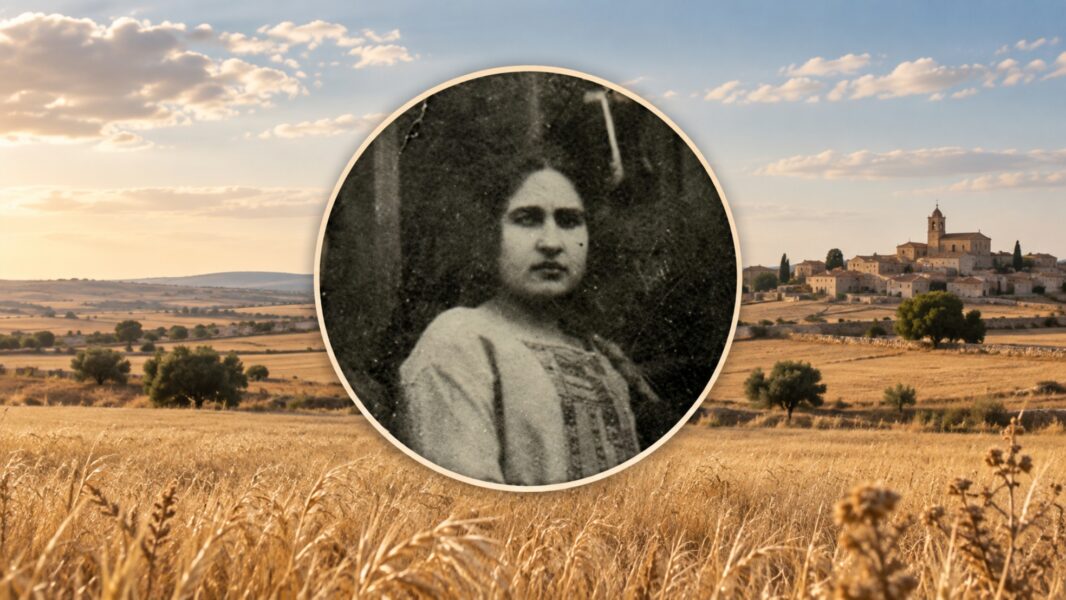
After ninety years, her virgin blood cries out
Msgr. Alberto José González Chaves
On this 6th of September, ninety years will have passed since a dawn that La Mancha should never forget. Somewhere in the countryside of Cuenca, near Casas de Luján, between Villamayor de Santiago and Saelices, when night was beginning to yield to the first light of day, a twenty-seven-year-old woman named María de la Piedad Suárez de Figueroa y Moya, “Piedaíta” to all who knew her, fell victim to a hatred whose brutality still horrifies today. She did not die in battle, nor did she fall by chance in one of those indistinct episodes that some prefer to dilute under the vague expression of “war violence.” She was arrested, pursued, humiliated, violated, and murdered after having been targeted for months because of what she was and what she represented.
Her story, moreover, possesses a documentary feature that makes it especially uncomfortable for the “selective and hysterical memory,” which is not historical. It was not necessary to wait until the end of the war to investigate the crime, nor was it necessary to construct a propagandistic narrative about it afterward: the republican courts themselves tried the perpetrators in 1937, while the conflict was still ongoing and Cuenca remained under Republican control. The fundamental facts were thus incorporated into a case file and a sentence that today constitute one of the most compelling testimonies of that night: we know who was murdered, how, and by whom.
A girl who was too Catholic
Piedaíta was born in Villanueva de Alcardete on February 16, 1909, into a well-to-do family. It would be all too easy, however, to explain her persecution solely by the social status of her household, as if it were enough to place her in a certain class to understand the hatred that had been accumulating around her. There was something far more visible in Piedaíta, and far more irritating to a Marxist revolution that sought to eradicate Catholicism (not so much Christianity, for the Lutherans were not persecuted, though they were few): she was a militant Catholic in the noblest sense of the word and recognizable as such in her town.
Her faith was not a distant baptism or a religiosity of good family. She lived on the Holy Mass, frequent communion, the rosary, mental prayer, devotion to the Virgin and Saint Joseph; she taught catechism, attended to concrete needs, collaborated with the parish, and cared for the Christian formation of young women from humble families, many of them connected to the household workers or to people of the countryside. She was an active member of the Daughters of Mary and eventually presided over the local association, organizing devotions, encouraging sacramental life, and exercising an apostolic influence that went far beyond the strictly devotional.
This profile explains better than any simplification why she became a target. An educated girl, socially visible, deeply religious, and capable of drawing other young women toward the Christian life could prove far more uncomfortable than a political adversary: she did not give speeches but prayed, taught, received communion, and did not hide her faith. From 1931 onward, that was enough. And the fact that she was president of the Daughters of Mary turned an innocent apostolate into a mark of identification.
During one of her first arrests, when she was threatened because of that religious activity, a phrase was associated with her that sums her up: better to die than to be unfaithful. Great words, when spoken before the real danger arrives, are not rhetoric; in Piedaíta they acquired a terrifying literalness.
They already had her name
From the summer of 1936 onward, violence ceased to be a general threat and became a concrete presence around her family. There were raids, arrests, insults, threats, and assaults. Her brother Amalio was murdered and dismembered; her mother, Doña Aureliana Moya, also knew prison.
When several militiamen burst into the house and attempted to abuse her, Piedaíta put up a desperate resistance and managed to prevent the assault at that time, although she ended up physically exhausted. To such an extent had she ceased to be protected by an ordinary framework of coexistence: she was not a citizen subjected to an investigation or a political accusation, but a hunted prey.
The family understood that they had to leave. Doña Aureliana obtained a safe-conduct to travel with her daughter to Madrid, and a way of escape seemed to open. But documentary protection was worth little where local committees had in fact replaced authority and claimed powers of detention, judgment, and punishment. Mother and daughter had to stop in Villamayor de Santiago, and there the encirclement closed definitively. They were taken to the Town Hall, interrogated, detained, and handed over to those who had decided that they would not continue the journey. There would be no Madrid: only the road to Luján remained.
The night when everything was permitted
Around midnight between the 5th and 6th of September 1936, Piedaíta and her mother were taken from Villamayor and driven by car toward Casas de Luján. The place would forever afterward be associated with their names, just as so many wastelands, cemetery walls, ditches, and secondary roads were linked during those months to the final fate of thousands of decent Spaniards.
If modesty must accompany the narration of martyrdom—not all suffering need be described in detail, because cruelty can become spectacle and grant the executioner a prominence he does not deserve—neither is it licit to sugarcoat the facts. Piedaíta was not killed by a single shot: first she was subjected to collective rape; afterward she was shot and mutilated, her mother having to witness it before also being murdered.
The twenty-seven years of Piedaíta, cut down in flower, evoke the young martyrs of the early centuries, when violence against the body was intended to be a final victory over a conscience that could not be subdued in any other way. The centuries and vocabularies change, but the old barbarity repeats itself: when the will cannot be conquered, an attempt is made to humiliate the body; if a renunciation cannot be extracted, the victim’s flesh is turned into a terrain of domination.
And yet, even in that extreme form of violence, a boundary remains that the executioner cannot cross. He can impose pain, nakedness, and death, but he cannot impose consent. He will destroy a body, but not the interior freedom of the one who refuses to surrender it. In that ultimate impotence of the persecutor is already found, paradoxically, his defeat.
An incontestable case file
Piedaíta’s story possesses a particular force because it does not rest exclusively on family memories, testimonies of devotion, or postwar reconstructions. In 1937, while the Republic was still fighting a war whose outcome no one could take for granted, the Popular Tribunal of Cuenca investigated and tried the crime. The investigation identified those responsible, examined statements, reconstructed what had happened, and ended by pronouncing sentence on May 31 of that year.
Five of the accused were sentenced to death and others received severe prison terms. The proceedings left behind documentation that today is uncomfortably eloquent: it was not the victors of 1939 who invented the atrocity of Luján, but a republican tribunal that considered it sufficiently proven to impose the maximum penalties provided by law.
This fact should suffice to dismantle one of the most frequent alibis used to neutralize the anti-Catholic violence of 1936: reducing it to “Francoist propaganda” or to a narrative constructed years later. In Piedaíta’s case, the essential evidence precedes the end of the war: the very “republican legality” in this instance recognized that committees and militiamen had crossed limits that even that revolutionary situation should not have tolerated.
Now, historical precision requires that planes not be confused. The Popular Tribunal judged murders, rapes, and criminal responsibilities; it did not judge martyrdom. The Church, for its part, must determine whether Piedaíta was killed formally out of hatred for the faith and whether she received death with the interior dispositions required for canonical recognition. But that necessary distinction does not turn the religious context into a later invention. Piedaíta was known for her apostolic life, had been arrested in connection with her position as president of the Daughters of Mary, and was caught up in a persecution in which churches, images, archives, bishops, priests, religious, nuns, and Catholic laity were systematically attacked. If History does not canonize, still less can it pretend not to see.
What violence could not touch
Piedaíta has often been presented as a martyr of purity, a venerable expression but one that today requires an especially careful explanation. Christian purity cannot be measured by the physical outcome of an assault suffered against one’s will. A raped woman does not lose her purity; the one who degrades himself is the rapist. Violence imposed from outside can wound the body, even destroy it, but it has no capacity to contaminate the victim morally. That is why Piedaíta’s purity must be understood on a much deeper level: it consisted in the interior unity of one who had previously surrendered her life to Christ and did not accept that fear, pressure, or suffering redefine that belonging. What for years had nourished her in the Eucharist, in prayer, in the rosary, in her apostolate, and in her daily self-giving was subjected in Luján to the ultimate test.
Here is a truth that the modern world finds difficult to understand: personal dignity does not depend on keeping intact a physical invulnerability that no one possesses, but on a deeper freedom that can be maintained even when everything external has been taken away. Piedaíta suffered one of the most humiliating forms of violence, but her executioners did not succeed in turning that humiliation into consent. They could not force her to desire what she endured, nor to renounce what she loved, nor to surrender to them that secret region of the soul where a person remains free even when defenseless. That failure of the executioner is the victim’s victory.
Partisan un-memory
Ninety years later, Piedaíta continues to be uncomfortable because she forces us to formulate an elementary question: can a society speak seriously of memory if it decides in advance which victims deserve to be remembered and which must remain on the margins?
For decades Spain has invoked historical memory, democratic memory, and the moral reparation of those who suffered political violence. Every serious effort to know the truth, identify the victims, and restore dignities is legitimate. But that memory ceases to be moral as soon as it begins to classify the dead according to their ideological utility. If a victim deserves a name, a grave, and a tribute only when she fits into the narrative of a particular political tradition, then we are no longer dealing with memory but with a partisan administration of suffering. Piedaíta forces us to look that contradiction in the face. She was a twenty-seven-year-old girl, Catholic, president of a Marian association, violated and murdered by militiamen. Recognizing that fact does not require denying the crimes committed by the other side, nor absolutely justifying the subsequent repression, nor turning pain into a weapon of political combat, but it does at least require applying the same human measure to all.
A victim is one before knowing who killed her, and if, in order to decide whether she deserves compassion, we must first ask which side she was on, we have lost something far graver than a historiographical battle: the sense of justice.
In Piedaíta’s case, moreover, the silence is even more difficult to justify because uncertainty of documentation cannot be alleged. The Republic investigated her murder. The Republic tried her killers. The Republic condemned them. Eighty-nine years after that sentence and ninety after the crime, the least that can be asked is that no one attempt to erase from memory what even her contemporaries could not deny.
Martyrdom did not begin in the ditch
To speak of the martyrs is not to concentrate everything on the final minutes, as if holiness were born suddenly at the moment of the shot. But Christian martyrdom is not a spectacular death that automatically turns a victim into a saint; it is the culmination of an existence that, long before, had learned to live in fidelity.
That is why the true story of Piedaíta does not begin in Casas de Luján but many years earlier, in a young woman who learned to pray, to receive communion, to attend to the poor, to teach catechism, and to use her social position to draw other young women to the faith. It begins in an ordinary life lived with a coherence that did not seem heroic when no extraordinary price had to be paid for it. Persecution did not create that fidelity: it revealed it.
Here lies the essential difference between a victim and a martyr. Every unjust death deserves memory and justice, but martyrdom adds something distinct: an existence that becomes testimony precisely because the persecutor attempts to force it to abandon that for which it lives. Blood does not create faith; it reveals how far it reached.
That is why the Church’s prudence in these causes does not diminish the greatness of its protagonists but preserves it from any sentimentalism. An atrocious death is not beatified for being atrocious, nor is a victim canonized for having suffered much. A fidelity tested to the extreme is recognized.
The medal of Mary upon her remains
Piedaíta’s remains currently rest in the parish church of Santiago Apóstol in Villanueva de Alcardete. In 2022 they were recognized and transferred to a new tomb, on which the medal of the Daughters of Mary was placed upon the urn. A more exact symbol could not be found: after the noise of rifles, slogans, committees, nocturnal automobiles, interrogations, prisons, and sentences, what remains upon her remains is a small medal of the Virgin. That insignia belonged to the world her persecutors wanted to make disappear: parishes, pious associations, rosaries, processions, catechesis, young women who gathered to learn to live like the Blessed Virgin Mary. All of that could seem fragile before weapons, but who really won?
Of the murderers we know the names because they appear in a criminal trial. We call Piedaíta by her name because today we pray before her tomb.
And us today?
This 6th of September 2026 marks ninety years since that dawn. Piedaíta would be one hundred seventeen years old today and her name might have faded into the discreet genealogy of a Manchegan family. But those who sought to erase her violently succeeded, without intending to, in introducing her into another, much longer memory.
To make of her a political banner would be to diminish her. Yet neither do we wish to conceal the brutality of her death in the name of a misunderstood reconciliation, because Christian reconciliation is not built upon amnesia but upon forgiven truth. Remembering Piedaíta is not reopening trenches but refusing to accept that some victims have a right to history and others must ask permission to enter it.
The question is not what those men did that night, because the documents allow us to know it with sufficient precision. The question is what convictions we possess today, when a society that enjoys freedoms, comforts, and securities unthinkable for that generation seems increasingly less capable of understanding those who were willing to lose everything rather than betray the Truth.
Piedaíta knew to Whom she belonged. Her executioners were able to arrest her, insult her, beat her, violate her, and kill her. They were able to dispose of her body for a few hours and leave it abandoned in the Manchegan night. What they did not succeed in doing was turning her into what they wanted. They believed that in Luján they had written the end, but ninety years later, Spanish Catholics like Piedaíta do not look upon that dawn as a defeat but as a victory. Hæc est victoria vestra, quæ vincit mundum: fides nostra! (1 Io 5, 4)