


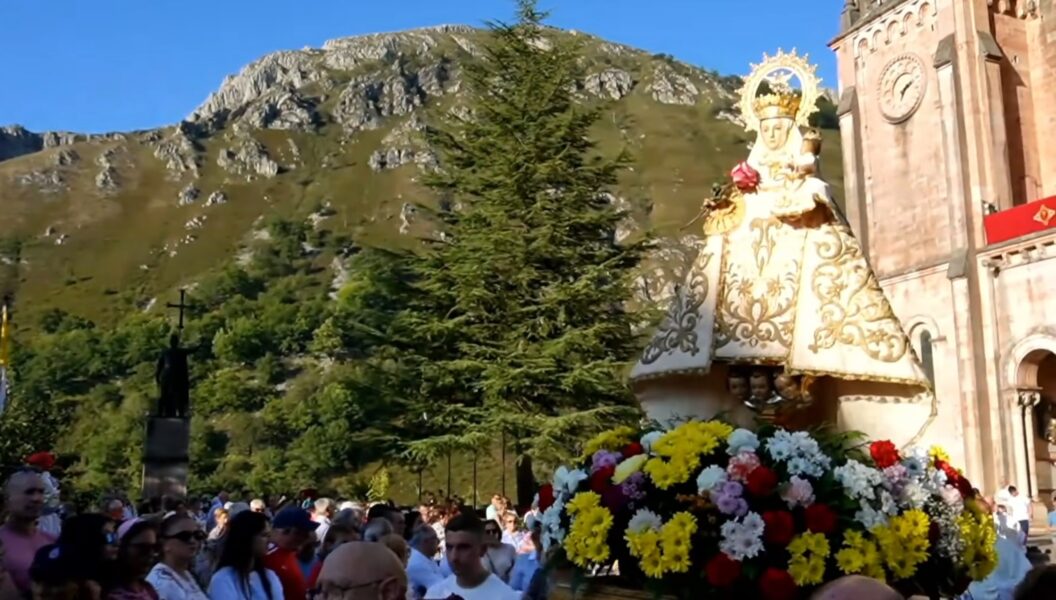
The Novena to Our Lady of Covadonga, celebrated since August 30 under the motto “Blessed Mary,” culminates this Tuesday, September 8, with the solemnity of the Santina, patroness of Asturias and Day of the Principality, in an edition that has far transcended the regional sphere. The sanctuary has become during these days a sounding board for the national debate sparked by the massive entry of more than 70,000 immigrants into Ceuta on July 30 and 31, which the police describe in a recent report as a “planned” operation with possible participation of agents linked to Moroccan security forces.
From the novena to the “reconquest”
The tone was set by the bishop emeritus of Córdoba, Demetrio Fernández, who opened the novena on August 30 with an explicit claim of the historical and Christian significance of the site: “Covadonga is the cradle of Spain,” he stated in the first homily, dedicated to “Mary, Lady of the Beatitudes.”
He was followed by the archbishop of Oviedo. After the demonstrations held on Wednesday across Spain in support of Ceuta and Melilla—with special follow-up in Oviedo and Gijón under the slogan “Ceuta is not for sale, Ceuta is defended”—Sanz Montes wrote on his X account: “Spain staged its solidarity with Ceuta and Melilla. Also in Covadonga during the novena to the Santina. A place of reconquest that reminds us that we must recover what is worthwhile, what sustains and identifies us in the face of Moroccan claims and the inaction of a failed government.”
The message has once again placed the archbishop at the center of public debate and earned him the usual criticism from the progressive press, which reproaches him for straying from the official line of the Episcopal Conference. Sanz Montes was among the first bishops to speak out on the crisis, which he described as a “sad premeditated invasion” and a “new green march in the face of the extreme weakness of a wounded government.”
Nine days of preaching and the Youth Vigil
Each afternoon the novena gathers hundreds of faithful in the Basilica: Mass at 6:00 p.m. followed by the recitation of the Holy Rosary in procession with the image of the Santina to the Holy Cave, where the Salve and the hymn to the Virgin of Covadonga are sung. After Demetrio Fernández, among others, the archpriests of Avilés and Villaviciosa, the episcopal delegates for Youth and University Pastoral Care, and the prior of the Carmelites and president of CONFER Asturias, Roberto Gutiérrez, have preached. The cycle will close this Monday the 7th with the abbot of Covadonga, David Cueto, with the meditation “Mary, faithful at the foot of the Cross,” followed at night by the Youth Vigil at the sanctuary.
On Tuesday the 8th, the feast of Our Lady of Covadonga, the solemn Eucharist will begin at 12:00 noon, presided over by Sanz Montes, in the most important religious and civil gathering on the Asturian calendar. His homily will be worth watching: everything suggests that the archbishop will not lower the tone on the great feast of his archdiocese.
A record year: two million pilgrims and the March of Christendom
The feast also comes after an exceptional year for the sanctuary. In an interview published this Friday by the Archdiocese, Sanz Montes recalls that Covadonga receives two million pilgrims each year and highlights two milestones of 2026: the JEMJ in July, with more than 2,000 young people from 23 countries, and the VI Pilgrimage of Our Lady of Christendom, which united Oviedo and Covadonga on foot. “This year’s Novena has been a great joy to see a people who know that, by going to Covadonga, they reach a house that is inhabited and lit where the Lady awaits us,” the archbishop affirms.
The March of Christendom, inspired by the Paris-Chartres pilgrimage, broke all its records this August: 1,700 pilgrims in 39 chapters—10 of them international, with faithful arriving from Australia, the United States, Mexico, or the Netherlands—and growth of over 40% compared to 2023, under the motto of the “spiritual reconquest of Spain.” For the third consecutive year, however, the pilgrims encountered the prohibition by the Dicastery for Divine Worship to celebrate the traditional Mass inside the Basilica, a restriction the organization hopes to reverse for the 2027 edition, already announced under the patronage of the Apostle James: “Patron of the Spains, protect your nation.”
An episcopate divided over Ceuta
The words of the archbishop of Oviedo contrast with those of the bishop of Mondoñedo-Ferrol and head of Migration for the CEE, Fernando García Cadiñanos, who this same week has stated that “migrants are not a threat” and has rejected framing the debate as a dilemma between Ceutans and immigrants. In between stands the president of the Episcopal Conference, Luis Argüello, who went so far as to warn that “the invasion of Ceuta is a test” and that “demography is a weapon.”
The feast of the Santina thus arrives with the Spanish episcopate visibly divided over the migratory phenomenon and with Covadonga once again turned into a disputed symbol between those who claim it as the cradle of the nation and those who would prefer the sanctuary to remain outside the political news cycle.