


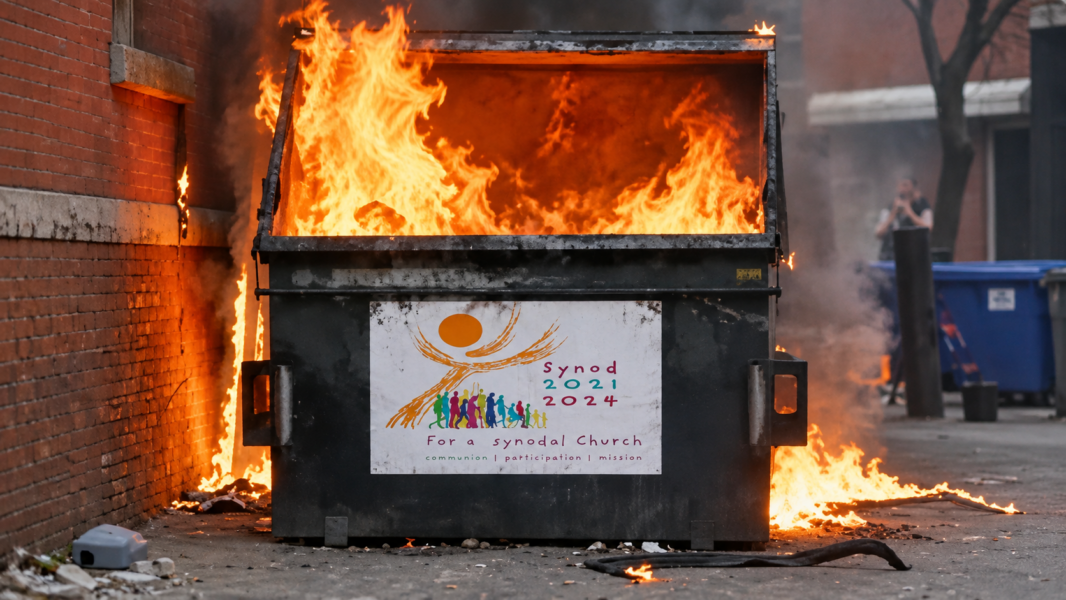
It is an evident fact that Pope Leo XIV has made his own the synodal process initiated by Francis. It is also a fact that synodality worries many of the baptized: the vagueness of the concept, the insistence from the ecclesiastical hierarchy, the contradictions with previous magisterial teaching, and other causes provoke the rejection of synodality by the sensus fidei fidelium. That is why articles continue to appear on this topic, which has unfortunately become the protagonist in a self-referential Church focused on these issues that are, at best, sterile and, at worst, harmful.
Regarding the “synodal path” developed by the German episcopate with the intention of applying it to the universal Church, Cardinal Raymond L. Burke stated in 2023: “We are told that the Church we profess, in communion with our ancestors in the faith since the time of the Apostles, to be One, Holy, Catholic, and Apostolic, must now be defined by synodality, a term that has no history in the doctrine of the Church and for which no reasonable definition exists. Synodality and its adjective, synodal, have become slogans behind which hides a revolution to radically change the self-understanding of the Church, in accordance with a contemporary ideology that denies much of what the Church has always taught and practiced. This is not a purely theoretical question, for the ideology has already been put into practice, for some years now, in the Church in Germany, spreading confusion and error and their fruit, division, with grave harm to many souls. With the imminent Synod on Synodality, it is rightly to be feared that the same confusion, the same error, and the same division will reach the universal Church.” Also in 2023, Cardinal Müller described synodality as a hostile takeover of the Catholic Church, and the late Cardinal Pell called it a “toxic nightmare.”
More recently, Fr. Jorge González Guadalix said on InfoCatólica with his usual clarity what many of us think: “the invention of the synod on synodality always seemed to me a joke.” And he quoted the words of Bishop Rob Mutsaerts, Auxiliary Bishop of ’s-Hertogenbosch: “My question is simple and serious: is the synodal process really helping to bring souls closer to Christ and to eternal salvation?” Has the faith been strengthened? Has Christ been proclaimed with greater clarity? Has Catholic identity been deepened? Have conversions, Mass attendance, and priestly vocations increased? Has Eucharistic reverence grown? Has the moral teaching of the Church been clarified? Because, in the current synodal discourse – Fr. Jorge González affirms –, synodality threatens to become an end in itself. And there begins, from a traditional Catholic perspective, the problem”.
And while these prophetic voices warn of the danger, the ecclesiastical establishment tells us something else. Let us look at just two recent examples. A few weeks ago, Infovaticana published a text by Brad Miner titled “Synodality Will Kill Catholicism,” in which one could read that “The claim to have received the Truth and to guard it is the entire reason for the Church’s existence and makes it something different from a voluntary religious association. But synodality, whatever its defenders may say, introduces a mechanism capable of dissolving that claim: a permanent, indefinite, and participatory process for generating endless contemporary ecclesial consensuses that increasingly function as rival sources of authority alongside the settled deposit of faith and —from the innovators’ point of view— ahead of it and, therefore, of the Magisterium destined to guard it. The vagueness we have seen so far in the synodal process has not been incidental. It is a feature, not a flaw. After multiple synodal meetings, the Church still lacks a fixed definition of synodality: only descriptions of a “style,” a “process,” an “instinct”; and this inability to clearly define synodality is no minor omission.”
In another text, titled “Selling radical synodality as social prophecy, InfoVaticana reported on how the recent annual assembly of the Leadership Conference of Women Religious received a video message from the Pope in which he stated that “all Christians are called to be builders of Christ’s communion, formed in a synodal Church in which all cooperate in the same mission according to their own charism and ministry. In a special way, those in religious life are called to become experts in synodality because of the opportunities that community life offers them to practice it, as well as the very structure in which their congregations are organized.” At the meeting, French religious sister Nathalie Becquart, secretary of the Synod of Bishops, made opaquely revealing comments: “synodality is presented as a necessary innovation, a different culture, an indispensable reform effort to recover the true identity and vitality of the Church. Synodality would imply the birth of a new style of ‘being Church,’ but it would not be ‘another Church’ in contradiction with the pre-synodal Church.
Fr. Gerald E. Murray, author of this article translated from The Catholic Thing, is clear that “the synodal project is an attempt to reshape the Catholic Church into a new entity, akin to various Protestant churches”, and that “the steamroller of synodality constitutes a danger to the Church. It must be recognized for what it is and stopped before it causes further havoc in the Church”.
From this modest platform, I wish to express my full agreement with Fr. Murray. I am increasingly convinced that, much more than the “conciliar” or “post-conciliar” Church, the synodal Church aims to deliver the final blow to the Church of Christ and turn it into something else. It is in fact functioning as a covert council, with its various sessions, in an endless process. In which we have seen, following the cited texts, how religious are exhorted / compelled to become synodal, whatever that may be. Just as after councils such as Trent or Vatican II, religious orders and congregations modified their constitutions. Synodality is not proposed. It is imposed.
But a dramatic fact occurs: the synodality being imposed constitutes total continuity with the spirit of the council (Vatican II) and an equally total rupture with the bimillennial tradition of the Church. False religious liberty, false ecumenism, the new anthropocentric and naturalistic liturgy, environmentalism. In short, the cult of man replacing the cult of God constitute the new synodal Church that aims to annihilate the Apostolic Catholic Church.
We reveal nothing new if we say that the beginning of the Second Vatican Council meant a coup d’état in the Church: the well-organized modernist / progressive minority overthrew the schemas prepared by the curia, except Sacrosanctum Concilium, on the liturgy, which had already been drafted by modernists, and new texts had to be written, most of them riddled with ambiguities and errors already condemned; very proudly, Cardinal Suenens declared that the Second Vatican Council was “the French Revolution in the Church.”
Peter Kwasniewski is right when he affirms that “from Pius X to Francis, modernism had gone from being banished to being enthroned”: The historical sequence of events is clear: in 1907, St. Pius X had already denounced in the encyclical Pascendi the modernism infiltrated in the Church, with lay theologians and clerics acting in a hidden manner in the Church. The infiltration denounced continued to grow especially in the countries crossed by the waters of the Rhine until it took over the Church at the Second Vatican Council. They no longer needed to hide. Theologians such as Congar, Rahner, de Lubac, and Küng, who had been labeled heterodox by the Church, were now experts or conciliar periti, accompanying various bishops and cardinals. Openly, modernist theologians and cardinals introduced into the conciliar documents principles condemned even by the last pre-conciliar pope, Pius XII, and they did so driven and supported by one of the most contradictory and tragic figures of the 20th-century Church, Pope Paul VI.
By the mid-20th century and massively after the Second Vatican Council, the modernists (or progressives) seized the highest positions in the hierarchy. As in the Arian crisis of the 4th century, but worse, because, as St. Pius X warned, modernism is the synthesis of all heresies.
In 1982, Cardinal Ratzinger, prefect of the Congregation for the Doctrine of the Faith, declared that, “if one wished to offer an analysis of Gaudium et Spes as a whole, we could say that (together with the texts on religious liberty and the religions of the world) it is a revision of the Syllabus of Pius IX, a kind of counter-syllabus.” Cardinal Ratzinger’s observation that, at the time of the Second Vatican Council, “there did not yet exist a fundamental declaration on the relationship that should exist between the Church and the post-1789 world” is curious when one considers the great encyclicals of the popes after 1789 that condemned the modernist errors of the world, making clear a “relationship” of clear opposition between the Church and the post-1789 world —declarations with which, apparently, the majority of the participants in the Second Vatican Council wished to express their disagreement—. Cardinal Ratzinger seemed to admit precisely that with frankness when he wrote: “Let us content ourselves with saying here that the text [of the documents of the Second Vatican Council, especially Gaudium et Spes] serves as a counter-syllabus and, as such, represents, on the part of the Church, an attempt at official reconciliation with the new era inaugurated in 1789.”
But what the ecclesiastical hierarchy sought to impose after the Second Vatican Council so attacked the sensus fidei that they failed to crush dissent or end the tradition of the Church, as they intended. The new Church did, however, cause churches to empty and vocations to plummet. The most unabashed progressivism was aging, but conservatism helped it maintain the revolution it had begun.
Today, synodality aims to finish the work begun by the spirit of the council, but which it could not complete: “synodality,” also called the “synodal Church,” seems to have triumphed: from the condemnation by all popes from Gregory XVI to Pius XII, with their proposals of religious liberty and ecumenism, their immoral morality, and their anthropolatric liturgy, it is now preached as ordinary magisterium. What was religious tolerance is now a religious liberty that the Church always condemned, and we are expected to obey it. Moreover, are not the innumerable charisms and current ecclesial movements, such as Hakuna, the Neocatechumenal Way, Opus Dei, Regnum Christi, the Charismatic Renewal, Emmaus, Alpha, and others, in total consonance with the synodality preached by the pastors? Are they not modernist movements, products of a modernist-synodal neo-Church?
Even so, synodality continues to repel the sensus fidei fidelium to such an extent that not only does it fail to convince many, but a minority resisted from the beginning and resists firmly today. A minority growing in numbers, not exempt from problems, internal divisions, and contradictions, but a minority of the baptized has firmly clung to the Church of always as the only plank of salvation. Because what great contempt for God and so many saints and simple faithful it supposes to believe that, of 2000 years of Church, only 60 years ago the truth was discovered. A truth that invalidates all previous Catholic teaching and practice before this “awakening.”
Is there a remedy for synodality? Is there a possibility that the Church will remain the Church of Christ, the Apostolic Catholic Church? Perhaps the closest phenomenon in terms of duration of a heterodox and even heretical phenomenon that has hijacked the highest ecclesiastical hierarchy is the Arian crisis. However, as St. Pius X affirmed, modernism is the sum of all heresies. Therefore, synodality (modernism) also contains Arianism and many more heresies within itself. That is why the crisis is now much more serious. Surely, the moment of greatest danger for the Catholic faith in all of history, attacked from within. But the Lord Himself promised us that the gates of hell will not prevail. So we must continually pray for His assistance and grace to remain faithful, contributing on our part all that is in our power to guard and transmit intact the deposit of faith.
The image illustrating the text aims to show the best possible fate for synodality.
Note: Articles published as Tribuna express the opinion of their authors and do not necessarily represent the editorial line of Infovaticana, which offers this space as a forum for reflection and dialogue.