


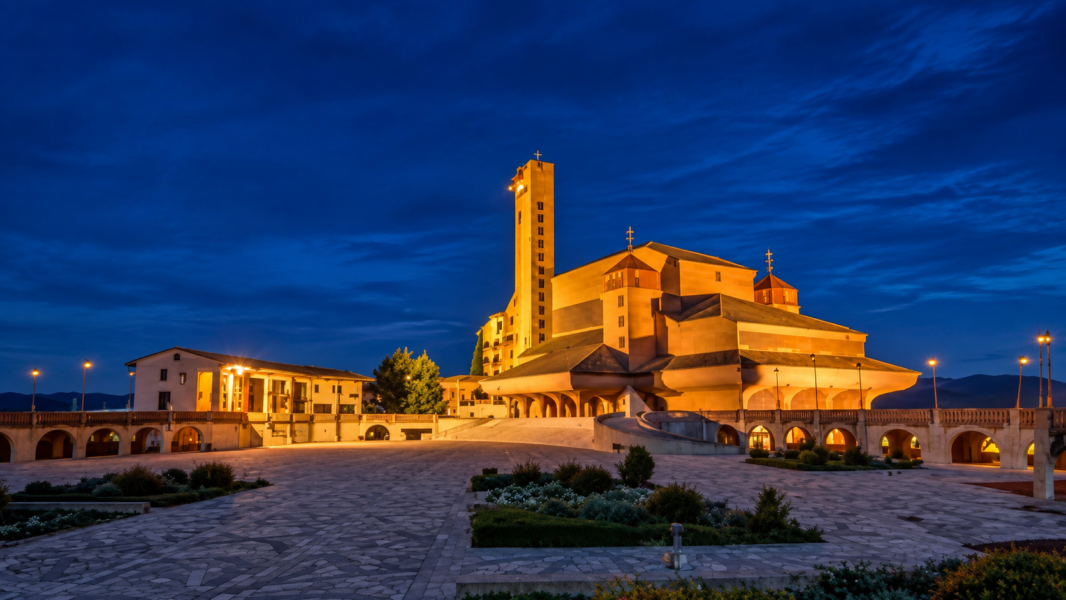
The Prelature of Opus Dei has responded to the latest statement from the Bishop of Barbastro-Monzón, Ángel Pérez Pueyo, regarding the image of Our Lady of the Angels of Torreciudad and has rejected the notion that its presence for the past five decades in the new church could be considered a “theft, usurpation, or illegal retention.”
In a statement published this Thursday, the Information Office of Opus Dei in Spain maintains that there are documents proving both the rights granted in 1962 over the image and the old hermitage, as well as the subsequent authorization from the Bishop of Barbastro for the statue to receive veneration in the new church. The response comes after Pérez Pueyo stated on August 31 that there is no record in the diocesan archives of an “authorized, lawful” removal of the image and demanded that the statue remain permanently in its historic hermitage.
This new episode also occurs on the eve of the 47th Pilgrimage of the Virgins of Ribagorza and Sobrarbe, scheduled for this Saturday, September 5. During that day, the original image will be temporarily transferred from the church inaugurated in 1975 to the old hermitage. Pérez Pueyo has announced that he will take advantage of the celebration to publicly reiterate his request that the Virgin remain there permanently.
Opus Dei recalls that the commissioner was appointed at the bishop’s request
Opus Dei begins its statement by recalling that the appointment of Monsignor Alejandro Arellano as pontifical plenipotentiary commissioner for Torreciudad was made by Pope Francis at the request of the Bishop of Barbastro-Monzón himself.
The Prelature refers to the statement published by the diocese on October 9, 2024, when the Diocese thanked the Holy See for “the swift response to its request,” expressed its “absolute confidence in the resolutions of the Holy See,” and placed itself at the commissioner’s disposal.
Opus Dei also notes that it expressed its willingness to cooperate at the time and now reiterates its commitment to accept the final resolution adopted by the Holy See.
This clarification responds to one of the points raised by Pérez Pueyo in his statement of August 31. The bishop emphasized that the commission “concerns Torreciudad; not the Diocese of Barbastro-Monzón” and maintained that the diocese retains “intact pastoral responsibility” for the faith of its people, their popular piety, and their memory.
The 1962 and 1966 agreements
The Prelature makes it clear that it does not dispute that ownership of the image belongs to the diocese. It places the controversy on another point: “the scope and validity of the rights of use, custody, and location established through agreements between the parties.”
To support its position, it first refers to the public deed of September 24, 1962, registered in the Property Registry of Benabarre.
According to the Prelature, that agreement granted in perpetuity the beneficial ownership—not the property, which belongs to the diocese—of the old hermitage and the image. In return, obligations were assumed, among others, for its restoration and conservation, the promotion of worship, and the guarantee of access for pilgrims.
The second document invoked by Opus Dei is the agreement documented on September 8, 1966. According to the Prelature, it established that the Board would build and finance the new sanctuary on the express condition that the image would receive worship and veneration there.
The same agreement stipulated that the old hermitage and the new church would form “a single enclosure suitably enclosed.”
The Prelature emphasizes that this provision was accepted by Monsignor Jaime Flores, then Bishop of Barbastro and the same prelate who had signed the 1962 agreement.
Opus Dei rejects that the image was stolen
Thus, Opus Dei responds to Pérez Pueyo, who stated last Sunday that in recent years the diocese has gathered historical and legal documentation that, in his view, prevents considering the removal of the image as a voluntary renunciation of its custody and original location.
“Its authorized, lawful removal is not recorded in the archives of either the Chapter or the Diocese,” the bishop stated.
The Prelature offers a different interpretation. It maintains that the image “was not moved to another town or removed from Torreciudad,” but was placed, “with documented authorization from the diocese,” in the new church built a few meters from the hermitage and within the same devotional complex.
It also rejects the existence of a clandestine appropriation of the statue. It recalls that it was restored in 1964 and again around 1970, always—according to its claim—with episcopal authorization, and that since 1975 it has presided over the altarpiece of the new church, publicly exposed to the veneration of the faithful.
Opus Dei admits that there may be “different interpretations regarding the legal effects of the agreements” and notes that it is up to the competent authority to resolve them. What it rejects is that this legal difference allows what happened to be presented as an unlawful act.
“A legal difference cannot be turned into an unfounded offensive accusation,” the Prelature maintains.
And it adds: “For all these reasons, we reject that what happened can be described as a theft, an usurpation, or an illegal retention, as the Bishop of Barbastro suggests in his statement of August 31.”
Pérez Pueyo had used particularly harsh terms in his statement. The bishop assured that he would never consent to a formula that deprived the diocese of the image and even announced that he would offer his resignation rather than accept what he described as an “improbable plunder” of the dignity of his people.
The diocese wants the image in the hermitage
The position expressed by Pérez Pueyo distinguishes between the future of the new church and that of the Romanesque image.
The bishop has explained that the diocese has renounced any financial compensation and does not claim “the governance of the new church, nor its assets, nor its accounts, nor the entities or companies linked to its management.”
He has also revealed that he has asked Pope Leo XIV to recognize Torreciudad as an international sanctuary directly dependent on the Holy See, so that Rome would oversee its economic and pastoral reality.
The diocesan claim focuses on the original statue of Our Lady of the Angels. Pérez Pueyo maintains that it should remain in the old hermitage, where it was venerated for centuries before its transfer to the new church.
For its part, Opus Dei recalls that since 2020 it has promoted the legal updating of Torreciudad and even proposed that the new church be recognized as a diocesan sanctuary.
Opus Dei claims the fifty years of Torreciudad
The Prelature also dedicates part of its statement to defending the work carried out in Torreciudad since the 1960s.
It maintains that the actions undertaken were aimed at preserving the image, restoring the old hermitage, and enabling a greater number of people to venerate Our Lady of the Angels.
According to the data cited by the Prelature, more than ten million pilgrims have passed through Torreciudad since the inauguration of the new church in 1975, and currently around 200,000 visitors are received each year.
Opus Dei also highlights the accessibility conditions of the new church for the elderly and people with disabilities and recalls that the old hermitage was restored, is preserved within the same enclosure, and remains open for worship and visits.
The Prelature maintains that this process made it possible to preserve the historic devotion of the inhabitants of the region and, at the same time, extend it to pilgrims from other places.
The final decision remains in the hands of the Holy See
Opus Dei concludes by reiterating its willingness to engage in dialogue, its respect for the Bishop of Barbastro-Monzón, its willingness to cooperate with Monsignor Arellano, and its commitment to accept whatever the Holy See decides.
“We desire and ask Our Lady of the Angels of Torreciudad that the sanctuary continue to be what it has been for millions of people: a place of encounter with God, of proclaiming the Gospel, of reconciliation, and of unity,” the statement concludes.
While Rome’s final resolution remains pending, the controversy will have a new episode this Saturday. The original image will return temporarily to the old hermitage on the occasion of the Pilgrimage of the Virgins of Ribagorza and Sobrarbe.
The transfer, however, required the authorization of the pontifical commissioner. As Torreciudad already explained, the sanctuary’s officials conveyed to Arellano the request made by Pérez Pueyo, and it was the commissioner who authorized the original statue to remain in the hermitage during the celebration.
For the subsequent procession to the new church, the original statue will not be used, but rather a pilgrim copy prepared for this type of movement.
Read also: The Virgin of Torreciudad will return to the old hermitage by order of the Bishop of Barbastro
The permanent location of the image therefore remains unresolved and forms part of the legal, canonical, and pastoral question of Torreciudad that remains in the hands of the Holy See.