


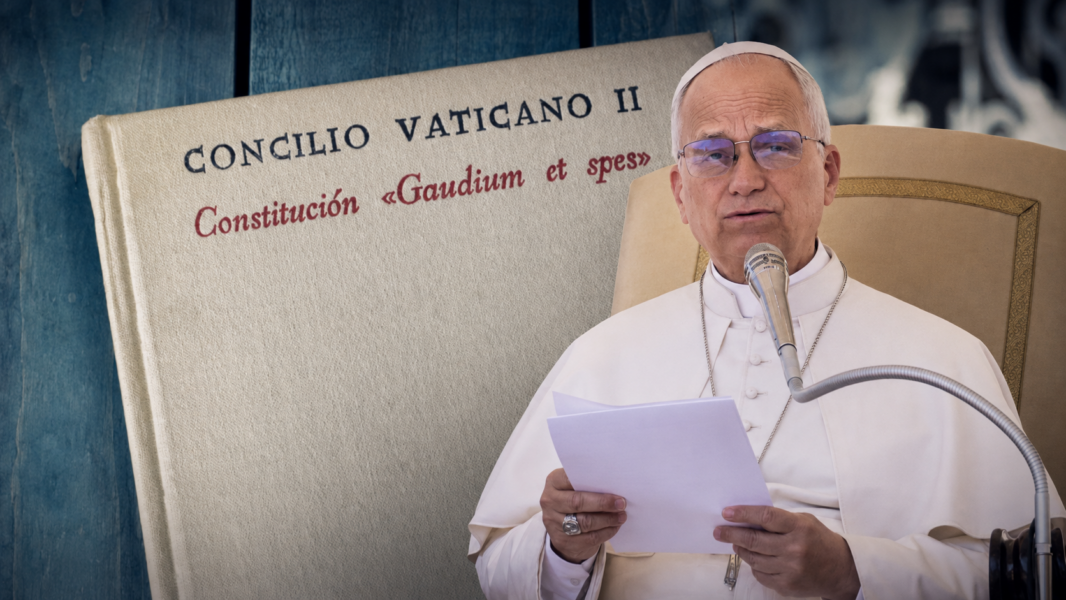
Pope Leo XIV has called on the Church this Wednesday to abandon «all passivity and indifference» in the face of events and to become especially involved in the suffering of those who endure «injustice, discrimination and violence.» During the general audience held this September 2 in St. Peter’s Square, the Pontiff began his catecheses on the pastoral constitution Gaudium et spes, within the cycle dedicated to the documents of the Second Vatican Council.
Leo XIV warned of the contradictions that persist in the contemporary world: scientific and technological progress that offers new possibilities but does not reach everyone; the growth of wealth and economic power while part of humanity continues to suffer hunger and misery; and concern for the future of the planet accompanied by resistance to abandoning «selfish consumption.» The Pope also pointed to «the illusion that war is an effective path to building peace» and recalled that the Church must «scrutinize the signs of the times and interpret them in the light of the Gospel.»
After the catechesis, the Pontiff addressed a special message to Polish faithful on the occasion of the beginning of the school year. Leo XIV highlighted the collaboration between «parents, school and Church» in the education of new generations and expressed his desire that attendance at Religion classes and catechesis broaden students’ horizons, deepen their knowledge of God and the world, and prepare them to receive the sacraments and participate in the life of the community. In his greeting in Spanish, he asked that the Church proclaim the Gospel «with joy and hope» and lead everyone to Christ, «the key, the center and the end of all human history.»
Below is the complete catechesis of Leo XIV:
Dear brothers and sisters, good morning and welcome:
With today’s meeting we begin to reflect on the Pastoral Constitution Gaudium et spes, with which the Second Vatican Council sought to delve into a fundamental theme, namely the relationship of the Church with the contemporary world. Saint John XXIII, already in the inaugural address of October 11, 1962, wished to dissent from the «prophets of misfortune» who, «although inflamed with zeal for religion […] go about saying that our times, if compared with past centuries, are completely worse; and they even go so far as to behave as if they had nothing to learn from history» (Gaudet Mater Ecclesia Address, October 11, 1962, 4.2). Hence the task entrusted to the conciliar Fathers: «In the present order of things, in which humanity seems to be entering a new order, we must rather recognize the mysterious designs of Divine Providence, which are realized in successive times through the work of men, and often beyond their expectations, and which wisely dispose all things, even adverse human vicissitudes, for the good of the Church» (Gaudet Mater Ecclesia, 4.4).
Three years later, the promulgation of Gaudium et spes recognized in this discernment an essential element of the nature of the Church, describing its pastoral character as constitutive: hence the definition of «Pastoral Constitution.» It is not a matter of naive optimism, but of a renewed fidelity to the Mystery of Christ who, by becoming incarnate, chooses to share our life: He became «in every respect like his brothers» (Heb 2:17; cf. 4:15) and bore the consequences of sin, dying «as a ransom for all» (1 Tim 2:6). This participation in humanity is the path that Christ asks of the Church; therefore, the conciliar Constitution Gaudium et spes begins by declaring that the Church feels as its own «the joys and the hopes, the griefs and the anxieties of the men of this age, especially those who are poor or in any way afflicted» (GS 1).
It is a participation that calls us to move beyond all passivity and indifference in the face of the events that occur, before history and the lives of persons, especially before the rapid and profound change that we experience today. It is not possible to remain disinterested spectators; it is necessary, instead, to listen with the heart, to allow oneself to be challenged, to become involved. With Christ and sustained by the strength of his Spirit, believers are called to take charge of the difficulties of their brothers and sisters, especially those who are crushed by injustice, discrimination and violence. Indeed, only through participation and commitment is it possible to arrive at adequate responses, always sustained by the certainty that «the sufferings of this present time are not worth comparing with the glory that is to be revealed to us» (Rom 8:18).
In this sense, closeness to humanity opens the way to a deeper reading of events and of Revelation itself and, from this same perspective, Gaudium et spes recalls the «permanent duty of the Church to scrutinize the signs of the times and to interpret them in the light of the Gospel» (GS 4). This conciliar Constitution has therefore called the Church to a permanent commitment to conversion, to bear witness that it is not moved by «any earthly ambition,» but «seeks but a solitary goal: to carry forward the work of Christ under the lead of the befriending Spirit. And Christ entered this world to give witness to the truth, to rescue and not to sit in judgment, to serve and not to be served» (GS 3).
It is not, in fact, a merely moral disposition. Pope Francis reminded us that for the Church «the option for the poor is a theological category before it is a cultural, sociological, political or philosophical one. […] We are called to discover Christ in them, to lend our voice to their causes, but also to be their friends, to listen to them, to understand them and to welcome the mysterious wisdom that God wishes to share with us through them» (Apost. Exhort. Evangelii gaudium, 198).
Christian participation commits us to take charge of reality and also to unmask the contradictions that characterize the personal and social life of the contemporary world: for example, a scientific and technological progress that offers ever new possibilities, but only to some and that human beings do not always manage to put «at their service»; or a clearer knowledge of the «laws of social life,» accompanied, however, by uncertainties «about the direction to be given them»; or also a greater availability of «wealth, resources and economic power,» which unfortunately, today as in the time of the Council, leaves «a great part of the inhabitants of the planet […] still tormented by hunger and misery» (GS 4); or a shared awareness that the future of the planet is at stake and, at the same time, the inability to renounce selfish consumption and the illusion that war is an effective path to building peace.
In a time marked by profound changes, from which worrying imbalances derive, the Church is called to serve the human person, listening to and welcoming the deepest questions of his heart and the longings that dwell within him, pointing to Christ as «the key, the center and the end of all human history» (GS 10). Therefore, in the Church, at all levels and in all times, the merciful kenosis of Christ must be realized, who «did not regard equality with God as something to be exploited, but emptied himself, taking the form of a slave, […] becoming obedient to the point of death—even death on a cross» (Phil 2:6-8).
Dear brothers and sisters, may joy and hope—gaudium et spes—be the distinctive traits of a Church that proclaims and bears witness to the Gospel, drawing near to the women and men of our time.