


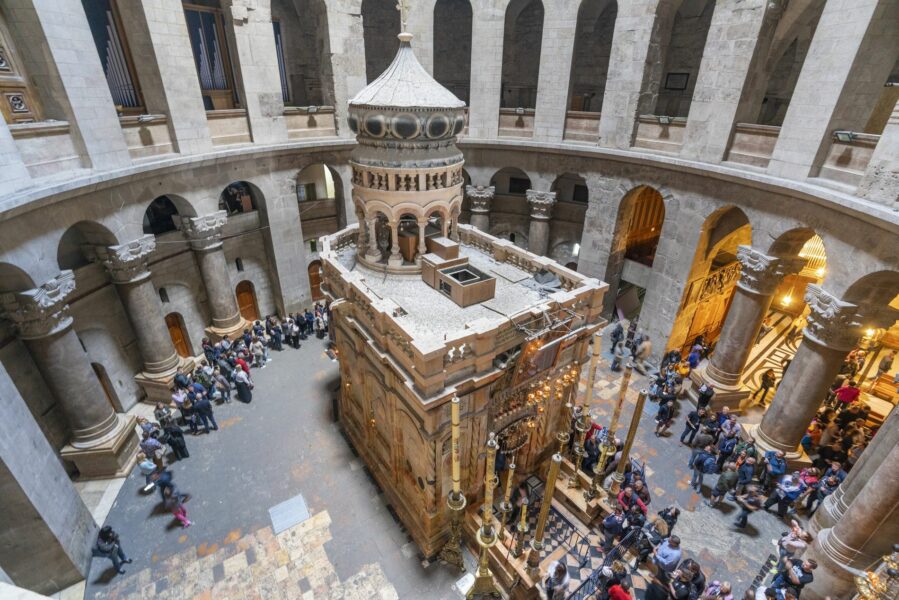
Archaeological excavations carried out beneath the Basilica of the Holy Sepulchre in Jerusalem, Israel, have provided new evidence that the site once featured a funerary landscape combined with cultivated areas, a configuration that aligns with elements of the description given in the Gospel of Saint John regarding the place of Jesus Christ’s burial.
The results form part of the research conducted by a team from Sapienza University of Rome led by archaeologist Francesca Romana Stasolla and have been published in the preliminary report for the 2025 campaign, appearing in the latest volume of Liber Annuus, the scientific journal of the Studium Biblicum Franciscanum in Jerusalem.
The investigations have made it possible to partially reconstruct the appearance of the site before the construction of the great Christian complex erected during the reign of Emperor Constantine. The archaeologists have identified an environment in which rock-cut funerary zones and cultivated land coexisted, with indications related to vines and olive trees.
The discovery is especially significant due to its correspondence with the description by Saint John:
“In the place where he had been crucified there was a garden, and in the garden a new tomb in which no one had yet been buried. Since it was the Jewish day of Preparation and the tomb was nearby, they laid Jesus there” (Jn 19:41-42).
The archaeological research does not by itself prove that any particular tomb is that of Jesus Christ, but it provides new material data on the landscape of the area and confirms that the setting described by the evangelist—a funerary space situated next to cultivated land—is compatible with the archaeological features of the site.
A funerary landscape with cultivated zones
Stasolla has explained that the investigations allow us to speak of “a funerary landscape” accompanied by small plots dedicated to vines and olive trees and an area with sporadic human activity.
Among the elements analyzed is vine wood found during the excavations, which cautiously suggests the possibility that this plant was cultivated directly on the site. Pollen analyses also point to the possible presence of olive trees.
These data, together with the rock-cut tombs known in the area, help to better understand the configuration of the zone before it was incorporated into the urban fabric and, later, into the Christian complex.
The scientific report nevertheless warns that the study of the documentation and materials is ongoing and that conclusions about the different phases of the site must still be considered preliminary.
Read also: New excavations at the Holy Sepulchre allow deeper insight into its original appearance and history
Years of excavations beneath one of Christianity’s holiest sites
The work is part of the archaeological project developed in connection with the restoration of the pavement of the Basilica of the Holy Sepulchre. The Sapienza team has carried out successive campaigns whose results have been published since 2022 in Liber Annuus.
The excavations have been made possible thanks to collaboration among the communities that share responsibility for the basilica: the Greek Orthodox Patriarchate of Jerusalem, the Franciscan Custody of the Holy Land, and the Armenian Patriarchate.
The project has allowed the archaeological study of the subsoil of different sectors of the church, following its chronological evolution. The researchers have documented an extensive historical sequence that begins before the construction of the Christian sanctuary and passes through the successive transformations the complex has undergone over the centuries.
The Studium Biblicum Franciscanum explains that the project makes it possible to study seventeen centuries of history preserved in the structures of the Holy Sepulchre, through stratigraphic excavation, three-dimensional documentation, and archaeological and scientific analyses.
From quarry to funerary zone and Christian sanctuary
The investigations carried out during the various campaigns have confirmed that before becoming a funerary site, the area had functioned as a stone quarry. Once that exploitation was gradually abandoned, certain sectors were used for burials and others acquired agricultural characteristics.
This reconstruction is relevant for understanding the topography of Jerusalem in the time of Jesus Christ. The site was then located outside the city walls, a circumstance consistent with the funerary use of the area.
Later, with urban expansion, the area was incorporated into Jerusalem. In the second century, during the transformation of the city into the Roman Aelia Capitolina, Emperor Hadrian promoted constructions over the site.
The great Christian transformation came in the fourth century, when Emperor Constantine ordered the construction of the complex intended to preserve the places identified by the Christian community of Jerusalem with Calvary and the tomb of Christ.
Previous excavations of the same project had already documented different phases of the Rotunda of the Anastasis and structures related to the Edicule that protects the tomb.
An archaeological coincidence with the account of Saint John
The new results now allow a more precise understanding of the landscape prior to those constructions. The combination of rock-cut tombs and cultivated spaces shows a notable correspondence with the brief description preserved in the Gospel of Saint John.
The discovery does not constitute a new archaeological identification of the tomb of Christ, nor does it allow a specific burial to be attributed to Jesus. Its importance lies in providing material evidence of what the environment was like in the place where Christian tradition has, since antiquity, located the crucifixion, burial, and resurrection of Christ.
The 2025 report concludes the current phase of excavations inside the basilica and now opens a period of analysis of the abundant documentation and recovered materials. The researchers believe that this work will continue to reconstruct the evolution of the Holy Sepulchre and its relationship with the topography of Jerusalem over the centuries.